By Alieu Ceesay
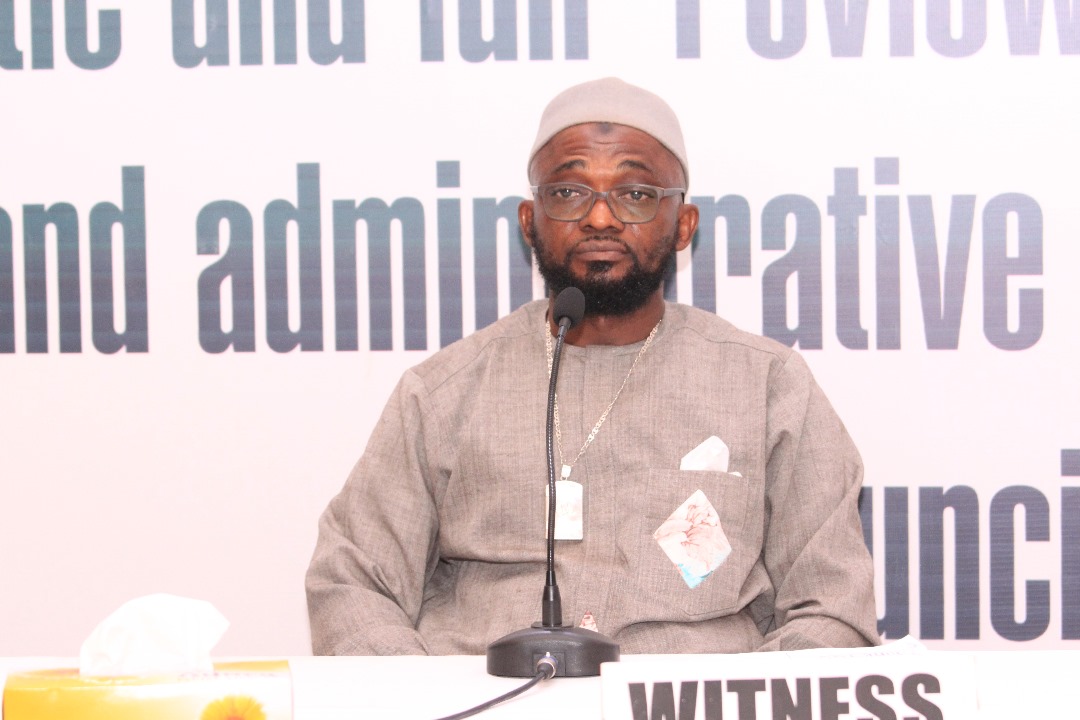
Sheriffo Sonko, the former Chairman of the Brikama Area Council (BAC), faced intense questioning on July 29, 2025, before the Local Government Commission of Inquiry, as he accounted for his tenure from 2018 to May 2023. The inquiry, tasked with investigating financial and administrative irregularities in local government councils from May 2018 to January 2023, exposed significant lapses in oversight, procurement violations, and mismanagement of public funds under Sonko’s leadership.
Sonko admitted to multiple failures during his chairmanship of the West Coast Region’s largest council, citing political instability and a challenging administrative system as key obstacles. However, the Commission, chaired by Jainaba Bah, pressed him on his lack of accountability, particularly regarding millions of dalasis in unaccounted funds, unauthorized loans, and undocumented financial decisions.
The inquiry revealed that Sonko’s leadership was marred by procurement violations, including double fueling of vehicles, payments without supporting documents, and cash transactions lacking receipts, as detailed in a 2022 internal audit report presented by lead Counsel Pattrick Gomez. When asked about his response to these issues, Sonko stated, “I cannot remember doing anything,” acknowledging his limited control over the council’s financial and resource management.
Sonko attributed some of his challenges to political turmoil, particularly a boycott by councillors following his 2020 expulsion from the United Democratic Party (UDP). The councillors, claiming he occupied the Chairman’s seat illegally, refused to attend meetings for over a year until a 2021 court ruling upheld his position.
Gomez, however, dismissed this as an excuse, arguing that the procurement violations were unrelated to the boycott and accusing Sonko of using the conflict to mask his oversight failures. “Millions of dalasis were mismanaged under your watch,” Gomez stated, noting Sonko’s repeated claim of being “distracted.”
The Commission also scrutinized salary increases for BAC staff, which Sonko claimed were approved by the Ministry of Lands and Regional Government and aligned with a nationwide 30% pay increment. However, he failed to provide supporting documentation, prompting the Commission to demand official records.
Significant concerns arose over loans taken by the BAC, including two interest-free loans from Jah Oil—D2 million in 2019 and D2.5 million in 2022—secured without council deliberation or approval. Sonko admitted to signing the first loan agreement, while the BAC’s CEO signed the second. He justified the loans as “interest-free” but could not clarify their purpose. Additionally, a D7 million loan from Eco Bank, allegedly approved by the Ministry, was discussed, but Sonko was unable to explain its purpose, stating the CEO had described it as for a “fixed deposit.”
The inquiry’s most alarming revelation centered on the Geology Funds, totaling D33,713,176.01, received between May 2020 and June 2023 as royalties from mining activities. Sonko claimed a finance committee was established to manage these funds for community development. However, the Commission revealed that only D3 million was allocated to communities—D2 million to Gunjur Ward, D1.6 million to Kartong Ward, and D767,300 to Pirang Ward—leaving over D29 million unaccounted for. Sonko admitted he was unaware of the discrepancy until the inquiry and could not explain how the funds were spent.
Chairperson Jainaba Bah sharply criticized Sonko’s lack of engagement with the council’s financial state, emphasizing his responsibility as head of one of The Gambia’s most revenue-rich councils. “You should have been interested in understanding why the loans and overdrafts, and where the council funds go,” Bah said. Sonko responded, “The system that I met at the BAC was very difficult to deal with,” citing poor planning and distancing himself from critical financial decisions.
The Commission has ordered Sonko to submit documentary evidence, including contracts committee minutes, salary increment approvals, and loan agreements, to substantiate his claims. His testimony has raised serious questions about accountability and transparency at the BAC, with millions of dalasis meant for community development allegedly diverted.
As the inquiry continues, Sonko’s admissions highlight systemic issues in local government administration, underscoring the need for stronger oversight to ensure public funds serve their intended purpose. The Commission’s findings are expected to shape reforms aimed at enhancing transparency across The Gambia’s councils.