By Fatou Dahaba
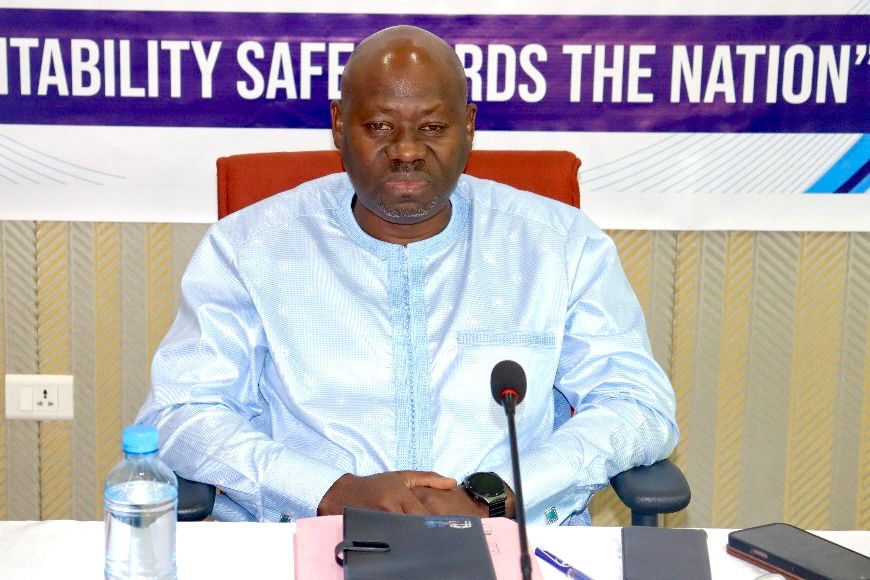
In a heated session of the Special Select Committee on the Sale and Disposal of Assets identified by the Janneh Commission, Hon. Kebba Lang Fofana sharply criticized Mr. Seedy Kanyi, General Manager of the Gambia Transport Service Company (GTSC), for the flawed depreciation valuation process applied to vehicles formerly owned by ex-President Yahya Jammeh. The committee’s probe revealed significant discrepancies in GTSC’s methodology, raising concerns about the accuracy of the valuation and its implications for asset disposal.
During Thursday’s session, Hon. Fofana, a prominent member of the committee, pressed Kanyi on the distinction between an asset’s book value and market value. He explained that book value, primarily an accounting tool, accounts for the asset’s original cost, annual depreciation, and accumulated depreciation. In contrast, market value considers dynamic factors such as the vehicle’s condition, mileage, usage history, and accident record. Fofana questioned how GTSC determined the depreciation percentage without knowing the original cost of the vehicles, a critical factor in accurate valuation.
“Your valuation process seems fundamentally flawed,” Fofana stated, addressing Kanyi. “If you relied solely on the year of manufacture to determine depreciation without knowing the cost, how could you accurately assess the value of these assets?”
Kanyi, reappearing before the committee, defended GTSC’s approach, explaining that the year of manufacture was the primary determinant in their depreciation calculations. He argued that the vehicles, assumed to have a book value of zero due to their age, were assessed based on their perceived market value. “We considered the vehicles fully depreciated and looked at market rates for similar vehicles,” Kanyi said, noting that the valuation process was guided by the vehicles’ estimated age of 15 years and their usable condition.
Fofana, unconvinced, challenged Kanyi’s reliance on the year of manufacture as the sole basis for depreciation. “Depreciation is an accounting principle tied to the date of acquisition,” Fofana emphasized. “When an organization acquires an asset, it applies a depreciation rate from that date to recover the asset’s value over time. Without knowing the cost or acquisition date, your valuation lacks credibility.”
The committee’s inquiry intensified as Fofana pressed Kanyi to disclose the original cost of the vehicles at the time of acquisition. Kanyi admitted that this information was unavailable to his team. “We did not know the cost of the vehicles,” he conceded, prompting Fofana to question the validity of GTSC’s depreciation process. “If you didn’t know the cost, why were you applying depreciation at all?” Fofana asked pointedly. “As the current manager of GTSC, would you stand by the valuation reflected in your documents?”
Kanyi acknowledged potential shortcomings in the process, admitting that the absence of acquisition records may have forced GTSC to rely on incomplete data. “There was a possibility that records were unavailable or hidden,” he said, explaining that the year of manufacture was the only feasible basis for their valuation. However, he conceded that errors in the process could have been avoided with better information.
Fofana underscored the broader implications of GTSC’s flawed valuation, noting that it failed to provide an accurate reflection of the vehicles’ market value. “This valuation does not serve as a reliable indicator of the assets’ worth,” he declared. “If this were the only valuation conducted by GTSC, it was fundamentally wrong.” He further highlighted the difficulty of establishing acquisition dates for vehicles owned by the former president, suggesting that GTSC should have prioritized a more comprehensive approach, such as assessing the vehicles’ condition and market demand.
The session exposed critical gaps in GTSC’s valuation process, raising questions about the transparency and accountability of asset disposal under the Janneh Commission’s mandate. The commission, established to investigate financial dealings and asset acquisitions linked to former President Jammeh, has identified numerous assets, including vehicles, for valuation and disposal. GTSC’s role in this process has come under scrutiny, as accurate valuations are essential to ensure fair and transparent disposal of public assets.
Kanyi’s admission of procedural errors has intensified calls for reforms in how state institutions handle asset valuations. The committee’s findings are expected to inform recommendations for stricter guidelines and oversight to prevent similar discrepancies in the future.
The session adjourned with Hon. Fofana urging GTSC to adopt more rigorous valuation practices, emphasizing that accountability and precision are paramount in handling public assets. The committee is scheduled to reconvene next week to review additional evidence and testimonies related to the Janneh Commission’s findings.