By Sainabou Sambou
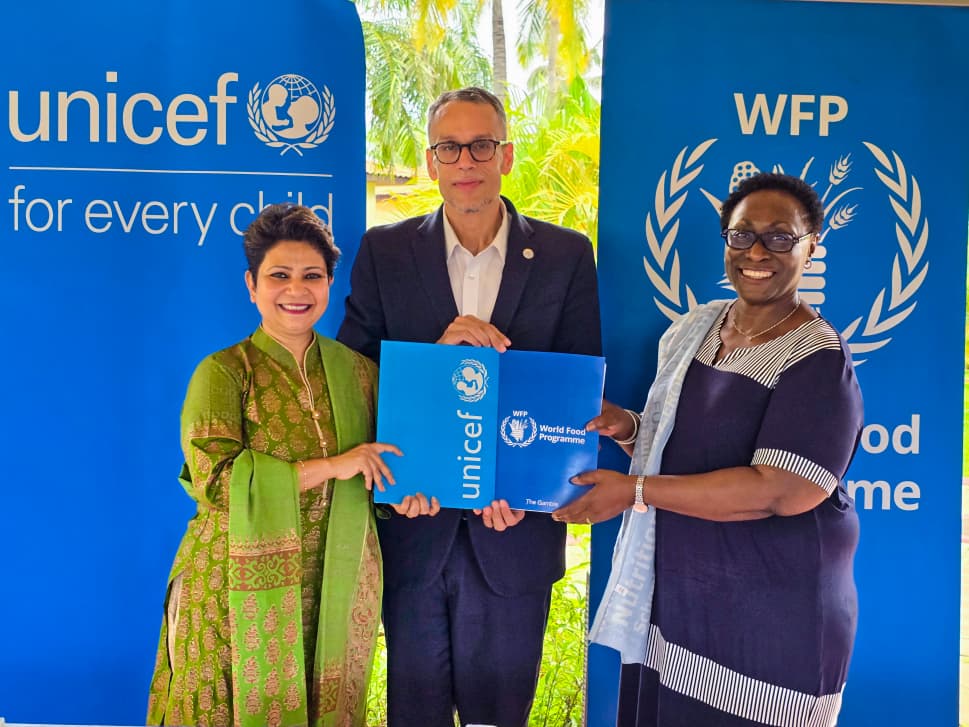
The World Food Programme (WFP) and UNICEF have reaffirmed their commitment to tackling malnutrition and food insecurity in The Gambia through a renewed Memorandum of Understanding (MoU) signed on Wednesday at the Ocean Bay Hotel. The agreement marks a significant step in bolstering collaborative efforts to address the country’s pressing nutritional challenges and enhance emergency preparedness.
WFP Representative and Country Director Miranda Sende highlighted the urgency of the situation, referencing the 2024 Gambia National Food Security Survey and Nutrition report. She noted that 24 percent of Gambians are food insecure, with 2 percent facing severe food insecurity. Additionally, global acute malnutrition affects 8.8 percent of children aged 6–59 months, while chronic malnutrition impacts 17.8 percent. “The food and nutrition security situation in The Gambia remains fragile,” Sende said, emphasizing that WFP and UNICEF are global leaders in the fight against malnutrition, particularly among children, women, and vulnerable populations.
“I am honored and proud to renew and strengthen our partnership through this MoU,” Sende declared. “It reinforces our commitment to strengthening national capacities, advancing data-driven nutrition responses, and ensuring the most vulnerable, especially children, receive the care and protection they deserve.” The agreement aims to address malnutrition, food insecurity, and emergency preparedness through joint efforts, aligning with national and global development goals.
UNICEF Representative Nafisa Binte Shafique described the MoU as more than a document—it is “a promise” to do more together in an era of limited resources. “Partnership is our greatest force multiplier,” she said, noting that WFP and UNICEF’s complementary efforts ensure communities feel tangible impacts. “A child does not experience our institutional boundaries, only the results of our unity,” Shafique added. She underscored the partnership’s alignment with The Gambia’s National Development Plan 2023–2027, the Sustainable Development Goals, the Convention on the Rights of the Child, and the International Conference on Nutrition Declaration and Plan of Action.
The MoU outlines key priorities, including scaling up prevention and treatment of malnutrition, strengthening nutrition and food security assessments, enhancing national systems for emergency response, and promoting initiatives like WASH in schools, climate action, gender equality, and social behavior change. “Our mission is clear: end all forms of malnutrition, confront food insecurity, and build resilience so shocks do not become crises,” Shafique said, emphasizing that no child under five, pregnant or breastfeeding woman, or vulnerable community should be left behind.
UN Resident Coordinator Karl-Frédérick Paul praised the collaboration, calling the MoU a “crucial milestone” in the fight against malnutrition. He acknowledged the presence of UN Heads of Agencies and commended their unity. “This agreement lays the foundation for cooperation in education, climate change, and social protection,” Paul said. By combining strengths, WFP and UNICEF aim to reinforce national systems, advance data-driven responses, and ensure vulnerable populations receive essential social services.
Paul stressed the importance of inter-agency collaboration to improve efficiency and effectiveness. “As long as food and nutrition insecurity persists, the fight against hunger continues,” he said. The partnership reflects a shared dedication to global frameworks and The Gambia’s development priorities, ensuring a coordinated approach to addressing the needs of the most vulnerable.
The renewed partnership between WFP and UNICEF signals a bold step forward in tackling malnutrition and food insecurity in The Gambia. By aligning their efforts with national and global goals, the agencies aim to deliver lasting impact, ensuring that children, women, and vulnerable communities receive the support they need to thrive.