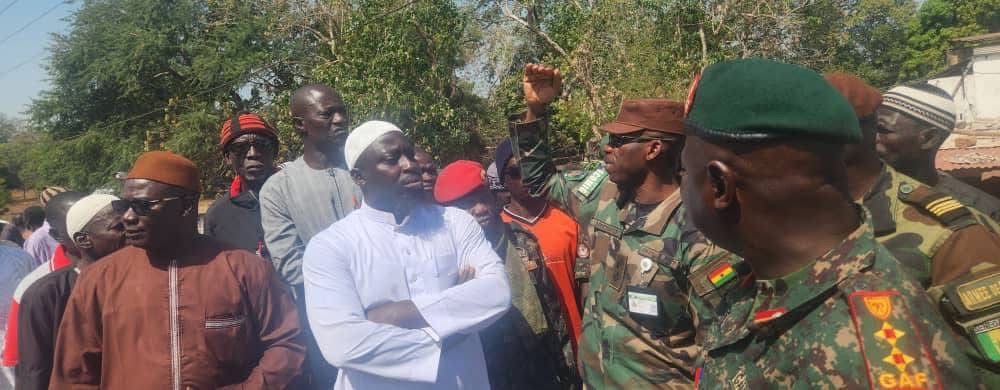
A long-standing military vehicle checkpoint (VCP) at the entrance to Bwiam village in Foni Kansala District, West Coast Region, has reignited public controversy, pitting national security priorities against local demands for road safety.
The Gambia Armed Forces (GAF) High Command issued a statement addressing ongoing debates about the checkpoint, which troops from the ECOWAS Mission in The Gambia (ECOMIG) – primarily Senegalese soldiers – have manned for nearly a decade. Positioned along the Trans-Gambia Highway, a vital corridor, the VCP forms part of broader security measures outside the Greater Banjul Area. GAF described these checkpoints as essential for early warning, situational awareness, threat deterrence, and operational control, based on rigorous assessments involving terrain, traffic patterns, and public safety.
In response to recurrent road accidents near the site – some fatal – GAF formed a joint assessment team with ECOMIG. Consultations with local authorities, the police, and Bwiam residents led to recommendations for modest repositioning, improved signage, and enhanced visibility. These changes, GAF stated, aimed to reduce accident risks without undermining the checkpoint’s core security functions. The military emphasized that all deployments undergo continuous review to balance effectiveness, proportionality, and public safety, while upholding its mandate to protect national sovereignty.
However, Hon. Almameh Gibba, the National Assembly Member for Foni Kansala Constituency, issued a sharp rebuttal, accusing authorities of backtracking on prior agreements and endangering lives anew.
Gibba highlighted that for almost nine years, residents of Foni and surrounding areas have suffered from accidents, restricted access to rice fields, fatalities, and property damage linked to the checkpoint. He questioned the prolonged presence of foreign ECOMIG troops at such a prominent highway location in a sovereign nation, stressing that while multinational support may aid stabilization, accountability must rest with national institutions.
A key high-level meeting on January 29, 2026, brought together GAF’s Operations Commander, Col. Yerro; ECOMIG’s Lt Col. Kuluta Manneh; Senegalese commanders; the 4th Infantry Commander from Kanilai; national assembly members; the Chief of Kansala; councillors; alkalolu (village heads); and other stakeholders. Discussions reportedly yielded agreements on safety improvements, though Gibba lamented that citizens received no formal briefing on the outcomes and called for greater transparency.
Following advocacy from Gibba, fellow lawmakers, councillors, and traditional leaders, wooden barricades were replaced with speed calming measures – commonly called “sleeping policemen” – intended to curb speeding and prevent fatalities.
Yet Gibba now warns of a “troubling development”: authorities added sandbags to each speed bump, transforming the site into what he described as a “combat-ready military position.” This reconfiguration, he argued, is “even more dangerous” than the original setup, heightening accident risks and contradicting the agreed safety focus.
The lawmaker questioned why these additions occurred without stakeholder consultation, especially after commitments to prioritize public safety. He urged GAF to avoid yielding to political pressures at the expense of citizen well-being, warning that the army must remain apolitical and never appear to act against its people’s interests.
Gibba threatened to present evidence on those responsible for the changes if corrective action is not taken swiftly to revert to the agreed layout. He described the current setup as “worse than before,” with imminent dangers looming, and called on GAF to lead decisively in restoring the prior configuration, demonstrating professionalism and a commitment to protecting lives.
The dispute underscores deeper tensions in the region, where security needs intersect with everyday civilian mobility and historical sensitivities around foreign military presence. ECOMIG’s role, established after the 2016 political transition, has faced scrutiny amid isolated incidents, including past accidents at Bwiam that prompted temporary removals or adjustments.
Both GAF and Gibba affirmed the need for a people-centered security approach that fosters public confidence. As the situation unfolds, residents await a resolution to ensure the Trans-Gambia Highway remains safe for travel while maintaining necessary vigilance along this strategic route.