By Fatou Dahaba
President Adama Barrow on Tuesday officially inaugurated The Gambia’s ambitious National Identity Management System, hailing it as a transformative leap toward modern, efficient, and secure governance in the West African nation.
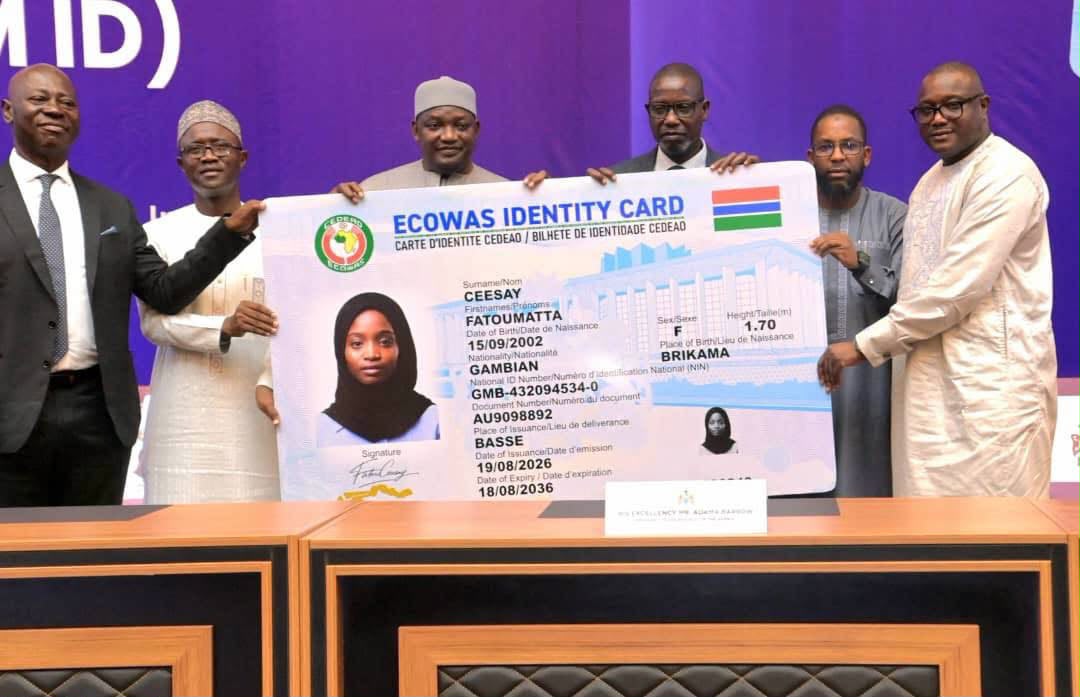
The launch ceremony, held at the Sir Dawda Kairaba Jawara International Conference Center, marked the debut of a sophisticated biometric identity platform designed to replace the country’s outdated and often problematic identification system. President Barrow, who personally became the first Gambian to enroll in the new system on Monday, June 29, 2026, received his personalized National ID card within minutes after his iris scan, portrait, fingerprints, and demographic data were captured and verified.
“We are here today to launch a system that will provide every Gambian with a secure, trusted, and verifiable identity,” Barrow told the gathering. He described the initiative as essential for effective governance, economic inclusion, border management, public service delivery, financial innovation, and national security.
The project is a public-private partnership between the Government of The Gambia, through the Ministry of Interior, and Margins ID Systems Applications Ltd. President Barrow emphasized that the collaboration blends government oversight with cutting-edge technical expertise to build a robust national identity infrastructure.
For years, Gambians have grappled with significant challenges under the previous identity card regime, including lengthy delays in issuance and renewals, difficulties in verifying personal data, and fragmented records across government institutions. Barrow acknowledged these shortcomings, noting that citizens often faced barriers to accessing essential services.
“For the first time in our history, The Gambia is establishing a unified and trusted National Identity Register, with a unique identity for every Gambian,” he declared. “With a single process, we can now collect information across government institutions with fewer errors, less duplication, less bureaucracy, and better service delivery.”
The President stressed that a reliable identity system is a fundamental duty of any sovereign state, without which governments cannot plan effectively, deliver services efficiently, or enable full citizen participation in national development.
Starting immediately, Gambians aged 18 and above can register for the new dual-interface biometric ECOWAS ID card. Valid for ten years, the card features secure embedded chips and Public Key Infrastructure technology. It complies fully with ECOWAS and ICAO international standards, ensuring interoperability across the region.
One of the system’s standout features is instant card issuance, slashing a process that previously took months down to mere minutes. Real-time verification capabilities are expected to reduce risks of duplication, impersonation, and fraud significantly. The system will also extend benefits to Gambians living abroad and non-Gambian residents, streamlining access to identity documents and associated services.
President Barrow called on chiefs, community leaders, religious figures, youth groups, and civil society organizations to actively support the nationwide rollout and mobilization efforts.
Professor Abdou Karim Jallow, Director General of the Gambia Information and Communication Technology Agency, described the launch as the dawn of a new era in public service delivery and digital governance. He highlighted how previous siloed identity systems forced citizens to repeatedly submit the same information to different agencies, resulting in duplication and inefficiency.
“The new digital ID is a secure and trusted representation of an individual, strengthened by biometric data that enables government systems to identify, authenticate, and verify people electronically,” Professor Jallow explained. “In simple terms, it allows each resident to establish their identity in a secure and trusted way across all government services.”
Officials believe the platform will serve as the foundational layer for broader digital government transformation, supporting The Gambia’s ambitions for a more responsive and efficient public sector.