By Aja Beyai
The 2026 presidential election may not be decided in Basse, Kuntaur or Janjanbureh, where President Adama Barrow already leads by more than 60 percent. According to the latest CEPRASS National Opinion Poll, it will instead be decided in Kanifing, Banjul and Brikama, where one in five voters remains undecided.
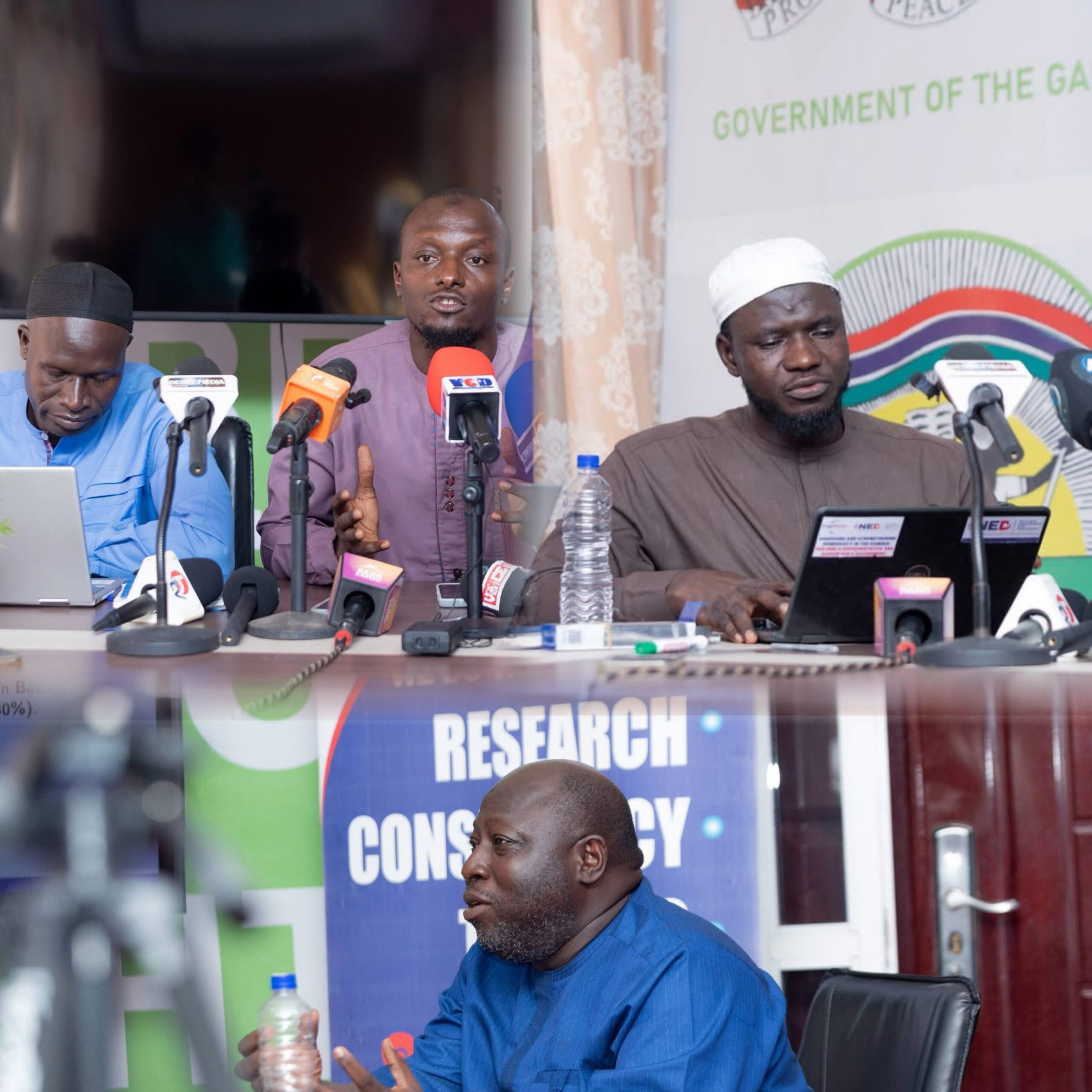
The poll, released Monday at the National Youth Council Hall, shows Barrow and his NPP-led alliance leading nationally with 37.9 percent voting intention, ahead of the Gambia First Coalition at 24.2 percent and Coalition 2026 at 11.3 percent. Behind that national lead, however, lies a large silent bloc concentrated in the country’s most populous area.
In Kanifing, 22.6 percent of voters are either undecided or prefer not to say whom they will support.
In Banjul, the figure is nearly 20 percent, and in Brikama it is 17 percent. Lead researcher Dr. Mustapha Jobarteh said this is where the election will be won or lost.
“Brikama has up to 47 percent of the total register. Seventeen percent of that is really, really significant,” Jobarteh said. “This is where all the contestants should really put in a lot of effort. Mainly in the Greater Banjul Area and Kerewan.”
In contrast, most voters in Kuntaur and Basse say they already know how they will vote on December 5 and need no further persuasion. “The campaign should camp in Kanifing, Banjul and Brikama. That is the battleground,” Jobarteh added.
Greater Banjul is also where concern over the election’s dominant issues is sharpest. In Kanifing, security ranks almost as high as the cost of living, with 27 percent naming it their top issue—far above the national average of 18 percent. Dissatisfaction with the economy exceeds 80 percent in both Banjul and Kanifing. Daily or near-daily electricity outages are likewise highest in Banjul, Brikama and Kanifing.
Trust in the process is lowest in the same urban areas. Nationally, 69 percent of respondents said the Independent Electoral Commission must become more independent and transparent before they can fully trust the elections.
The West Coast is the only region where Barrow does not lead. In Brikama, the Gambia First Coalition edges the NPP-led alliance by 29.6 percent to 27.8 percent—a gap of less than two points and well within the poll’s margin of error of plus or minus 3 percent. In Kerewan, the NPP leads by roughly one point. “These are very close races,” Jobarteh said. “One percentage point can be huge.”
Turnout is expected to be high. Ninety-two percent of respondents hold a voter’s card, and 87 percent of those say they are completely certain to vote, pointing to a national turnout of around 84 percent or higher. Certainty is strongest in Kanifing, Banjul and Mansakonko and lowest—but still 77 percent—in some rural areas. “Even if you have a 77 percent turnout, it’s still not bad,” Jobarteh noted.
The poll also cautions that coalition-building is not automatically additive. The gap between voting intention for the NPP alliance (37.9 percent) and attachment to the NPP alone (37 percent) is just 0.9 points; similar patterns hold for other parties. Seven in ten voters said they are unlikely to support their own party if it joins an alliance they dislike. “Coalition building alone is unlikely to win votes. We need credible leaders and policies to do the heavy lifting,” Jobarteh said.
For candidates seeking the undecided urban vote, the message is clear. Forty-three percent named cost of living as the most important issue; when food prices are included, 57 percent said economic concerns will decide their choice. Competence ranked highest among candidate qualities at 39 percent, followed by policies and integrity. Policies matter most in Kerewan, Banjul, Brikama and Kanifing—the same areas with the largest undecided pools—while track record carries more weight in Basse, Janjanbureh and Kuntaur, where Barrow already leads.
The CEPRASS survey was conducted face-to-face from 17 October to 1 November 2026 with 1,180 households across 53 districts and 118 enumeration areas. The National Endowment for Democracy funded it under the project “Assessing and Strengthening Democracy in The Gambia.” Researchers stressed that the results are a snapshot of perceptions at the time of fieldwork, not a forecast.
Barrow may lead nationally, but undecided voters in Kanifing, Banjul and Brikama will decide December 5.