By Sainabou Sambou
Senior Ministry of Health official Balla Kandeh firmly denied any involvement in the alleged irregular recruitment of consultants, unauthorized payments, or the use of forged documents in a high-profile case involving over D11.4 million in Global Fund monies.
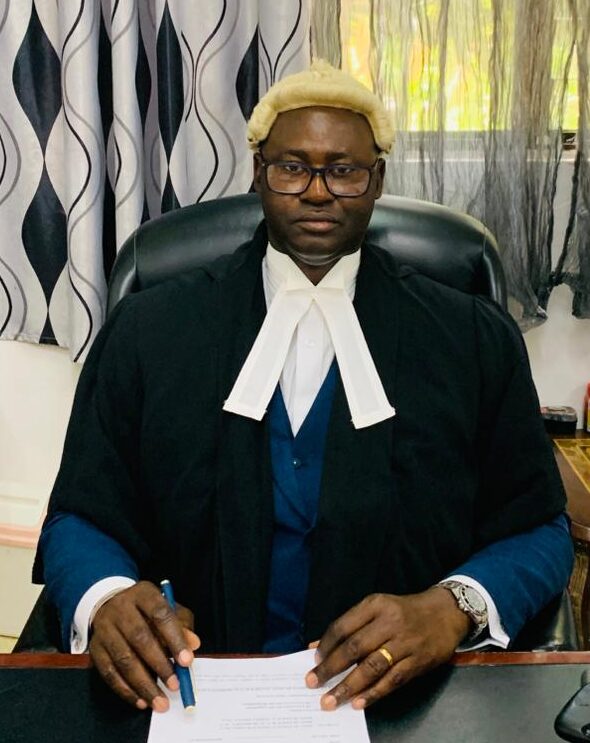
Presiding over the matter, Justice Ebrima Jaiteh heard the continued cross-examination of defense witness Balla Kandeh, designated as DW1. State counsel AM Yusuf led the cross-examination while K. Jallow represented the accused persons.
Kandeh, a veteran health administrator with more than 30 years of service at the Ministry of Health, testified extensively about his role in donor-funded programs, particularly those supported by the Global Fund. He categorically rejected prosecution claims that consultant recruitment and payments under the Malaria Control Program were handled irregularly.
“No consultant payments were processed through the program in the manner alleged,” Kandeh told the court. He emphasized that once a Memorandum of Understanding (MOU) was signed, it clearly defined the operational boundaries of any arrangement. The witness dismissed suggestions that the MOU mandated the recruitment of two specific consultants per study, explaining that the document outlined only general roles, responsibilities, qualifications, and reporting lines, without naming individuals or requiring specific hires.
Shown a series of financial documents known as the P21 series (P21A to P21G), which the prosecution described as Global Fund payment vouchers, Kandeh acknowledged that they formed part of standard financial processing for donor projects. However, he insisted the documents did not demonstrate that he personally approved any consultants or authorized the disputed payments.
The witness told the court he had no prior knowledge of the consultants during the 2018-2020 implementation period. He said he first learned of their involvement in 2021 during an audit committee briefing and only identified them fully in 2023 when police investigations commenced. “I had no role in identifying or engaging those consultants,” he maintained.
Kandeh explained that studies conducted under the program required reports to be submitted to the National Malaria Control Program through a designated focal person, in accordance with standard donor-funded procedures. He confirmed holding multiple positions simultaneously between 2018 and 2020, including Program Manager of the National Malaria Control Program and Board Chair of HEFDO, while also contributing to the establishment of a Project Coordination Unit (PCU) that only became fully operational around 2020.
He clarified that consultants did not report directly to the board but were referenced in general program updates during meetings. Board information was shared via circulated minutes, though he admitted he did not retain personal copies, describing such documents as institutional records.
The witness noted that his deputy, Lamin Jarjue, a vector control specialist who played a technical role in the program, passed away in 2021 and was therefore unavailable for investigations. Kandeh stressed that Global Fund activities followed strict terms of reference and financial procedures, with procurement and hiring decisions processed through designated controllers rather than unilateral authority.
Justice Ebrima Jaiteh directed Kandeh to produce his Terms of Reference (TOR) at the next hearing, invoking Section 221 of the Evidence Act, 1994.
Throughout the cross-examination, Kandeh denied all allegations of fraud, forgery, and misconduct.
He rejected claims that he knowingly approved or facilitated irregular payments and stated he did not know several individuals named in testimony, including Abou Sallah. He described his involvement as strictly administrative and oversight-related, becoming aware of the disputed issues only years later through formal audits and investigations.
The prosecution alleges that between 2018 and 2020, the accused persons caused a financial loss of D11.4 million to the Government of The Gambia by awarding consultancy contracts in violation of procurement rules. Some consultants are alleged not to have existed or performed the claimed work, with forged CVs purportedly used to justify payments for studies on insecticide resistance, mosquito net effectiveness, and vector control. Individuals named in the allegations include Abdou Sillah, Mamout Ceesay, Basirou Phillott, and Muhammadou Sissoho.
The case has been adjourned to Tuesday, 12 May 2026, from 10:00 a.m. to 11:00 a.m. for continuation of the hearing.