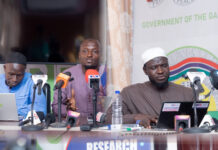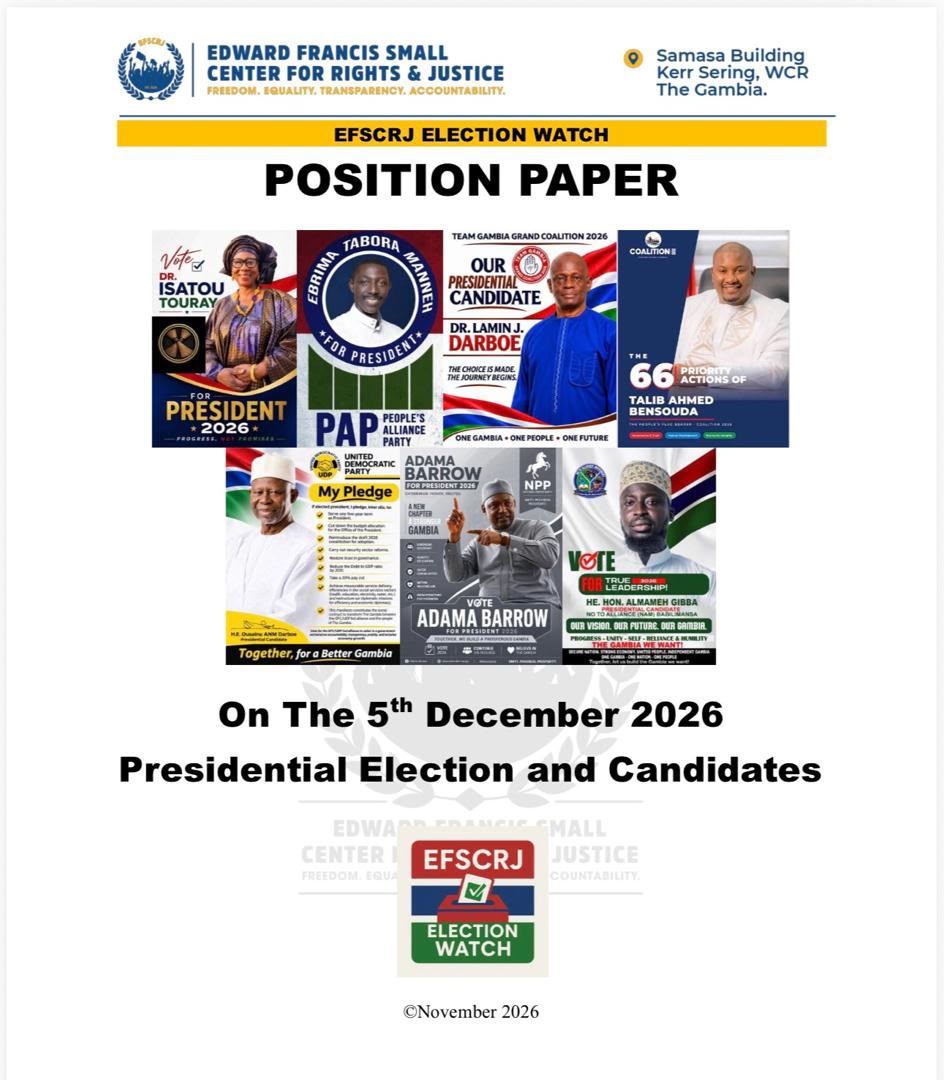
The Edward Francis Small Center for Rights and Justice (EFSCRJ) has released a detailed position paper on the 5 December 2026 presidential election, urging Gambians to weigh candidates against the standards of constitutionalism, human rights, transitional justice, and national development ten years after the fall of dictatorship.
In the paper, EFSCRJ firmly opposes President Adama Barrow’s bid for a third term. Although the current Constitution does not bar a third term, the Center argues that Barrow’s earlier public commitments to presidential term limits, constitutional reform, and democratic renewal create a binding political and moral obligation he has failed to honor. “The absence of a legal restriction does not absolve the President of his commitments to the Gambian people,” the paper states.
The organization also expresses serious reservations about Almameh Gibba’s candidacy. It cites his continued allegiance to former dictator Yahya Jammeh, his failure to unequivocally reject the human rights abuses and corruption of the former regime, and his efforts to overturn the legal ban on female genital mutilation as positions that conflict with The Gambia’s democratic and transitional justice goals.
At the same time, EFSCRJ welcomes Dr. Isatou Touray’s historic candidacy, describing her appearance on the ballot as the first by a Gambian woman and a significant milestone in the struggle for gender equality and political inclusion.
The paper reviews the manifestos and campaign promises of Dr. Touray, Lamin J. Darboe, Ebrima Tabora Manneh, Talib Ahmed Bensouda, and ANM Ousainou Darboe, noting their various pledges on constitutional reform, accountable governance, economic transformation, and better public services. EFSCRJ stresses that this analysis does not endorse any candidate.
It specifically raises human rights concerns over Talib Ahmed Bensouda’s proposal to apply the death penalty, citing the right to life, the risk of irreversible wrongful convictions, and The Gambia’s international obligations.
The Center calls on voters to look beyond campaign rhetoric, party loyalty, and personal ties, and instead judge candidates on integrity, competence, track record, respect for human rights, democratic commitment, and ability to deliver measurable results. “The presidency is a public trust, not a personal entitlement,” the paper declares. “No individual is indispensable to the governance and development of the Republic.”
EFSCRJ urges all eligible citizens to vote freely, peacefully, and responsibly. It also calls on candidates, parties, and supporters to respect electoral laws, honor the Presidential Election Peace Pact, await the Independent Electoral Commission’s official results, and settle any disputes through lawful, peaceful means.