By Fatou Dahaba
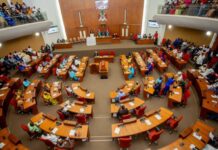
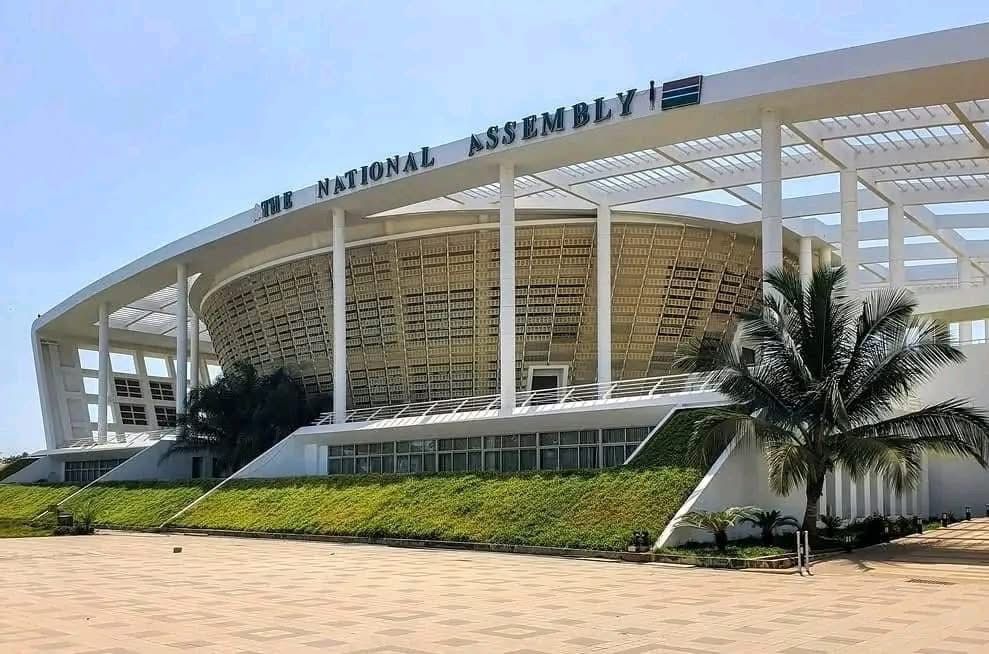
In a heated session of the National Assembly on Wednesday, September 17, members fiercely criticized President Adama Barrow’s controversial decision to remove the Auditor General from office forcibly and condemned the arrests of young protesters. The debate, sparked by a Matter of Urgent Public Importance raised by Almameh Gibba, National Assembly Member (NAM) for Foni Kansala, underscored deep concerns over constitutional democracy, institutional integrity, and the rule of law in The Gambia.
Gibba, invoking Clauses 51(1) and (3) of the Assembly’s Standing Orders, described the president’s actions as a “constitutional crisis” that threatens the separation of powers, the independence of the National Audit Office (NAO), and due process. “The National Audit Office is a cornerstone of transparency and accountability in governance. Undermining its independence weakens our democratic institutions and erodes public trust,” he stated. Gibba also decried the arrests of youths, asserting that a democratic state must uphold the right to peaceful assembly and expression without fear of repression. “The use of force to suppress civic engagement undermines our democratic values and violates fundamental human rights,” he added.
The Auditor General, Modou Ceesay, was reassigned to a political appointment at the Ministry of Trade, a move many NAMs argued compromises the NAO’s autonomy. Alfusainey Ceesay, NAM for Sami, challenged the president’s authority to unilaterally remove the Auditor General, warning that such actions could destabilize independent institutions. “The president has no discretionary powers to remove the Auditor General. This requires an interpretation of the constitution to prevent the collapse of independent institutions,” Ceesay said. He also urged the government to maintain peace and refrain from mobilizing police to arrest and mistreat young protesters.
Samba Jallow, NAM for Niamina Dankunku, echoed these concerns, calling on President Barrow to reconsider his decision. He highlighted unresolved issues in pending audit reports and cautioned that Ceesay’s removal could fuel public speculation. Jallow noted Ceesay’s international stature, stating, “Modou Ceesay serves as Chairperson of the Governing Board of African Professionalism and Gambian National Audit and is part of the African Association of Supreme Auditing Institutions. Removing him risks losing Gambia’s standing on the international stage.”
Modou Lamin Bah, NAM for Banjul North, condemned the arrests of youths as a violation of Section 25 of the constitution, which guarantees the right to peaceful assembly. Labeling the actions of the Inspector General of Police (IGP) and law enforcement as “unacceptable,” Bah called for accountability and restraint.
Alagie Mbowe, NAM for Upper Saloum, emphasized the NAO’s critical role in supporting the Assembly’s oversight functions. “As representatives, we cannot stand by while the country goes astray. We are not blindfolded,” he declared. Mbowe stressed that The Gambia, as a democratic society governed by laws, must respect the independence of institutions and the legal frameworks governing appointments and powers.
Minority Leader Alagie S. Darboe, NAM for Brikama North, described the president’s decision as irrational and a potential threat to the NAO’s independence. “The president should reconsider his move and act accordingly to protect the independence of all independent institutions,” Darboe urged, warning of broader implications for governance.
However, not all members opposed the president’s actions. Nominated member Fatou K. Jawara and Gibbi Mballow, NAM for Lower Fulladu West, defended Barrow’s decision, arguing that the president has the authority to hire and fire the Auditor General. They suggested that Ceesay could either accept the redeployment, vacate the office, or challenge the decision in court. Addressing the youth protests, Jawara and Mballow cautioned against being manipulated by politicians, urging young people to respect the country’s laws and procedures. “This country cannot go ungoverned. People must respect the laws of this land,” Mballow asserted.
The debate highlighted a deepening divide within the Assembly, with most members rallying to protect institutional independence and citizens’ rights, while a minority upheld the president’s authority. The controversy surrounding the Auditor General’s removal and the arrests of youths has intensified scrutiny of Barrow’s administration, raising questions about democratic governance in The Gambia. As tensions mount, the Assembly’s call for constitutional adherence and respect for fundamental rights signals a critical moment for the nation’s democratic institutions.