Ousainou Jallow has been sentenced to death by hanging for the murder of 62-year-old Binta Gassama, whom he and an accomplice suffocated in her home during a violent robbery in September 2022.
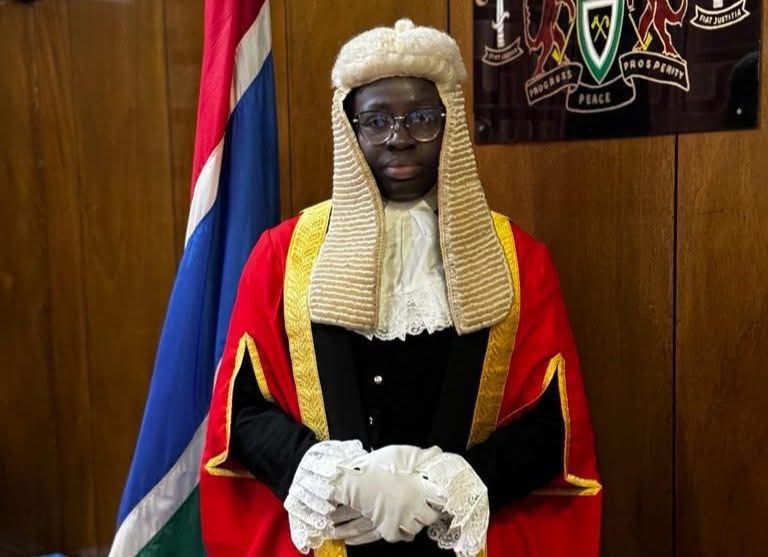
Justice Isatou Janneh of the Bundung High Court delivered the judgment and sentence today, describing the crime as one of “exceptional gravity.”
In a detailed ruling spanning several hours, Justice Janneh convicted Jallow on two counts: murder contrary to Section 187 of the Criminal Code and robbery contrary to Section 272, punishable under Section 273(2). The court also convicted his co-accused, Lamin Jammeh, whom it described as an Alleged Child Offender (ACO) at the time of the offense. Jammeh was remitted to the Kanifing Children’s Court for appropriate juvenile orders.
The case stemmed from events on the morning of September 4, 2022, at South Atlantic, Fajara, in the Kanifing Municipality.
According to the prosecution, Jallow and Jammeh unlawfully entered the deceased’s residence with the intention to rob her.
They allegedly scaled the fence, lured the victim out by throwing objects at the gate, and then attacked her when she confronted them.
Prosecution witnesses described how Sally Fiah, the deceased’s daughter, found her mother lying naked on the bathroom floor with a cloth across her face and water pouring directly onto her from the shower.
The house had been ransacked, with valuables missing. Neighbors who responded to Fiah’s cries confirmed the chaotic scene and signs of violence on the victim’s body.
Pathologist Professor Gabriel Olebiyi Ogun, who performed the autopsy (Exhibit G), testified that the cause of death was asphyxiation due to smothering and neck compression, compounded by blunt force trauma to the head resulting in a skull fracture. The medical evidence showed ligature marks on the neck, bruises, defensive wounds, and other injuries consistent with a sustained assault.
Justice Janneh placed significant weight on the voluntary confessional statements of both accused persons, admitted as Exhibits A2 and B2 after a trial-within-a-trial on voluntariness.
In graphic detail, the statements described how the pair entered the compound, subdued the elderly woman by covering her mouth and applying pressure to her neck until she stopped moving, dragged her to the bathroom, and then ransacked the house.
They allegedly stole an iPhone, a Samsung phone, a Huawei tablet, a router, a power bank, headphones, jewelry, cash, and the deceased’s car key. Some items were sold at the Serrekunda market shortly afterward.
Police recovered the iPhone from bushes in Bakau and the car key from the roof of a toilet at Jallow’s residence, following leads provided by the accused.
The court applied the doctrine of recent possession, noting that the accused were found with or led police to property recently stolen from the crime scene and offered no credible explanation.
Justice Janneh ruled that the confessions were corroborated by independent evidence, including witness testimonies from buyers of the stolen Samsung phone and police officers involved in recoveries.
Defense counsel, C. Mendy, argued that the prosecution failed to prove its case beyond a reasonable doubt, challenged the admissibility and reliability of the statements, and raised an alibi defense.
Jallow claimed he was at his tailoring workshop, supported by a witness who said they worked together that day. However, the court rejected the alibi, finding it was not raised at the earliest opportunity during police investigations and was contradicted by the detailed confessions and other evidence.
“The defense of alibi was a mere denial unsupported by credible facts,” Justice Janneh stated. She emphasized that the burden of proof remained on the prosecution throughout, citing authorities such as Woolmington v DPP and Gambian precedents.
On the murder charge, the court found all ingredients proved: the death of Binta Gassama, causation by the acts of the accused, unlawfulness, and malice aforethought. The joint enterprise, use of extreme violence in the course of robbery, and deliberate acts intended to cause grievous harm or death satisfied Section 190 of the Criminal Code.
For the robbery count, the court held that actual violence was used to overcome the victim’s resistance and facilitate the theft. The sentences reflect the law as it stood at the time of the offense, despite the later repeal of certain provisions of the Criminal Code.
In her sentencing remarks, Justice Janneh described the attack on a vulnerable woman in the sanctity of her home as particularly heinous. “This was not a momentary lapse but a calculated, prolonged, and brutal assault,” she said.
Aggravating factors included the victim’s age, the breach of her home, the extreme violence, lack of remorse, and the fact that the murder occurred during another serious felony.
Jallow, described as a tailor, was sentenced to death on the murder count and life imprisonment on the robbery count, to run concurrently. The court informed him of his right to appeal within ten days.
Lamin Jammeh, confirmed as a minor at the time through an age determination report, will face proceedings in the Children’s Court. He remains in the Juvenile Wing of the State Central Prison pending that process.