By Sainabou Sambou
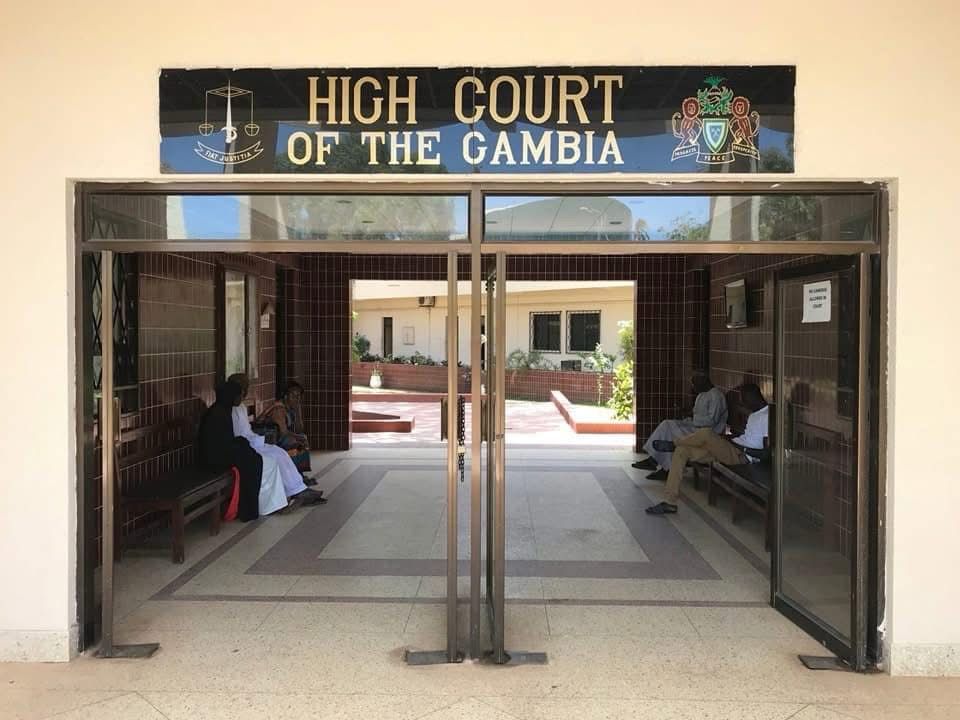
In a tense session at the High Court in Banjul on Tuesday, former Ministry of Health official and ex-HEDO board chairperson Balla Kandeh firmly distanced himself from any involvement with allegedly forged curriculum vitae (CVs) submitted in connection with controversial consultancy studies conducted between 2018 and 2020.
Presiding over the matter, Justice Ebrima Jaiteh heard extensive cross-examination of Kandeh as the trial into the Health Education and Development Organization (HEDO) affair continues. Director of Public Prosecutions (DPP) A.M. Yusuf led the state’s case, while defense counsel K. Jallow represented the accused.
The proceedings opened with procedural matters concerning documents Kandeh had been ordered to produce. He confirmed that he would bring the Terms of Reference (TOR) papers previously submitted to an internal panel in January. With no objection from the defense, Justice Jaiteh admitted two key exhibits into evidence.
Exhibit D-26 (pages 1-7) was identified as the Terms of Reference Program under the Global Fund Malaria Grant Manager, effective 14 April 2014. Exhibit P-27 (pages 1-6) comprised the Ministry of Health National Malaria Control Program’s Terms of Reference for the positions of Medical Entomologist and National Focal Point for Vector Control and Entomological Officer, dated May 2015.
The core of Tuesday’s hearing, however, centered on rigorous cross-examination by the DPP, who probed Kandeh on administrative protocols and financial oversight within public institutions. Kandeh explained that correspondence marked “Attention to” a named officer designates that individual as responsible for the matter.
Questioning then shifted to Kandeh’s tenure as HEDO board chairperson during the period when the disputed consultancy studies took place. The DPP highlighted that Kandeh co-signed all cheques issued by HEDO to consultants. The witness acknowledged signing or co-signing numerous cheques during his time in office, but stressed that he could not recall specific details related to the studies without seeing copies.
“There are cheques I have signed or co-signed, but specifically, I would need to see a copy of the cheque being referenced because there are many cheques I have signed,” he told the court.
Kandeh elaborated on HEDO’s financial procedures, noting that any two authorized signatories could approve cheques and that the board chairperson was not required to sign every payment. He further testified that, while payment vouchers typically included supporting documents, it was not his duty as a co-signatory to scrutinize every attachment.
“You are assuming I go through all those attached vouchers,” he said. “As a co-signatory, I do not go through all the vouchers because it is not my responsibility. The HEDO administration is responsible for those documents. My responsibility is to co-sign.”
When the DPP suggested this amounted to endorsing payments without full knowledge of their purpose, Kandeh replied that he relied on the director or authorized signatory having performed due diligence. “What I am saying is that once I see the director has signed after due diligence, then I sign,” he stated. He repeatedly insisted he did not need to examine all supporting documents once prior approval had been granted.
Defense lawyer K. Jallow objected at one point, arguing that the prosecution was attempting to compel the witness to accept a premise he had consistently rejected. Justice Jaiteh allowed the line of questioning to continue but noted that the court would ultimately weigh the evidence.
The most pointed exchanges came when the DPP turned to CVs tendered as Exhibits P1A, P1B, and P1C. Referring to earlier testimony from prosecution witnesses and investigators alleging that the documents did not belong to the named individuals—specifically those of Muhammad Sisso, Basiru Pinot, and Abu Sallah—the DPP asked Kandeh whether he accepted that they were forged.
Kandeh categorically denied any prior knowledge. “I do not know anything about those CVs because I only saw them in 2023, five years after the activities were completed,” he emphasized. Despite persistent questioning linking the documents to court testimonies claiming forgery, the witness held firm: “I do not know anything about the CVs,” and said, “I do not know.”
Justice Jaiteh adjourned proceedings to Tuesday, 2 June 2026, at 11 am for continuation of the trial.