By Ousman Jah
Introduction
Over the past few weeks, discussions surrounding car drifting have dominated conversations across The Gambia. Images of young people gathering in large numbers, social media videos of vehicles performing dangerous drifts on public roads, and community reactions have generated both concern and debate.
One particular social media post captured national attention. It showed what was described as the Gunjur Anti-Drifting Response Team, waiting for a group known as the “Outlawz.” Fortunately, the expected confrontation never occurred.
The accompanying message encouraged young people not to resort to violence, humorously suggesting that any confiscated drifting cars should instead be repainted as taxis and allocated to unemployed youths.
While humorous on the surface, the message reflects a deeper reality.
Many Gambians are frustrated by dangerous driving on public roads.
At the same time, many young people participating in drifting feel misunderstood, believing they are simply expressing passion for motorsports.
The truth is that both sides have legitimate concerns.
Public safety can never be compromised.
Likewise, youthful passion, innovation, and talent should never be dismissed simply because it lacks proper organization.
Instead of asking whether drifting should exist, perhaps the better question is:
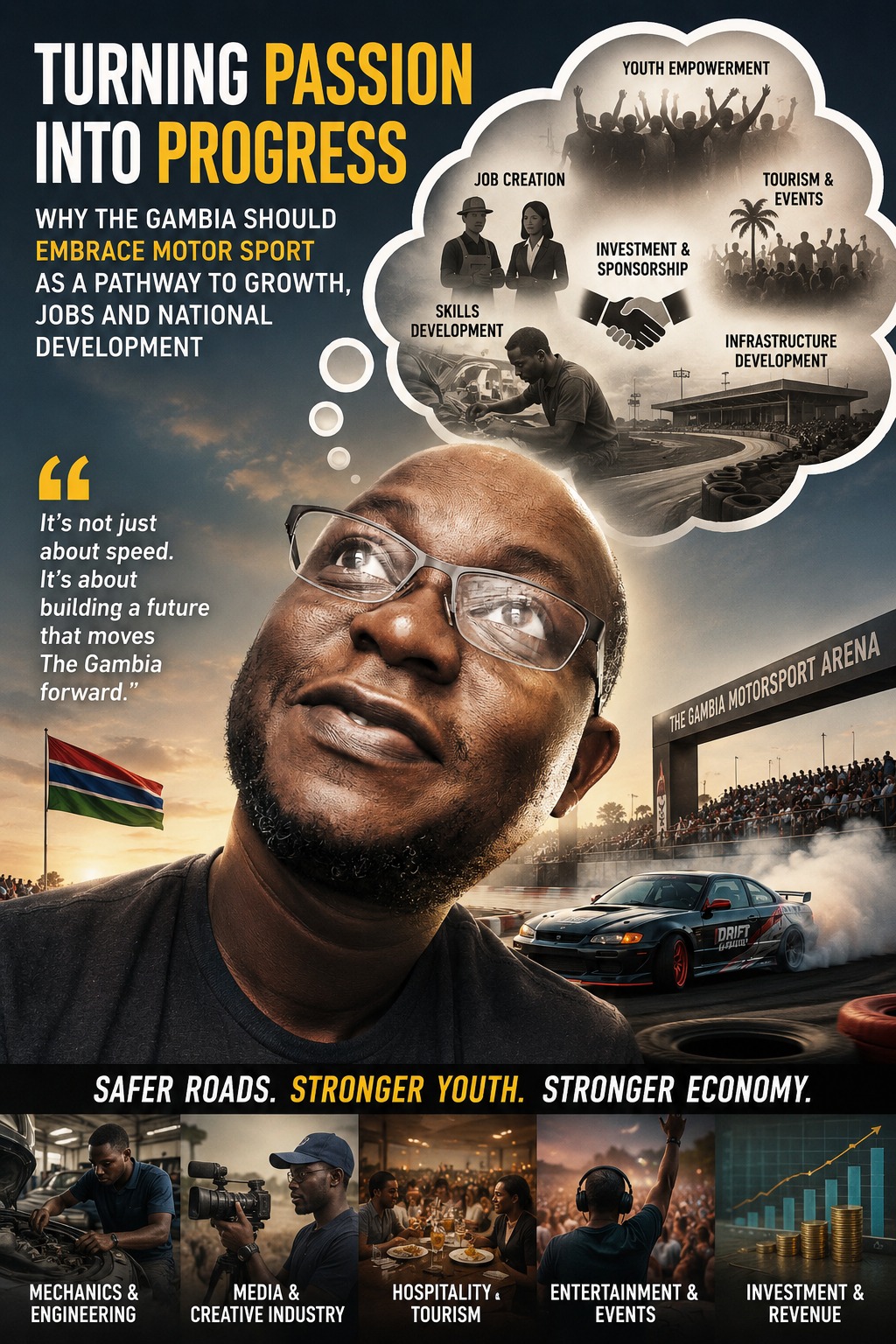
How can The Gambia transform an uncontrolled activity into a regulated motorsport industry capable of creating jobs, attracting tourism, generating tax revenue, and giving young people a productive outlet?
Understanding the Difference Between Illegal Drifting and Motorsport
The first misconception is treating every form of drifting as criminal behavior.
Professional drifting is an internationally recognized motorsport.
Illegal street drifting is not.
The difference lies in:
- Location
- Safety
- Rules
- Licensing
- Crowd control
- Vehicle inspection
- Insurance
- Emergency response
Formula One is dangerous when done on public roads.
Motorcycle racing is dangerous on highways.
Even cycling competitions require road closures.
Drifting is no different.
The problem is not the sport itself.
The problem is where and how it is currently takes place.
Why Communities Are Right to Be Concerned
Communities across The Gambia have every reason to worry.
Illegal drifting on public roads can lead to:
- Fatal accidents
- Injuries to spectators
- Damage to private property
- Traffic disruption
- Noise pollution
- Fear among residents
- Negative perception of young people
Authorities are therefore justified in enforcing traffic laws.
No sporting activity should endanger innocent road users.
Young drivers must understand that public roads belong to everyone.
Winning public support begins with respecting public safety.
The Other Side of the Story
While enforcement is necessary, it should not be the only response.
Many of the young people involved in drifting possess remarkable driving skills.
Others have developed mechanical expertise by modifying vehicles.
Some have built large online audiences.
Others have attracted sponsors without any formal structure.
Instead of asking:
“How do we stop them?”
We should also ask:
“How do we channel this energy into something productive?”
History shows that countries which embraced motorsports rather than simply criminalizing them eventually created thriving industries.
Motorsports Are a Multi-Billion Dollar Global Industry
Worldwide, motorsports generate billions of dollars annually.
Revenue comes from:
- Ticket sales
- Television broadcasting
- Sponsorship
- Tourism
- Advertising
- Merchandise
- Hospitality
- Vehicle manufacturing
- Automotive technology
- Driver academies
- Racing schools
Drifting alone has evolved into one of the fastest-growing motorsports globally.
Major competitions now attract hundreds of thousands of spectators and millions of online viewers.
Countries That Successfully Developed Drifting
Japan – The Birthplace of Modern Drifting
Japan transformed drifting from underground mountain-road culture into an internationally respected motorsport.
Organizations created proper championships.
Dedicated circuits were built.
Manufacturers became sponsors.
Today Japan attracts enthusiasts from around the world.
Tourism benefits significantly from motorsport-related travel.
South Africa
South Africa hosts professional drifting championships with corporate sponsorships.
Events attract thousands of spectators.
Sponsors include automotive brands, tyre manufacturers, fuel companies, insurance firms and telecommunications companies.
These events support:
- Hotels
- Restaurants
- Mechanics
- Security companies
- Event organizers
- Media houses
Kenya
Kenya has steadily developed a growing motorsport culture.
Through organized events and motorsport associations, young drivers compete in legal environments while attracting sponsorship and tourism.
The government increasingly recognizes motorsports as part of sports development and tourism promotion.
Nigeria
Nigeria has witnessed increasing investment in drifting and motorsport festivals.
Private companies organize exhibitions, competitions and automotive expos that attract thousands of visitors.
The events generate significant publicity for sponsors.
United Arab Emirates
Dubai transformed motorsport into an international attraction.
Purpose-built facilities host drifting championships, drag racing and track days.
The industry supports:
- Tourism
- Hotels
- Airlines
- Restaurants
- Car dealerships
- Luxury brands
United States
Professional drifting championships attract global audiences.
Drivers become celebrities.
Automotive companies spend millions sponsoring teams.
Entire businesses revolve around motorsport culture.
Lessons for The Gambia
The Gambia does not need to reinvent the wheel.
The country can learn from nations that have already made the transition.
Rather than allowing drifting to continue illegally—or attempting to eliminate it entirely—The Gambia could establish a structured framework that promotes safety, discipline, and economic opportunity.
What Government Can Do
Government has an opportunity to transform a challenge into a new sector of economic activity.
Possible initiatives include:
1. Establish a National Motorsport Association
A governing body could regulate drifting, autocross, karting and other forms of motorsport.
2. Construct a Motorsport Arena
Instead of drifting on public roads, competitions could be held at a dedicated facility.
Such a venue could also host:
- Concerts
- Trade fairs
- Vehicle exhibitions
- Motorcycle competitions
- Car festivals
3. Introduce Driver Licensing for Motorsport
Participants would undergo safety training before competing.
4. Develop Youth Training Programs
Driving skills could be combined with:
- Mechanics
- Engineering
- Vehicle diagnostics
- Welding
- Fabrication
- Event management
5. Integrate Motorsport Into Tourism
Annual drifting festivals could attract visitors from Senegal and the wider region.
The Role of the Private Sector
Government cannot do everything.
Private investment is essential.
Potential investors include:
Automotive Companies
- Toyota
- Nissan
- Ford
- BMW
- Mercedes-Benz
- Volkswagen
- Hyundai
- Kia
Tyre Manufacturers
- Michelin
- Bridgestone
- Goodyear
- Pirelli
- Dunlop
- Yokohama
Oil and Lubricant Companies
- Shell
- TotalEnergies
- Castrol
- Mobil
- Petronas
Telecommunications Companies
- Africell
- Qcell
- GAMCELL
- Comium
Banks
- Access Bank (Gambia) Ltd
- Agib Bank Ltd (Arab Gambian Islamic Bank)
- Bloom Bank Africa (Gambia) Ltd
- BSIC Bank (The Gambia) Ltd
- Ecobank Gambia Ltd
- First Bank Gambia Ltd (FBNBank Gambia)
- Guaranty Trust Bank (Gambia) Ltd (GTBank)
- Trust Bank Ltd
- Vista Bank (Gambia) Ltd
- Zenith Bank (Gambia) Ltd
Insurance Companies
Motorsport insurance represents a growing market in many countries.
Beverage Companies
Energy drink companies have historically been among the biggest supporters of motorsports.
Brands like Red Bull and Monster Energy have invested millions globally in drifting, rally, Formula 1, motocross, and extreme sports because motorsports provide strong visibility among young audiences. Similar partnerships could emerge in The Gambia as the sector develops.
Who Would Benefit?
A regulated drifting industry would benefit far more people than just drivers.
Drivers
Professional competition.
Career development.
International exposure.
Mechanics
Increased demand for vehicle preparation.
Welders and Fabricators
Custom roll cages.
Suspension systems.
Performance modifications.
Auto Parts Dealers
Higher sales.
Tyre Dealers
Tyres wear quickly in drifting.
This creates continuous demand.
Fuel Stations
Higher fuel consumption during organized events.
Hotels
Accommodation for teams and visitors.
Restaurants
Food sales during competitions.
Photographers and Videographers
Content creation.
Graphic Designers
Vehicle wraps.
Branding.
Posters.
Merchandise.
DJs and Musicians
Entertainment during events.
Security Companies
Crowd management.
Medical Personnel
Emergency response.
Event Management Companies
Planning and logistics.
Tourism Operators
Travel packages.
Government
Tax revenue.
Licensing fees.
Tourism income.
Employment creation.
Local Communities
Business opportunities during events.
Responsibilities of the Drifting Community
Those passionate about drifting also have responsibilities.
If they genuinely wish to be recognized as athletes rather than reckless drivers, they must lead by example.
This means:
- Rejecting illegal road drifting.
- Respecting traffic laws.
- Wearing appropriate safety equipment.
- Working with the police and local authorities.
- Establishing clubs with clear leadership and accountability.
- Registering associations.
- Organizing legal competitions.
- Maintaining discipline and respect for surrounding communities.
Public trust is earned through responsible behavior.
A Call for Dialogue, Not Division
The recent tension surrounding drifting should not become a battle between communities and young people.
Violence is not the answer.
Neither is public hostility.
Instead, this moment presents an opportunity for constructive dialogue involving:
- Government
- The Gambia Police Force
- The National Road Authority
- The Ministry responsible for Youth and Sports
- The Ministry responsible for Tourism
- Municipal and Area Councils
- Community leaders
- Private investors
- Motorsport enthusiasts
Working together, these stakeholders can design a safe, regulated framework that protects lives while unlocking economic opportunity.
Conclusion
Every successful motorsport nation once faced the same dilemma.
There was a time when drifting in Japan was viewed as reckless.
There was a time when rally racing in Kenya was considered too dangerous.
There was a time when motorsport in South Africa struggled to gain public acceptance.
Those countries did not eliminate the passion.
They regulated it.
They invested in infrastructure.
They educated participants.
They attracted sponsors.
They created employment.
They built industries.
The Gambia now stands at a similar crossroads.
We can continue treating drifting solely as a law-enforcement issue, or we can recognize that, when properly managed, motorsport has the potential to become a driver of youth empowerment, entrepreneurship, tourism, innovation, and national revenue.
The objective should never be to encourage illegal drifting on public roads.
Rather, it should be to replace unsafe street activity with professionally organized motorsport conducted in designated facilities under strict safety regulations.
Young people deserve opportunities.
Communities deserve safety.
Government deserves new sources of revenue.
Investors deserve new markets.
With vision, discipline, collaboration, and leadership, The Gambia can transform today’s controversy into tomorrow’s success story—proving that the true measure of progress is not how we suppress youthful energy, but how wisely we channel it toward national development.