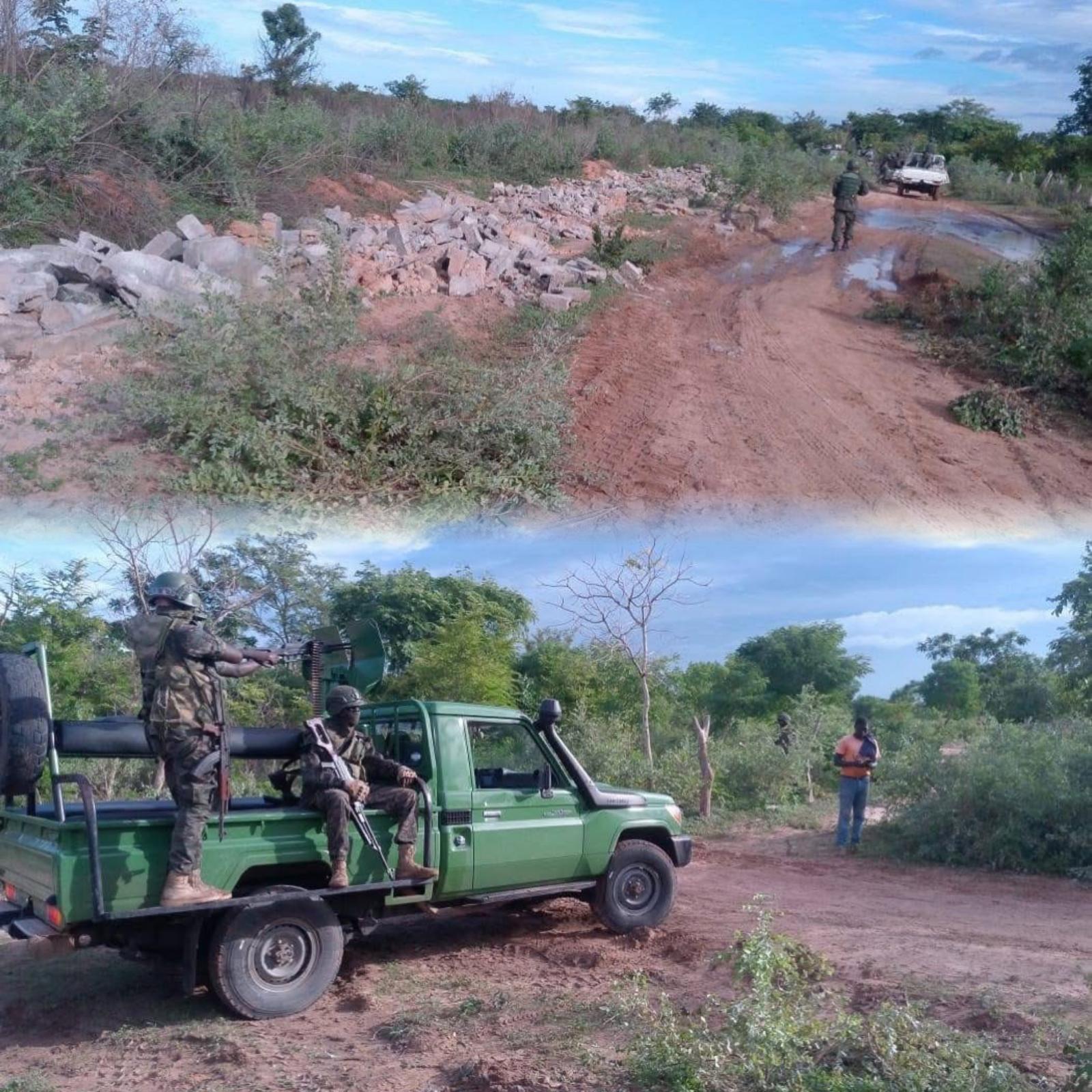
In the early hours of Thursday, 16 July 2026, Senegalese military personnel crossed into the disputed stretch of land at Bullock Military Camp in Foni Kansala and, under heavy security, used a bulldozer to demolish approximately 200 meters of newly constructed perimeter fencing. What began as a long-simmering border ambiguity has now escalated into the most serious physical confrontation between Gambian and Senegalese forces in recent memory.
The Alkamba Times has spoken to multiple senior military sources with direct knowledge of the incident and its background. Their accounts, corroborated across independent channels, paint a picture of a preventable escalation rooted in years of bureaucratic neglect, poor due diligence, and deliberate inaction at the highest levels in Banjul. Gambians at home and in the diaspora are united in condemning the method and the government’s perceived weakness.
The Encroachment That Was Never Addressed
A senior Gambian military commander with extensive knowledge of the Southern border told The Alkamba Times that the section of the camp demolished by Senegalese forces lies inside Senegalese territory. The Bullock camp itself has existed for decades, including throughout former President Yahya Jammeh’s rule. Until 2023, however, it remained unfenced because of its vast size, which made full surveillance extremely difficult.
In 2023, The Gambia’s National Assembly allocated funds for fencing and maintenance. A 200-meter perimeter fence was constructed. According to the source, the contractor and local community assumed the entire stretch fell within Gambian territory. No proper survey or joint demarcation with Senegalese authorities was conducted.
“Due diligence was missing,” the commander stated. “The 200 meters went deep into Senegal. When Dakar realized what had happened, they reached out to Banjul through the proper channels and asked that the construction be reversed. Those appeals were ignored.”
The same source revealed that the Gambian military itself had flagged the problem. Then, Chief of Defense Staff Mamut Cham tasked a team with assessing the site. The team reported back that part of the camp infrastructure was indeed on Senegalese soil. No decisive corrective action followed.
The Show of Force on 16 July
By mid-2026, Senegal had lost patience. On 16 July, Senegalese forces arrived at Bullock with significant military assets: three tankers, multiple trucks, and more than 200 personnel. Some soldiers reportedly took up positions in the surrounding bush in case of resistance. Gambian troops present at the camp were heavily outnumbered and outgunned.
“The Gambian soldiers could do nothing but stand and watch,” one source said. “They were poorly equipped compared to the Senegalese unit. There was no realistic option for resistance without triggering a much larger confrontation.”
The Alkamba Times has also learned that the Senegalese soldiers who have provided security to President Adama Barrow since 2017 are fully aware of the Gambian Armed Forces’ equipment and readiness levels. This knowledge appears to have informed Dakar’s decision to enforce its territorial claim directly.
Compounding the imbalance is a long-standing issue within the Gambian military. Sources confirm that nearly three containers of arms and ammunition have remained packed and unused in one of the country’s military Barracks since the fall of Jammeh in 2017. The Barrow government has reportedly hesitated to distribute the weapons for fear that some elements within the army may still harbor loyalty to the former president.
Official Responses: Condemnation and Defense
Both governments issued statements on Friday, 17 July. The Gambia described the demolition as “profoundly provocative and totally unacceptable,” noting that it bypassed established bilateral military and diplomatic channels. Government Spokesperson Ebrima G. Sankareh emphasized that Gambian troops had shown “exemplary professionalism and restraint.” Banjul said diplomatic engagement with Senegal is already underway and urged citizens to remain calm.
Senegal’s Ministry of African Integration, Foreign Affairs and Senegalese Abroad acknowledged the Gambian statement but defended the operation. Dakar claimed the area had been the subject of repeated discussions and that Banjul had failed to honor commitments to resolve outstanding border issues. Senegal insisted the action did not reflect any desire to undermine Gambian sovereignty or bilateral relations.
Nationwide Outrage and Cross-Party Condemnation
The incident has sparked fierce backlash from Gambians at home and abroad, with politicians across party lines, activists, and analysts condemning Senegal’s military action as an act of aggression and criticizing Banjul’s response.
Prominent human rights activist and Pan-Africanist Madi Jobarteh issued a scathing rebuke:
“The Senegalese military’s action in the Bullock area is an act of aggression and must be unequivocally condemned. You cannot preach good neighborliness and Pan-African solidarity while invading another nation’s territory and demolishing its structures.”
Jobarteh accused the Barrow administration of surrendering sovereignty to Dakar since 2017, failing to secure borders, and neglecting security sector reform. He highlighted repeated past violations ignored by successive governments and called the current statement “irresponsible and irrelevant.”
He demanded concrete steps: summoning the Senegalese ambassador, dispatching the Foreign Minister to President Faye, suspending joint commission engagements until borders are addressed, alerting ECOWAS and AU, removing Senegalese personnel from the President’s security detail, and withdrawing ECOMIG. Jobarteh warned the incident is “a referendum on Gambian sovereignty.”
UNITE Party Leader Talib Ahmed Bensouda urged President Barrow to prioritize national sovereignty as a top priority and treat the matter with utmost seriousness.
The Gambia Action Party (GAP) strongly condemned the “reckless and provocative act.” Party Leader and Secretary General Musa Ousainou Yali Batchilly described it as a direct violation of Gambia’s sovereignty and territorial integrity. GAP called on the government to reassure citizens that borders are protected and urged the Gambia Armed Forces to take steps to prevent future violations.
Analysts across the board argue that even if Senegal’s territorial claim holds merit, military demolition should never have been the first or last resort. Many view the heavy-handed approach as disproportionate and damaging to brotherly relations.
Not Just a Border Dispute – A Warning Shot from Within Senegal?
Economist and security analyst Musa Bassadi Jawara argues that the demolition should be read as an internal message directed at Dakar rather than Banjul.
“Three power centers are operating in and around Casamance,” Jawara wrote in a detailed commentary. “The Presidency under Bassirou Diomaye Faye, the National Assembly under Ousmane Sonko, and the MFDC military wing. The July 16 fence demolition may have nothing to do with the Senegalese Presidency. It could be a faction using The Gambia as a stage to send a message to rivals in Dakar.”
Jawara warns that Banjul risks becoming collateral damage in Senegal’s domestic power struggles. “If different camps in Dakar are using our border to send messages to each other, then The Gambia risks being caught in the crossfire. Our interest is clarity. We must not become a weapon in Dakar’s civil war.”
Border governance specialist Dr Kebba Gibba (Major, Rtd) takes a different but complementary view. He stresses that sovereignty cannot be treated as an afterthought. “Any activity involving military facilities or border infrastructure must be handled through established diplomatic and military channels with prior consultation,” he said.
Gibba called for an urgent joint technical assessment, strengthened border surveillance, and, if necessary, recourse to regional or international mechanisms.
What Happens Next
As of Saturday, both sides reported the situation on the ground as calm. Diplomatic channels remain active. Lawmakers, including Foni Kansala representative Almamy Gibba, have long called for a permanent diplomatic solution to recurring border ambiguities that stem from colonial-era demarcations.
The Bullock incident has exposed serious gaps in Gambia’s border management, military preparedness, and inter-agency coordination. It has also highlighted how quickly a technical boundary dispute can be weaponized amid political turbulence in Senegal.
The “brotherly” relations between the two nations remain vital. Preserving them, however, requires that both governments treat sovereignty, due diligence, and clear communication as non-negotiable priorities rather than optional courtesies.
The Alkamba Times will continue to investigate the command chain behind the 16 July operation and the status of the long-ignored 2023 complaints.