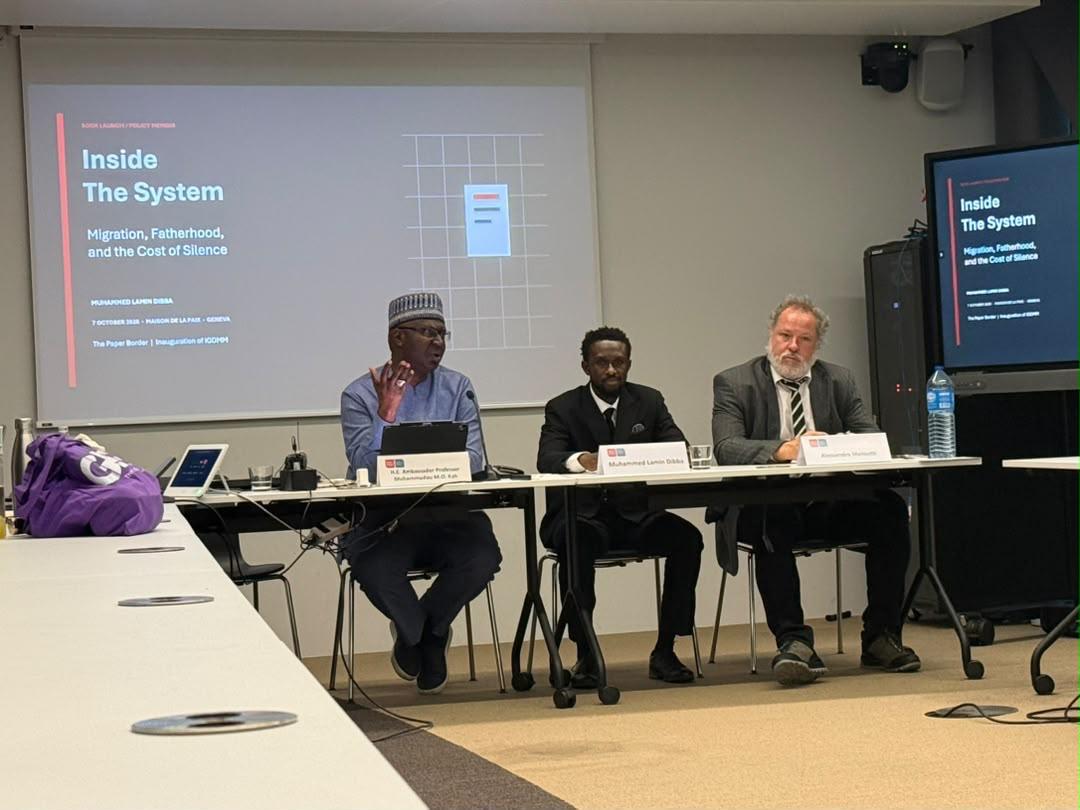
Gambian author and migration specialist Muhammed Lamin Dibba has launched his policy memoir, Inside the System: Migration, Fatherhood, and the Cost of Silence, at the Geneva Graduate Institute.
The launch, held on Wednesday, was co-organized by the Permanent Mission of The Gambia to Switzerland, the United Nations, the World Trade Organization and other international organizations in Geneva, together with the Global Migration Center of the Geneva Graduate Institute and the institute’s Afrique Student Association. Hosted under the theme “Bridging the Gap,” the evening brought diplomats, academics, and members of the Gambian diaspora together to examine migration governance, administrative systems, and family life within European migration frameworks.
Dibba, founder of the Institute for Governance, Development, Migration and Mobility (IGDMM) and a graduate of the Graduate Institute of International and Development Studies, described the book as both a personal account and a policy argument. “I am not here simply to launch a book. I am here to open a conversation about that silence,” he told guests. “What happens when you are still physically present, but slowly become invisible inside the system?”
The memoir draws on his experience as a father and international development practitioner navigating Swiss administrative processes after arriving in Geneva in 2022 to study mobility, migration and boundaries. “Inside The System is deeply personal,” he said. “It is a story about migration, but it is also a story about fatherhood. It is a story about bureaucracy, but also about dignity.”
At the center of the argument is what Dibba calls administrative silence: the period in which a file is being processed, no clear answer is given, and waiting itself begins to shape a life. He distinguished institutional time from human time. “For an institution, a delay can appear as a processing issue,” he said. “For the person waiting, those same days affect employment, income, family planning, psychological stability and the ability to make decisions about the future.”
He argued that such delays rarely remain administrative. “It can become an employment problem. It can become a financial problem. It can become a family problem. And eventually, it can become a governance problem.” The book traces that chain through residence status that can outweigh qualifications, the translation of everyday fatherhood into institutional evidence, a prolonged administrative gap, and the rebuilding of agency through work.
Dibba said the larger purpose is to connect lived experience with the design of migration systems. “Policymakers should not design migration systems without listening to the people who live inside them,” he said. The monograph combines critical auto-ethnography and socio-legal analysis to examine procedural timeliness, administrative governance and fatherhood. It closes with practical questions on provisional work documentation, coordination between authorities, and clearer information for applicants.
Professor Alessandro Monsutti of the Geneva Graduate Institute delivered the welcoming remarks. Ambassador Professor Muhammadou M.O. Kah, The Gambia’s ambassador to Switzerland and to international organizations in Geneva, delivered an official address. Other diplomats, academics and diaspora guests attended in person and online.