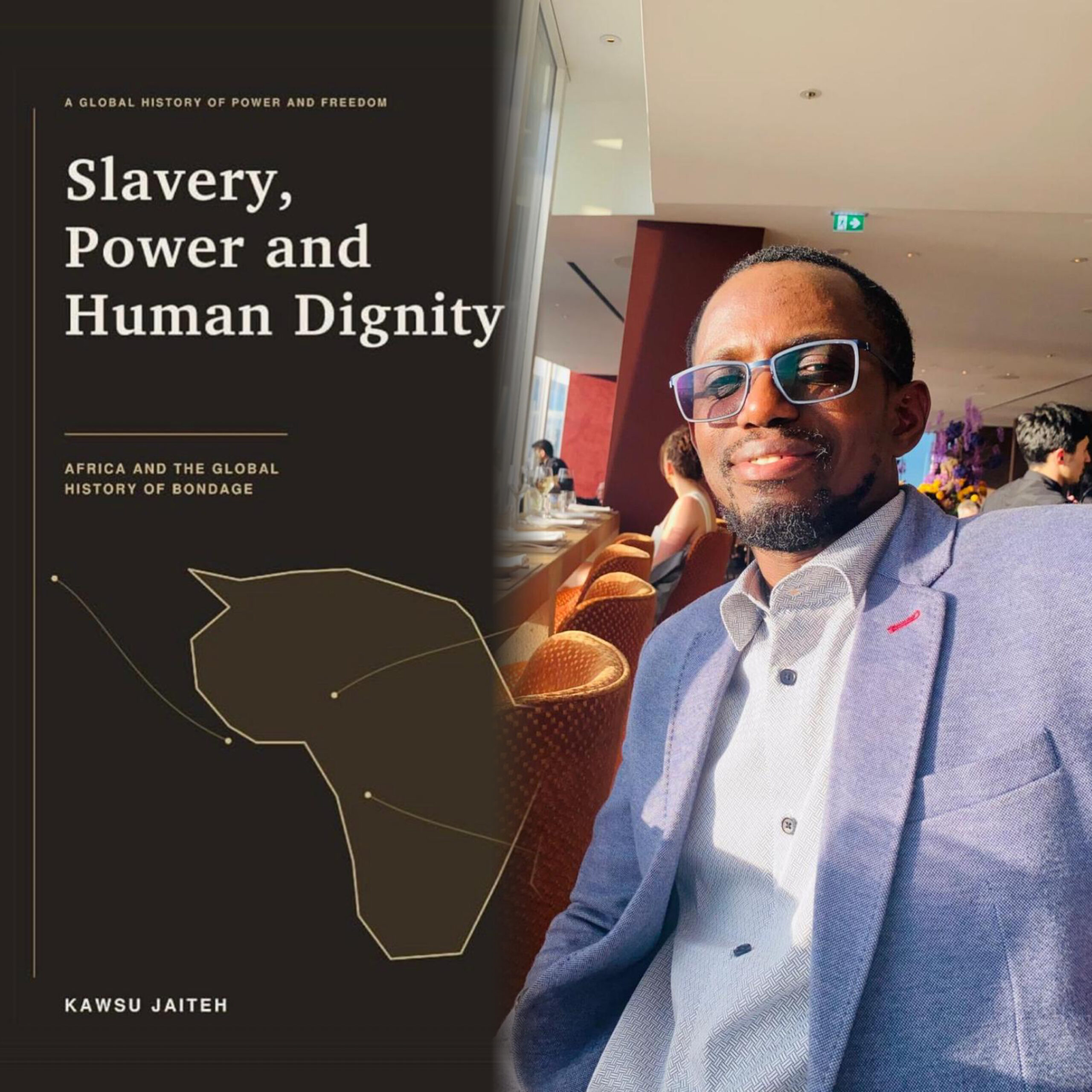
By: Kebba Ansu Manneh
UK-based Gambian author Kawsu Jaiteh has published a new book that challenges long-standing narratives about Africa’s past and humanity’s ongoing responsibility to confront systems of exploitation. Slavery, Power and Human Dignity: Africa and the Global History of Bondage argues that slavery did not originate with the arrival of European ships on African shores, and that legal abolition, while transformative, did not end the struggle against human exploitation.
In an exclusive interview, Jaiteh described the work as an examination of one of history’s most disturbing questions: how societies came to accept that one person could possess the power to own another. He stressed that the answer reaches far beyond the Atlantic trade, any single civilization, religion, or empire, and into the deeper interplay of power, economic interests, human behavior, and moral responsibility.
“For centuries, human beings were captured, bought, sold, transported, inherited and forced to labour under systems that treated their lives as instruments of power and profit,” Jaiteh said. “But behind every historical statistic was a human being. Someone’s mother. Someone’s father. Someone’s child. A person with a name, a family, a language, a home, and dreams for the future. This is the history we must understand—not simply because of what happened to our ancestors, but because of what it teaches us about ourselves.”
A core message of the book is that African history did not begin with enslavement. Long before the Atlantic slave trade expanded, the continent was home to powerful kingdoms, established trading networks, centers of scholarship, complex political institutions, and major cultural achievements. The empires of Ghana, Mali, and Songhai formed part of a broader history of commerce, governance, intellectual life, and international connections. While forms of slavery existed in some African societies—as they did elsewhere in the world—Jaiteh maintains that Africa’s history cannot be reduced to slavery alone.
He argues that understanding the societies that preceded the major external trades, how those trades transformed them, and how African communities responded is essential to avoid an incomplete inheritance of the past.
The book resonates particularly with The Gambia. The River Gambia served as an important commercial corridor linking inland communities with the Atlantic coast; over time, existing trade networks became connected to the commerce in enslaved people. Sites such as Juffureh and Kunta Kinteh Island remain among the most recognizable locations associated with that history. For millions familiar with Alex Haley’s Roots, the name Kunta Kinte has come to symbolize families torn apart by slavery and the determination to preserve identity across generations.
Jaiteh cautioned, however, that historical memory and documentary evidence must be carefully distinguished: the cultural significance of the Kunta Kinte story does not independently establish every biographical detail. “Our history deserves more than emotional storytelling,” he said. “It deserves careful investigation.”
Estimates cited in the book indicate that approximately 12.5 million enslaved Africans embarked on transatlantic ships between 1501 and 1866, with roughly 10.7 million disembarking alive. These figures convey the scale of the tragedy but cannot capture every family destroyed, community disrupted, or individual life altered. Jaiteh notes that the history of the River Gambia is also part of the wider Atlantic world, linking African waterways and coastlines to plantations and societies thousands of miles away.
Another central argument is that the history of slavery must be examined honestly, even when evidence challenges familiar narratives. European merchants, investors, plantation owners, and colonial authorities played major roles in organizing and profiting from the Atlantic system. African rulers, merchants, and intermediaries also participated in the capture, exchange, and sale of enslaved people. Separate systems of enslavement operated across the Sahara, the Red Sea, the Swahili Coast, and the Indian Ocean, connecting African communities with North Africa, the Middle East, and other regions. These systems differed in scale, organization, legal structures, labor arrangements, and consequences. Religious authorities and institutions sometimes accommodated or justified slavery, yet religious arguments and movements also contributed to opposition and abolition.
Jaiteh explained that the purpose is not to declare one civilization uniquely guilty or another entirely innocent, but to understand how political authority, economic interests, established beliefs, and social customs could make the domination of human beings seem normal. The abolition of slavery represented a monumental legal and moral transformation, gradually rejecting the idea that one human being could legitimately own another. Yet legal freedom did not automatically guarantee economic independence, political equality, or protection from coercion. During colonial rule, some administrations condemned older slave systems while imposing compulsory labor, taxation pressures, and other forms of control. Government language changed, but power could still deny individuals meaningful freedom.
The book follows these threads into modern Africa, examining how slavery and colonialism affected institutions, economies, social relationships, and political development.
Jaiteh argues that these legacies merit serious investigation but must not become an explanation for every contemporary African problem or an excuse to overlook the responsibilities of present institutions and leaders.
Kawsu Jaiteh, a Gambian author resident in the United Kingdom, focuses in his work on the relationship between history, power, human behavior, freedom, and moral responsibility. He encourages readers to approach difficult historical questions through evidence, critical thinking, and respect for human dignity.