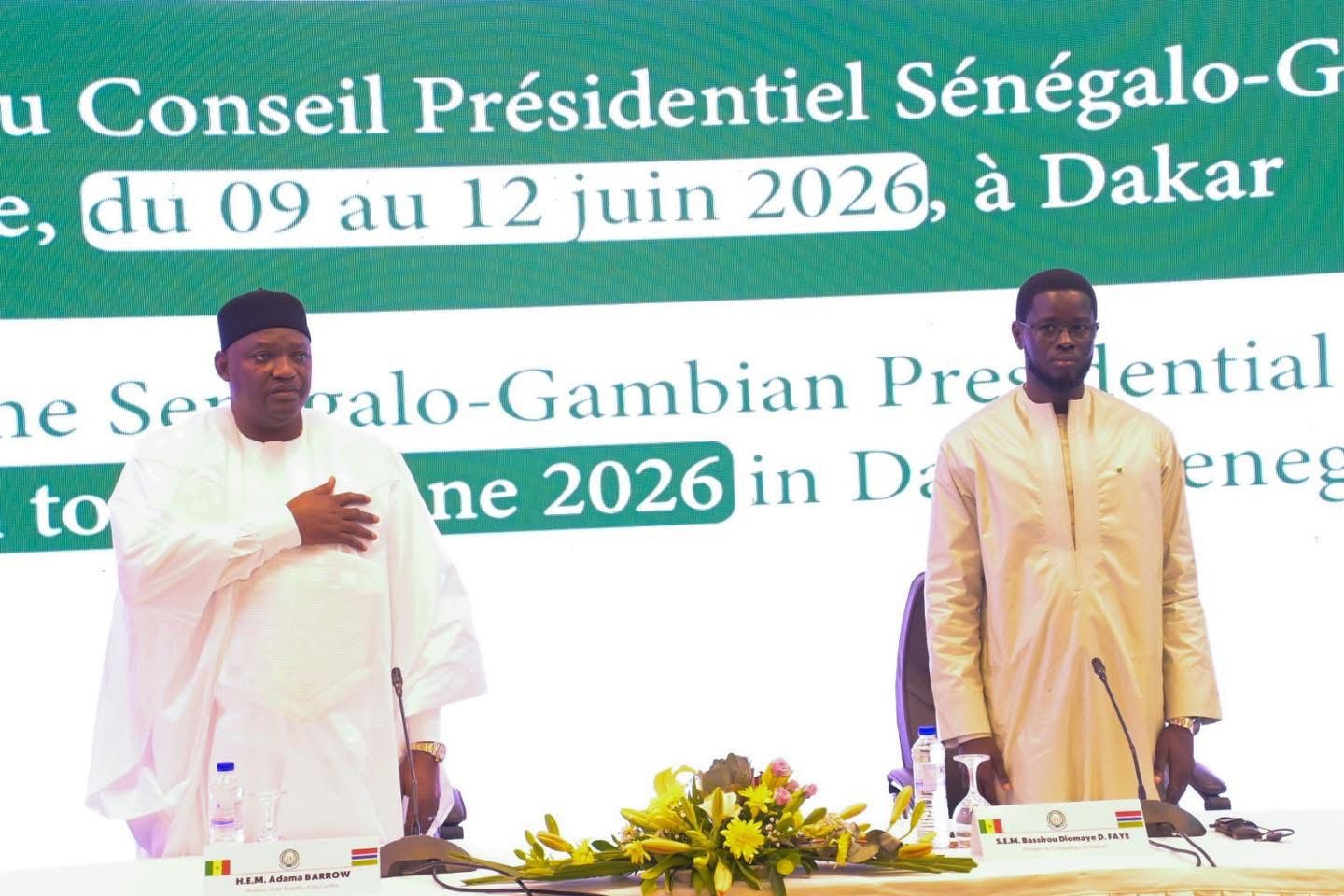
President Adama Barrow of The Gambia on Friday co-chaired the Fourth Session of the Senegalo-Gambia Presidential Council with his Senegalese counterpart, President Bassirou Diomaye Faye, reaffirming the two nations’ historic bonds and pledging intensified cooperation to tackle shared challenges and unlock economic opportunities for their citizens.
Speaking at the high-level summit in Dakar, President Barrow described the gathering as a vital platform for advancing bilateral ties that transcend formal borders.
“Although The Gambia and Senegal are two political states, the people share a common heritage, a common history, and one destiny,” he declared. “We are interrelated by blood, culture, religion, language, commerce, and centuries of peaceful coexistence.”
The Gambian leader used the occasion to express deep gratitude to the Senegalese government and people for their warm hospitality. He praised President Faye’s personal commitment to strengthening relations and commended ministers and experts from both countries for laying the groundwork for productive discussions.
Established in 2018, the Senegalo-Gambia Presidential Council serves as the apex decision-making body for renewed bilateral cooperation. It has become a strategic mechanism for implementing agreements, building mutual trust, and improving livelihoods in both nations.
President Barrow highlighted tangible achievements that have emerged from the partnership. The Senegambia Bridge stands out as a landmark symbol of integration, transforming transportation, boosting trade, and enhancing social and economic links between communities on both sides of the border.
He also pointed to successful collaborations between the Gambia Transport Service Company (GTSC) and Senegal’s Dakar Dem Dikk, as well as progress in air transport arrangements between Banjul and Dakar.
“These achievements reflect the true spirit of Senegalo-Gambia relations, ECOWAS integration, and African solidarity,” Barrow said.
The summit takes place amid growing transnational threats, including terrorism, irregular migration, food insecurity, climate change, trafficking, cybercrime, and economic shocks. Barrow stressed that such challenges require stronger bilateral and regional solidarity. “Our Senegambian ties, therefore, remain absolutely relevant and indispensable,” he noted.
Looking ahead, the two leaders are expected to focus on expanding cooperation across priority sectors, including defense and security, trade and investment, agriculture, fisheries, energy, transportation, tourism, education, health, youth and sports, culture, environmental protection, digital transformation, and border management.
President Barrow called for greater infrastructure connectivity, including improved road networks, maritime and river transport, and potential future rail links. He emphasized the importance of encouraging private sector participation and people-to-people exchanges as drivers of sustainable development.
Peace and security featured prominently in his remarks. He applauded the ongoing collaboration between the defense and security institutions of both countries to address cross-border threats, describing it as a model for regional partnership.
He also urged the removal of remaining trade bottlenecks and administrative barriers to facilitate smoother movement of goods and people.
The Gambian president proposed that pragmatism, solidarity, and a results-oriented approach should guide future efforts. “Let us ensure that the commitments and resolutions adopted by this Presidential Council translate into tangible outcomes that positively impact the lives of our citizens,” he said.
Barrow further lauded the work of the Senegalo-Gambian Permanent Secretariat, diplomats, and other stakeholders for their tireless efforts in sustaining the relationship.
In closing, he expressed optimism that the deliberations would yield fruitful outcomes, strengthening cooperation, advancing regional integration, and improving prosperity for both populations. “May the two countries continue to coexist and cooperate as trusted, complementary, and exemplary allies,” he prayed.
The Fourth Senegalo-Gambia Presidential Council Meeting underscores a maturing strategic partnership between the two West African neighbors, whose intertwined geography and shared cultural fabric make collaboration not just beneficial but essential. Observers expect concrete agreements to emerge from the session, potentially accelerating joint projects in infrastructure, security, and economic development.
As Africa continues to grapple with complex regional challenges, the Senegalo-Gambian model of fraternity and practical integration offers a compelling example of what neighboring states can achieve when they prioritize unity and shared prosperity.