By Sainabou Sambou
President Adama Barrow on Saturday underscored the critical role of infrastructure in national progress, declaring that The Gambia cannot achieve meaningful development without solid foundations in roads, utilities and public services.
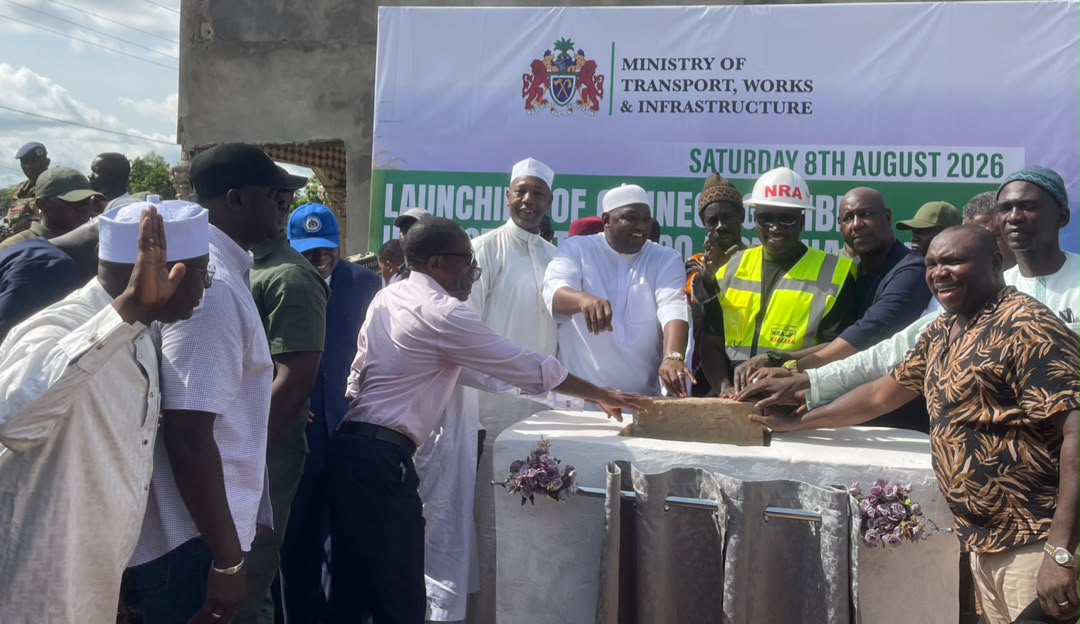
Speaking at the Barra Ferry Terminal during a stone-laying ceremony for a package of new development projects, the President made clear that his administration views infrastructure as the indispensable backbone of economic and social advancement.
Addressing officials, community leaders and residents gathered at the busy terminal that serves as a vital link between the north bank and the rest of the country, President Barrow said successive projects completed by his government and those now being launched form part of a deliberate, long-term development agenda. He emphasised that the focus remains firmly on social infrastructure—roads, electricity, water supply and health facilities—that directly touch the daily lives of ordinary Gambians.
“There can be no development without proper infrastructure,” the President stated, framing the remark as both a diagnosis of past shortcomings and a guiding principle for current policy. He argued that improved road networks in particular deliver multiple dividends: lower transportation costs, reduced travel times, and tangible improvements in living standards. By cutting the wear and tear on vehicles and shortening journeys, good roads also reduce fuel consumption, easing household budgets at a time when the cost of living remains a concern for many families.
Beyond individual savings, President Barrow highlighted the wider economic and security benefits. Reliable roads, he noted, facilitate the smoother movement of goods and people, thereby boosting internal trade and strengthening commercial ties between regions. They also enhance security by enabling faster response times for security services and improving connectivity in areas that have historically been isolated. “If you build the roads, you cut down on your petrol. It cuts down on the costs and also improves the lives of the people. Trade, security, you name it—all are part of the social projects that we are doing,” he told the audience.
The stone-laying event itself marked the formal start of several initiatives intended to modernise facilities around the Barra Ferry Terminal and surrounding communities. While specific project details were not exhaustively listed in the President’s remarks, the ceremony signalled continued investment in an area that has long served as a commercial and transport hub. Local stakeholders present at the event expressed hope that the works would ease congestion, improve passenger experience and stimulate economic activity on the north bank.
President Barrow used the occasion to reaffirm his government’s resolve to maintain momentum. He said the administration remains committed to seeing through its development agenda and implementing projects designed to raise living standards across the country. The emphasis on social infrastructure, he suggested, reflects a recognition that economic growth alone is insufficient if citizens lack access to basic services and reliable transport links.