By Sainabou Sambou
The Central Bank of The Gambia has decided to keep its Monetary Policy Rate unchanged at 14 percent, even as headline inflation rose slightly to 6.3 percent in October 2026.
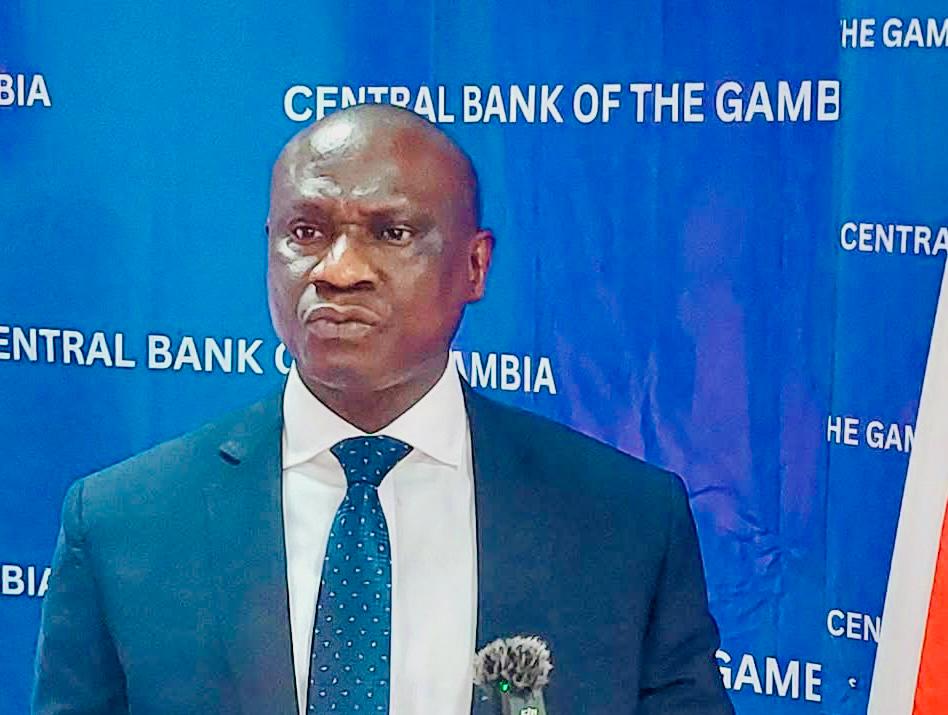
Governor Buah Saidy announced the decision at a press briefing following a two-day meeting of the Monetary Policy Committee held on November 25 and 26. The Committee also maintained the Required Reserve Ratio at 13 percent, the Standing Lending Facility Rate at 15 percent, and the Standing Deposit Facility Rate at 5 percent.
Governor Saidy said the decision reflected developments in both the global and domestic economies, including rising inflation, global economic uncertainty, and rising food and energy prices. Global economic growth is projected to slow to 3.1 percent in 2026 from 3.5 percent in 2025, before recovering to 3.4 percent in 2027.
He noted that ongoing conflicts in the Middle East and disruptions to international trade could raise the cost of food, fuel, and transportation, further pressuring import-dependent economies such as The Gambia.
Domestic economic activity remains strong, with real GDP growth projected at 5.5 percent in 2026. This represents a 0.3 percentage-point downward revision from the August forecast, mainly due to slower domestic demand and reduced private sector activity.
Headline inflation rose to 6.3 percent in October from 6.1 percent in September, ending three consecutive months of decline. Food inflation increased to 5.4 percent, driven largely by higher prices of oils and fats, meat, and fish, while non-food inflation remained steady at 7.6 percent. Although inflation remains well below its 2026 peak of 17.6 percent, the Bank projects it will average 6.4 percent this year before declining toward its medium-term target of 5 percent in 2027.
On the external front, the current account deficit narrowed to US$21.9 million in the third quarter of 2026 from US$23.2 million in the previous quarter, supported by higher inflows of official budget support, remittances, and a gradual recovery in re-export trade. Private remittance inflows reached US$753 million in the first nine months of 2026, up from US$641.2 million in the same period in 2025.
Gross official international reserves stood at US$546.84 million at the end of October, equivalent to 4.2 months of imports of goods and services.
The overall fiscal deficit, including grants, narrowed to D5.2 billion (2.3 percent of GDP) in the first nine months of 2026, compared to D8.1 billion (4.1 percent of GDP) in the same period last year.
The banking industry remained stable, with total assets rising to D137.8 billion in September 2026. However, non-performing loans increased to 9.8 percent in September from 7.8 percent in June, raising concerns.
Governor Saidy warned that the recent rise in headline and core inflation indicates that the path toward lower prices remains fragile. Rising international food and energy prices, climate-related shocks, and continued global supply chain disruptions could place additional pressure on domestic prices. He said the Committee believes monetary policy must remain firm to return inflation to a downward path and move it toward the Bank’s medium-term target.
The Governor reaffirmed the Central Bank’s commitment to price stability and said the Bank will continue to monitor developments in the domestic and international economies closely. The next Monetary Policy Committee meeting is scheduled for February 24, 2027, with the policy decision expected the following day.