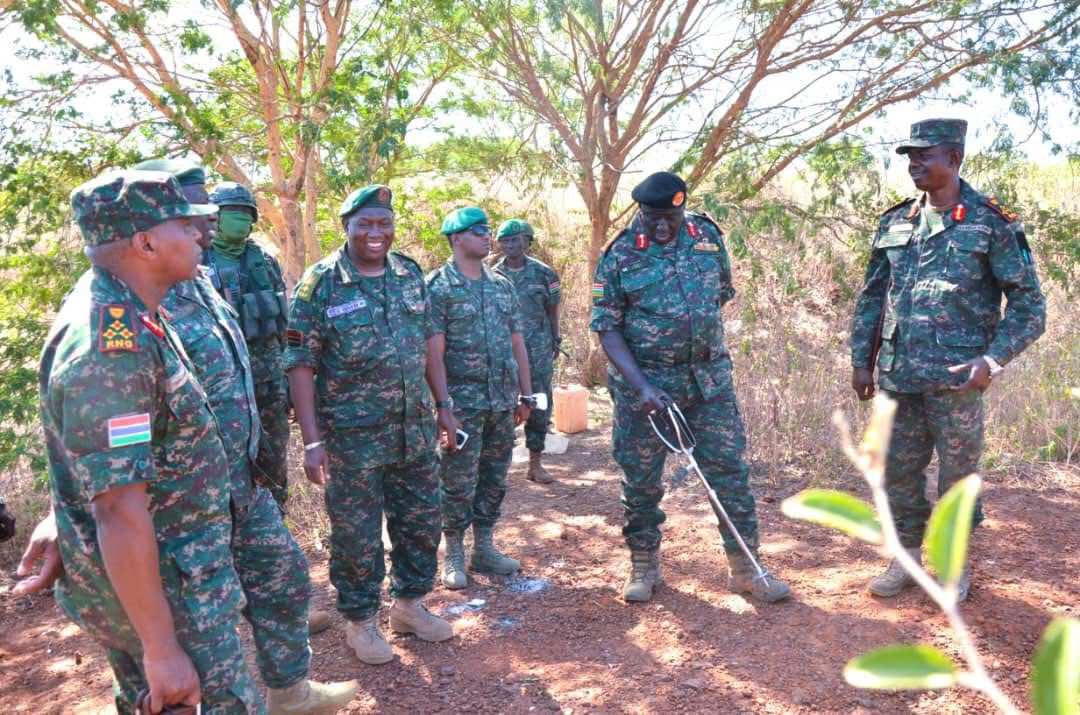
In a stark warning about the evolving dynamics within The Gambia’s security apparatus, a senior officer in the Gambia Armed Forces has raised alarms over what he describes as the “creeping militarization” of internal security forces, including the police.
Speaking exclusively to the Alkamba Times on condition of anonymity due to the sensitive nature of his position and lack of authorization to address the press, the officer cautioned that such trends risk blurring constitutional lines, fostering inter-service rivalry, and undermining the country’s democratic security governance.
The officer’s concerns come amid the government’s ongoing Security Sector Reform agenda, which aims to modernize and harmonize the nation’s defense and law enforcement institutions. However, he argues that recent developments—such as the adoption of military-style ranks, appointments, symbols, and titles by civilian agencies—are driven more by a quest for prestige than operational needs. “This is not modernization,” the officer told Alkamba Times. “It is institutional drift, with potentially serious consequences for democratic security governance, inter-agency harmony, and long-term national stability.”
In his detailed statement shared with our investigative desk, the officer outlined how modern security challenges necessitate cooperation between the Armed Forces and internal security agencies to combat threats like terrorism, organized crime, and hybrid warfare. He emphasized that joint operations and intelligence sharing are essential in democratic states, but warned against conflating this with a convergence of identities or doctrines. “Cooperation must not be conflated with convergence of identity, doctrine, or institutional culture,” he stated. “Each security institution is designed to perform a distinct function within a constitutional and legal framework, and its effectiveness depends on maintaining that distinctiveness.”
At the heart of the issue, according to the officer, are clear constitutional distinctions enshrined in The Gambia’s 1997 Constitution. The Armed Forces are primarily mandated to defend national sovereignty and territorial integrity against external aggression, with a combat-oriented doctrine and hierarchical structure. In contrast, the Gambia Police Force and other internal security services are civilian entities focused on law and order, public safety, and the application of minimum force. “These constitutional provisions deliberately create distinct roles, responsibilities, and institutional cultures,” he explained. “Any attempt to blur these boundaries through structural imitation or symbolic militarisation runs counter to the spirit and letter of the Constitution.”
The officer highlighted several manifestations of this militarization, starting with the proliferation and inflation of ranks in the police and other services, which he sees as mimicking military hierarchies for symbolic parity rather than functional necessity. He drew a sharp contrast between military commissioning processes—where a board selects officers, grants a Presidential Commission, and gazettes them for combat command—and police promotions, which are administrative. For instance, he noted that an Army Lieutenant Colonel commands a battalion of 700 to 900 troops and is accountable for combat operations, whereas a Police Chief Superintendent, often informally equated with, lacks comparable responsibilities. “Equating such ranks ignores the qualitative and quantitative differences in selection, authority, training, and accountability,” he said. “This artificial equivalence diminishes the meaning of military rank, erodes professional boundaries, and risks fostering resentment and misunderstanding between services.”
Another concern is the adoption of military-style appointments, such as Regimental Sergeant Major (RSM), in civilian agencies. The RSM role, intrinsic to military units for enforcing battlefield discipline, is “doctrinally unsound” when transplanted into policing, the officer argued. “Police and other internal security agencies do not operate regimental systems, nor are they structured around combat units requiring battlefield discipline,” he stated. “Introducing military appointments into civilian services risks imposing a command-and-control culture ill-suited to law enforcement, potentially encouraging excessive rigidity and undermining the principles of discretion, proportionality, and civilian oversight.”
Symbolic elements, such as the use of Colours on parade, also drew criticism. In military tradition, Colours symbolize battle honors and sacrifices, reserved for units with combat history. Their adoption by internal security services without similar lineage “constitutes a symbolic overreach that trivialises their historical and emotional significance,” the officer warned, adding that it blurs boundaries and offers no functional value.
Semantic shifts, like referring to Assistant Inspectors General of Police as “Generals,” further exacerbate the issue. A military Brigadier General commands over 3,000 troops with strategic implications, unlike the administrative role of a police equivalent. “This semantic inflation fuels inter-service rivalry, weakens protocol discipline, and risks turning rank into a contest of prestige rather than a reflection of responsibility and function,” he asserted.
The officer outlined why such trends should not be encouraged, pointing to the erosion of institutional identity, where civilian services weaken their own legitimacy by mimicking the military. This breeds inter-service friction, as “artificial parity breeds competition rather than cooperation,” leading services to contest prestige and authority. He also highlighted risks of politicization, where blurred lines in fragile democracies turn institutions into political tools. Operationally, militarized policing can result in excessive force and reduced public trust, as evidenced in comparative studies.
Drawing historical lessons, the officer cited Nigeria’s pre-1999 era, where police militarization under military rule led to abuses and lingering distrust. In Latin America during the 1970s–1980s, similar blurring in countries like Argentina and Chile caused human rights violations and institutional trauma. Conversely, the United Kingdom’s model—close cooperation against terrorism without militarization—preserves distinct cultures and is seen as best practice.
In conclusion, the officer stressed that ranks, symbols, and titles are functional tools, not ornaments. “When internal security services seek to replicate military structures without the corresponding roles, responsibilities, doctrine, or command burdens, the outcome is institutional confusion, erosion of professionalism, damaged morale, and strained inter-service relations,” he said. He called for a recommitment to clear mandates and mutual respect, ensuring the Armed Forces remain military-focused while internal services stay civilian-oriented.
This opinion, presented as that of a concerned citizen, urges stakeholders in The Gambia’s Security Sector Governance ecosystem to scrutinize these trends, especially given high expectations for reforms. As the nation navigates its post-dictatorship era, maintaining distinct institutional roles could be key to sustainable stability. The Alkamba Times reached out to the Ministry of Defense and the Gambia Police Force for comment, but did not receive responses by press time.