By: Fatou Dahaba
Mining remains essential to Africa’s development, but it must not come at the expense of environmental protection or future generations’ interests, the Organization of African Geological Surveys (OAGS) has stressed.
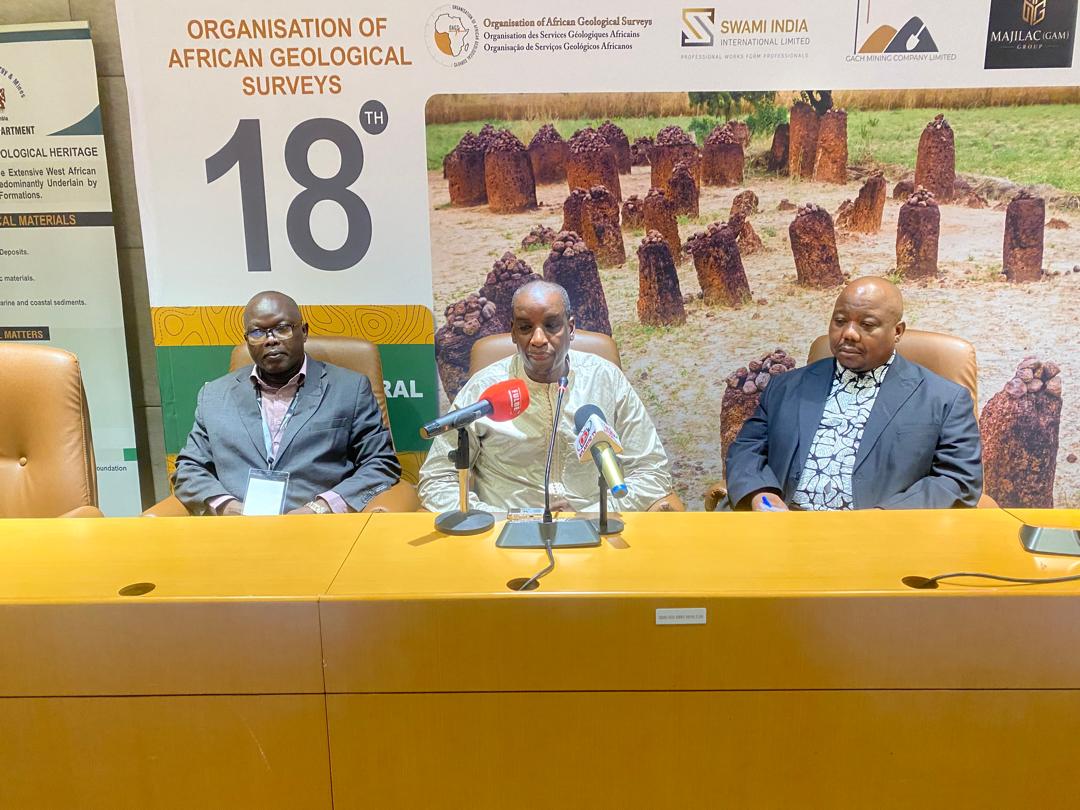
The warning came during a press conference on Tuesday, on the sidelines of OAGS’s 18th Annual General Assembly in The Gambia. Officials used the gathering to outline the growing importance of geoscience in shaping sustainable development, managing natural resources, and informing policy decisions across the continent.
Responding to a journalist’s question on the environmental impact of mining, Gabriel Data, Secretary General of OAGS, said development and conservation should not be treated as opposing goals. “For the longest time, indeed, the focus of nations was on development alone before the notion of sustainable development was introduced,” he said. “Many of the members had the opportunity to develop instruments and tools to balance development and conservation. Those two do not have to be in conflict.”
He emphasized that mining remains central to modern life and economic growth, noting that nearly everything people use comes either from agriculture or from minerals extracted from the ground. “As human beings, we need mining,” Data said. “For communications, for defense, for mobility and everything else that we do, we need mining. But mining, its importance cannot supersede conservation.”
Data added that the role of geoscientists is to provide research and evidence that can help societies pursue both development and environmental protection simultaneously.
According to him, OAGS serves as a vital platform for African countries to learn from one another and share practical approaches to managing mining responsibly while safeguarding ecosystems and communities.
The press conference also highlighted geoscience’s broader contribution to Africa’s future, including climate change adaptation, water security, food security, infrastructure planning, and energy development.
The Secretary General noted that while the continent is richly endowed with minerals, many countries still a not fully understand the extent of their resources. “Africa is endowed with minerals. But Africa does not quite know how many minerals it has,” he said. “It is our duty with our knowledge to characterize the mineral potential of our country, our continent, our region.”
For his part, Alieu Jawo, Director of the Department of Geology in The Gambia, said hosting the General Assembly has significantly raised the profile of the country’s geology and mining sector and opened new opportunities for technical cooperation and investment. “The Gambia is very happy and proud to host the OAGS in this country,” Jawo said. “This event alone has raised the profile of the Geological Department or the geological sector of The Gambia to new levels.”
He explained that The Gambia stands to benefit from data sharing, staff training, and partnerships with other African geological surveys and international institutions. Jawo stressed that no geological survey can work effectively in isolation. “With the cooperation that this OAGS is trying to foster within Africa to mobilize all the geological surveys together to share knowledge, experience, and data, we can develop our mineral sectors,” he said.