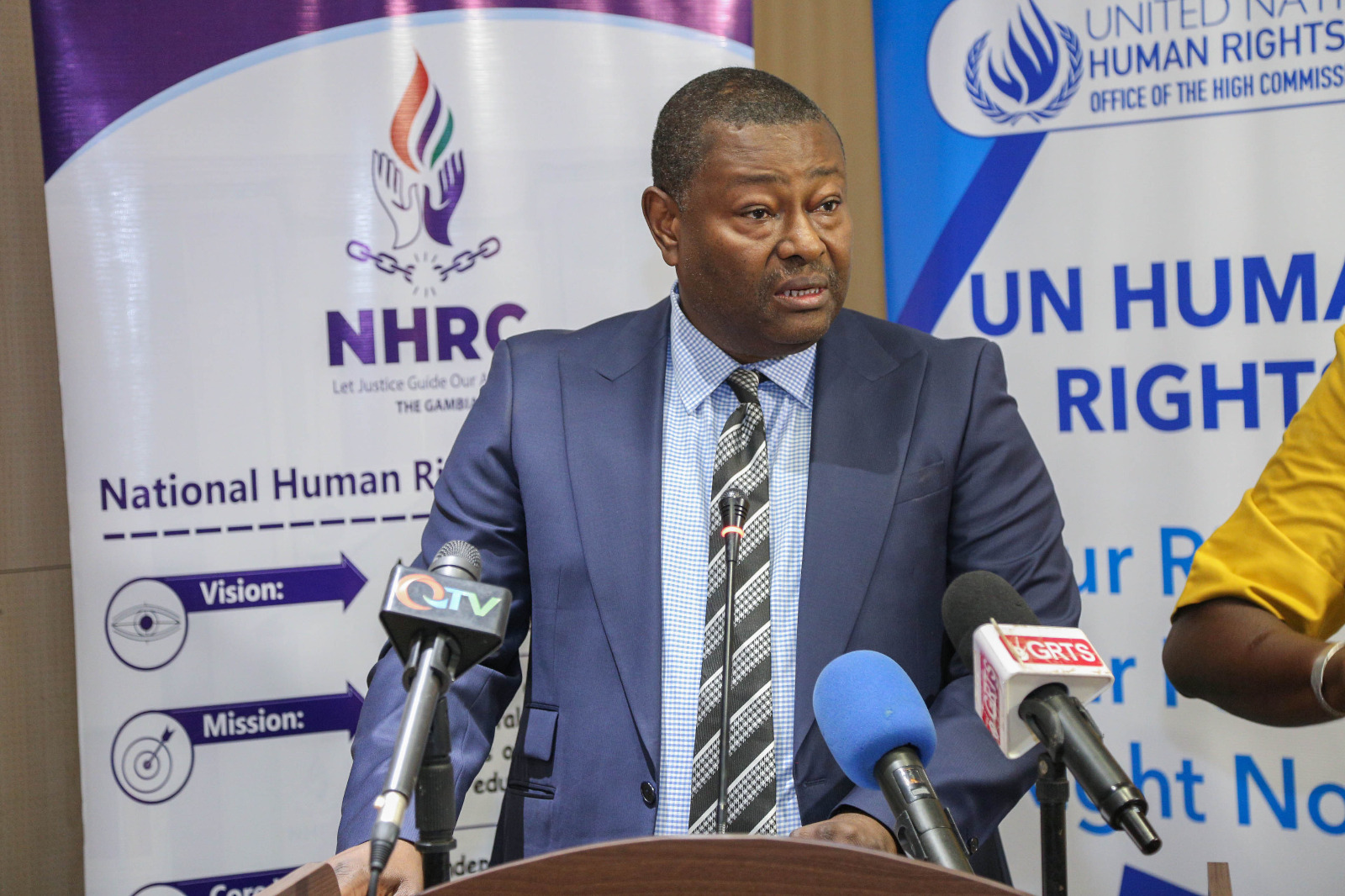
The Chairperson of The Gambia’s National Human Rights Commission (NHRC), Emmanuel Daniel Joof, has issued a measured advisory opinion urging all stakeholders to prioritize the rule of law, institutional independence, and national peace as the country prepares for the presidential election on 5 December 2026.
The statement comes amid intense public discussion over the possible disqualification of Talib Ahmed Bensouda, Mayor of Kanifing Municipal Council, from contesting the presidency.
In the advisory addressed to government officials, the Independent Electoral Commission (IEC), political parties, civil society, faith-based organizations, security services, the media and the Gambian people, Joof stressed that the NHRC is not intervening to take sides or prejudge the matter. Instead, he said the moment requires “wisdom, restraint and a strong sense of collective responsibility” as presidential nominations continue.
The controversy centers on the interpretation and application of section 62(3)(c) of the Constitution in light of findings by the Local Government Commission of Inquiry and the subsequent Government White Paper. Joof noted that a distinction must be drawn between a commission’s finding of liability for misconduct, negligence, corruption or improper behavior and a mere recommendation for further investigation. He also highlighted questions surrounding the legal effect of the White Paper and any appeal lodged against the adverse findings.
While acknowledging that legitimate legal questions exist, Joof stated that the NHRC does not consider it appropriate to pronounce on their merits. He insisted that the IEC must be allowed to exercise its constitutional mandate independently and impartially, and that any substantial ambiguity over constitutional interpretation should, where necessary, be resolved by the courts. Seeking judicial clarification, he argued, demonstrates respect for the Constitution rather than an attempt to frustrate the electoral process. Any decision on a candidate’s eligibility, he added, must be grounded in law, supported by evidence and reached through a fair process.
Beyond the technical legal issues, Joof emphasized the importance of public confidence in institutions. He observed that some Gambians have questioned the timing of the publication and implementation of the Commission of Inquiry’s findings so close to the election, and have raised concerns about perceived inconsistent treatment of individuals mentioned in other inquiries, including cases where pardons or clemency were reportedly granted. Whether or not such perceptions are fully justified, he said, they cannot be dismissed lightly.
Government and public authorities, he stressed, have a responsibility to apply the law consistently, fairly and without favoritism or political considerations. Authorities should avoid creating the impression that constitutional or legal provisions are being selectively applied to prevent an individual from holding public office or exercising fundamental political rights. At the same time, Joof made clear that no one is above the law and that accountability must always be pursued within due process.
The advisory places the current debate in the broader context of The Gambia’s democratic gains. Joof recalled that in December 2016, Gambians peacefully ended 22 years of authoritarian rule under former President Yahya Jammeh, a period marked by widespread human rights violations. That transition earned the country international admiration and restored hope. These gains, he said, belong to all Gambians and must be protected above any political ambition.
Political competition and disagreements over legal interpretation are normal in a democracy, Joof noted, but no political interest should overshadow the collective duty to preserve peace, uphold the rule of law and protect citizens’ rights. He called on political leaders and supporters to show restraint and responsible leadership, respect the rights to peaceful assembly, freedom of expression, and political participation, and refrain from threats, intimidation, or violence. Peace must not be used as an excuse to suppress legitimate rights, nor must exercising democratic rights justify lawlessness.
In specific appeals, Joof urged the government and public officials to exercise authority in the national interest and strictly in accordance with the Constitution. He called on the IEC Chairperson, Commissioners, and staff to discharge their duties independently, transparently, and without fear or favor. Political parties were asked to pursue differences through lawful means, while civil society organizations, including TANGO, and faith-based institutions were encouraged to promote dialogue, tolerance and national cohesion. Security services must act professionally and impartially with due regard for human rights, and the media should inform the public accurately and responsibly, avoiding speculation and inflammatory narratives.
Addressing all Gambians, Joof concluded that elections matter, but democracy is bigger than any single contest. It rests on respect for the rule of law, protection of fundamental rights, independent institutions, accountability, and citizens’ ability to choose freely and peacefully. “The Gambia is bigger than any one of us. Our democracy is bigger than any political party. And our peace is more valuable than any political ambition,” he stated.
He appealed for wisdom, fairness, and restraint so that the forthcoming elections can demonstrate the country’s continued commitment to peaceful, credible, and democratic governance, honoring both current citizens and those who suffered in the struggle for democracy.