By Sainabou Sambou
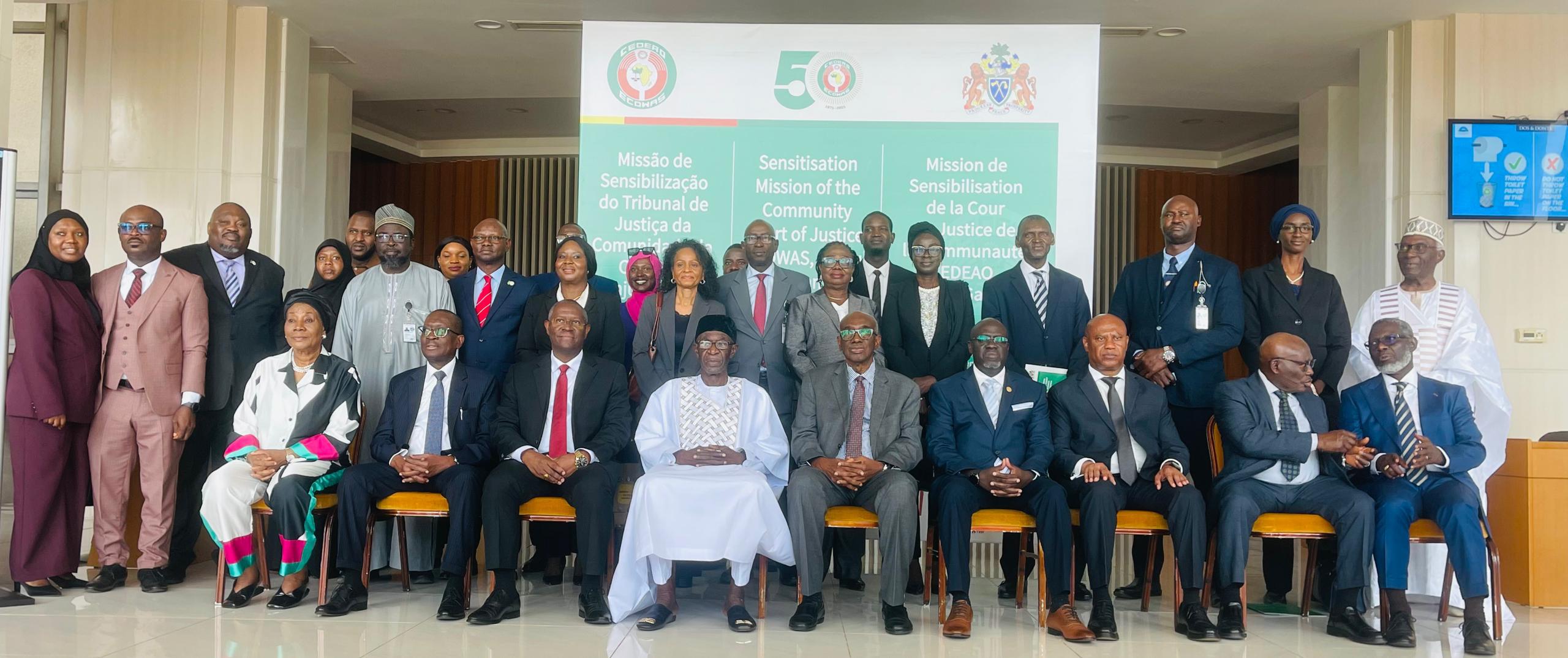
The ECOWAS Community Court of Justice on Wednesday opened a high-level sensitization program in Banjul, calling for greater public awareness, improved compliance with its judgments, and closer cooperation between national courts and the regional judicial body.
The event, held at the Sir Dawda Kairaba International Conference Center in Bijilo, brought together senior government officials, judges, lawyers, civil society organizations, and representatives of the ECOWAS Court.
In his opening address, Justice Ricardo Cláudio Monteiro Gonçalves, President of the ECOWAS Community Court of Justice, said the sensitization mission aims to deepen stakeholders’ understanding of the Court’s mandate, jurisdiction, and procedures across West Africa.
“The Court is the judicial arm of ECOWAS, tasked with interpreting Community law and safeguarding human rights in the region,” Justice Gonçalves explained.
He emphasized that the Court does not act as an appellate body over national judiciaries and does not interfere in domestic court decisions. Instead, it holds Member States accountable under ECOWAS and international law.
He highlighted the Court’s expanded human rights jurisdiction as one of its most significant achievements, describing it as a vital avenue for victims of rights violations who may not find redress at the national level. However, he expressed concern over the limited enforcement of the Court’s judgments by some Member States and low public awareness of its existence and processes.
Justice Gonçalves noted recent progress, including the signing in December 2025 in Abuja of a Supplementary Act by eleven ECOWAS Member States to harmonize key protocols governing the Court. He called for enhanced judicial dialogue, capacity building, and institutional partnerships between the regional Court and national judiciaries.
Representing the Attorney General and Minister of Justice, Solicitor General Hussein Thomas described the sensitization mission as “timely and strategic.” He said it would help bridge the awareness gap, particularly regarding the Court’s human rights mandate, which allows individuals direct access to regional justice.
“The ECOWAS Court complements rather than replaces national judicial systems,” Thomas stated, adding that it plays a crucial role in promoting accountability and the rule of law.
He linked the program to The Gambia’s ongoing justice-sector reforms and transitional justice efforts, reaffirming the government’s commitment to complying with ECOWAS Court decisions.
Minister of Trade, Regional Integration and Employment, Mod. K. Ceesay, described the Court as a key pillar of regional integration that extends beyond justice to support trade, investment, and economic development.
“The Court provides legal certainty and ensures compliance with Community obligations, which are essential for building investor confidence and maintaining regional stability,” Minister Ceesay said.
He stressed the Court’s relevance to frameworks such as the ECOWAS Trade Liberalization Scheme and the African Continental Free Trade Area (AfCFTA), noting that effective dispute-resolution mechanisms are critical to successful economic integration.
Chief Registrar of the ECOWAS Court, Yaouza Ouro-Sama, recalled that ECOWAS was founded in 1975 through the Lagos Treaty to promote regional integration. The Court was established under the revised Treaty and, in 2005, had its jurisdiction expanded to include human rights, administrative disputes, and arbitration, granting individuals direct access against Member States.
He noted that the majority of cases before the Court now concern fundamental rights violations, making it a major human rights institution in West Africa. However, awareness remains a significant challenge, as many citizens are still unaware of how to access the Court.
Ouro-Sama emphasized that national courts and the ECOWAS Court are complementary institutions, with the regional body serving as a supranational avenue when national remedies are exhausted or unavailable.
He called for stronger partnerships with national judiciaries, legal professionals, academia, and civil society to build a cohesive regional legal order.
The sensitization program is expected to continue with further engagements aimed at enhancing access to regional justice and strengthening compliance across ECOWAS Member States.