By Sainabou Sambou
The high-profile murder trial of former “Jungler” Sanna Manjang took a deeply emotional turn at the Banjul High Court on Monday as two prosecution witnesses – a serving soldier and a prison officer – recounted harrowing accounts of alleged torture and death threats linked to the brutal crackdown following the failed March 2006 coup attempt in The Gambia.
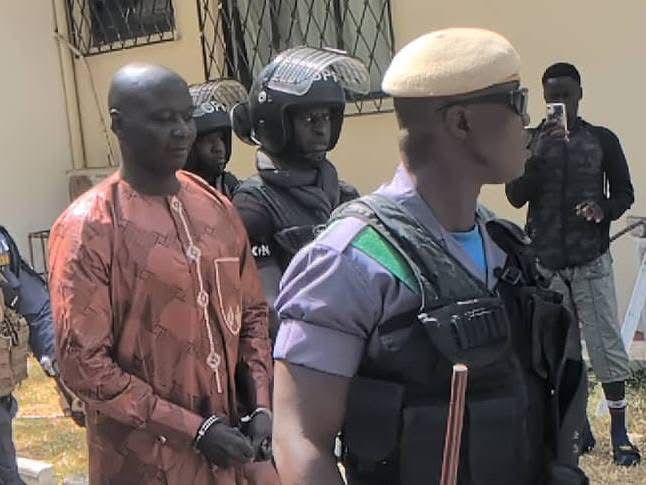
Presided over by Justice Sidi K. Jobarteh, the proceedings saw Deputy Director of Public Prosecutions E.R. Dugan leading the state’s case, while defense counsel Sheriff K. Jobe represented the accused. Manjang, a former member of the notorious Junglers unit, faces charges connected to the death and alleged mistreatment of individuals during the post-coup investigations under the Yahya Jammeh regime.
The fourth prosecution witness, Yaya M.S. Darboe, who served the Gambia Armed Forces for 31 years, delivered one of the most gripping testimonies of the day. Darboe told the court he had known Sanna Manjang since 2002, when both men attended the same military training course. His arrest came shortly after the failed coup, which prosecutors say was led by then-Army Commander Colonel Ndure Cham.
According to Darboe, armed men dressed in black stormed his home in Brusubi. He identified the group’s members as Sanna Manjang, Bora Colley, Tumbul Tamba, Malick Jatta, Michael Correa, Nuha Badjie, and others. The men, he said, immediately began issuing chilling threats.
“They told me, ‘Small boy like you, you came to the Army just yesterday, and you want to become President. We will kill you and fuck your wives,’” Darboe recounted, his voice steady but heavy with the weight of memory.
The witness described being beaten by the group before Bora Colley intervened. He was subsequently transferred to the National Intelligence Agency (NIA) headquarters, where he endured what he called severe interrogation sessions. Handcuffed and beaten repeatedly with sticks and palm leaves, Darboe said he was questioned intensely about alleged sponsors of the coup.
He alleged that Musa Jammeh gave instructions not to leave visible marks on his body because he was due to appear on national television the following day. Despite those orders, Darboe claimed the torture caused permanent injuries, including the total loss of sight in one eye.
In the most dramatic moment of his testimony, Darboe recalled a direct encounter with Sanna Manjang during another torture session.
“Today we will kill you and bury you here, and nothing will come out of it,” Manjang allegedly told him.
Darboe said he was then beaten while a cement block was placed on his head and a plastic bag was pulled over his face. The men, he testified, laughed as they photographed the ordeal. He received no medical treatment for his injuries.
Defense counsel Sheriff K. Jobe subjected Darboe to a rigorous cross-examination, challenging his credibility. Jobe reminded the court that Darboe had previously been convicted of treason in connection with the 2006 coup, sentenced to life imprisonment, and later pardoned and reinstated into the army.
Jobe further argued that Sanna Manjang could not have been involved, stating that Manjang was posted to Kanilai on border patrol duties at the time and played no role in coup-related investigations. Darboe firmly rejected the suggestion.
“Sanna Manjang was always part of the people who tortured me,” he insisted, adding that while he could not confirm Manjang’s exact official posting, his memory of the man’s presence during the abuse remained clear.
The witness confirmed he had never testified before the Truth, Reconciliation and Reparations Commission (TRRC), though three human rights bodies in Senegal had approached him. He agreed to produce copies of his earlier court judgment and related documents for the next hearing.
The court then heard from the fifth prosecution witness, Chief Prison Officer Lamin Fadera, who served at Mile 2 Prison’s Security Wing Number Five from 2005 to 2011. Fadera, a newly trained officer in 2006, described how detainees linked to the coup probe were brought to the wing.
He recounted multiple late-night visits by armed men in black who demanded access to specific inmates. On one occasion between midnight and 1 a.m., Fadera said he initially refused to open the gate because he could not identify the visitors or see their faces.
After persistent knocking, he opened a viewing window and recognized Bora Colley. His senior officer then ordered him to comply. One of the men handed Fadera a written list of names, including Mr. Faal, Pierre Mendy, Yaya M.S. Darboe, and Faring Sanyang.
“I took the list and opened the cells and brought them out and handed them over to the men in black as I was instructed,” Fadera testified.
The detainees were returned around 4 a.m. with visible injuries. Several requested medical attention. Fadera said he contacted the prison doctor, but the doctor was reportedly unavailable. The late-night removals, he added, occurred on several occasions. Upon return, the only medication provided was Paracetamol.
Under cross-examination, defense lawyer Jobe pressed Fadera on his duty to protect prisoners. The witness acknowledged his responsibility for their safety and welfare, but said he “didn’t have the power to stop them,” and that he acted under his superiors’ orders and out of fear.
Fadera denied any personal involvement in torture. He stood by his account that detainees, including Bunja Darboe, who suffered a broken arm, were injured, contradicting defense suggestions to the contrary.
A tense exchange developed over the missing list of detainees, which Fadera said had been kept by the late Chief Jammeh. Jobe suggested the witness was unfairly implicating a deceased officer who could not defend himself. Fadera rejected any claim of misleading the court.
Like Darboe, Fadera confirmed that he had not testified before the TRRC and that he had only been contacted recently to give his account.
The testimonies painted a vivid picture of the climate of fear and impunity that allegedly prevailed in Gambian detention facilities in the aftermath of the 2006 coup attempt. Both witnesses described systemic abuse carried out by masked operatives operating with apparent official sanction.
The case was adjourned to Tuesday, 19th May 2026, at 11 a.m., when further witnesses are expected to take the stand.