The Gambia experienced a severe nationwide internet outage on Thursday, with connectivity collapsing across much of the country around midday, leaving thousands of citizens, businesses, and institutions cut off from online services.
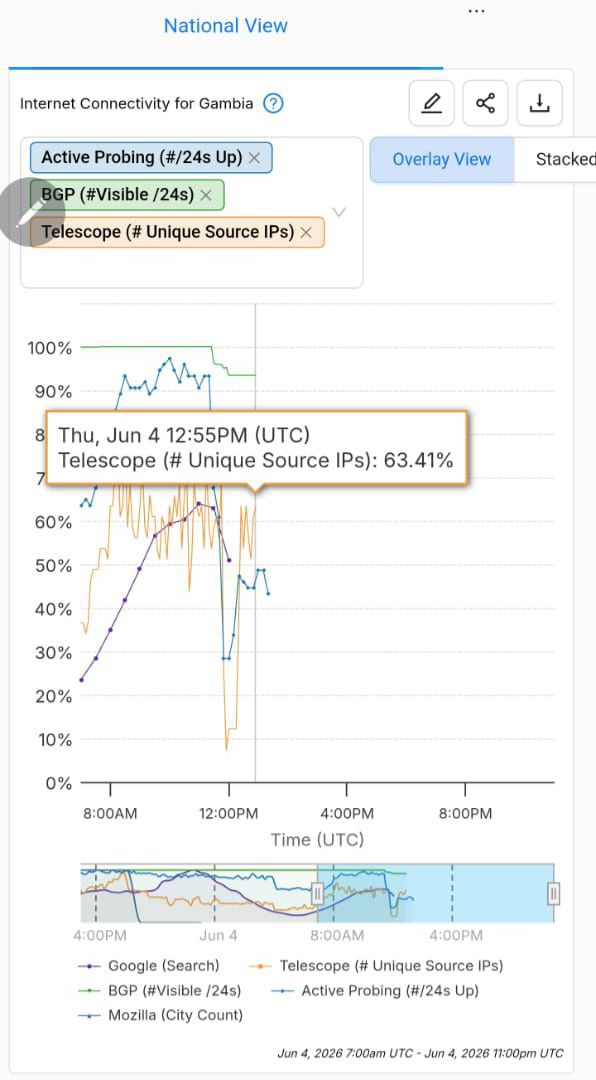
Independent monitoring data from the Internet Outage Detection and Analysis (IODA) platform, operated by the Georgia Institute of Technology, confirmed the disruption in real time. IODA tracks internet health through three key metrics: BGP routing visibility, Active Probing of responsive addresses, and Telescope data on visible device IPs. All three signals remained stable through the morning but dropped sharply between 11:30 a.m. and noon UTC.
Active Probing plummeted from approximately 92% to 29%, while Telescope readings — reflecting connected devices — crashed from 65% to as low as 8%. BGP visibility fell from 100% to 93%, indicating that several Gambian network prefixes became unreachable from the global internet. Partial recovery was noted by 12:55 p.m. UTC, but Telescope levels remained at just 63.41%, suggesting widespread ongoing disruption well into the afternoon.
On-the-ground reports painted a fragmented picture of the impact. Users of Africell and Commium mobile networks reported near-total loss of data services, while multiple WiFi providers across the country also went offline, affecting homes, offices, schools, and commercial operations.
In contrast, Qcell subscribers largely maintained connectivity, apparently benefiting from an alternative routing path through Senegal’s Sonatel operator. This disparity points strongly to a failure in primary international links serving other Gambian telecom providers.
Although the precise trigger remains unconfirmed, many observers are linking the outage to the country’s chronic electricity shortages. The National Water and Electricity Company (NAWEC) has been struggling with severe load shedding, with some areas experiencing 12 to 20 hours of blackouts daily. Telecom infrastructure is highly vulnerable to such instability.
Mobile base stations rely on backup batteries and generators that often fail during prolonged outages. Data centers, internet exchange points, and routing equipment similarly require constant power. When the grid collapses — especially during peak daytime demand — cascading failures can knock entire networks offline. Equipment damage from power surges upon restoration further compounds the problem.
This incident highlights the deepening entanglement between Gambia’s fragile power supply and its digital infrastructure. The country depends heavily on the ACE (Africa Coast to Europe) submarine cable, which lands in Banjul and serves as its main international gateway. A 2021 outage was caused when a contractor accidentally severed a backup cable during NAWEC-related works, underscoring the infrastructure overlap.
As of publication, neither GAMTEL, the Public Utilities Regulatory Authority (PURA), nor NAWEC had issued official statements explaining the cause or expected restoration timeline.
The outage arrives amid growing public frustration over deteriorating public utilities. For a nation increasingly reliant on digital services for banking, education, healthcare, and small business operations, such disruptions carry high economic and social costs.