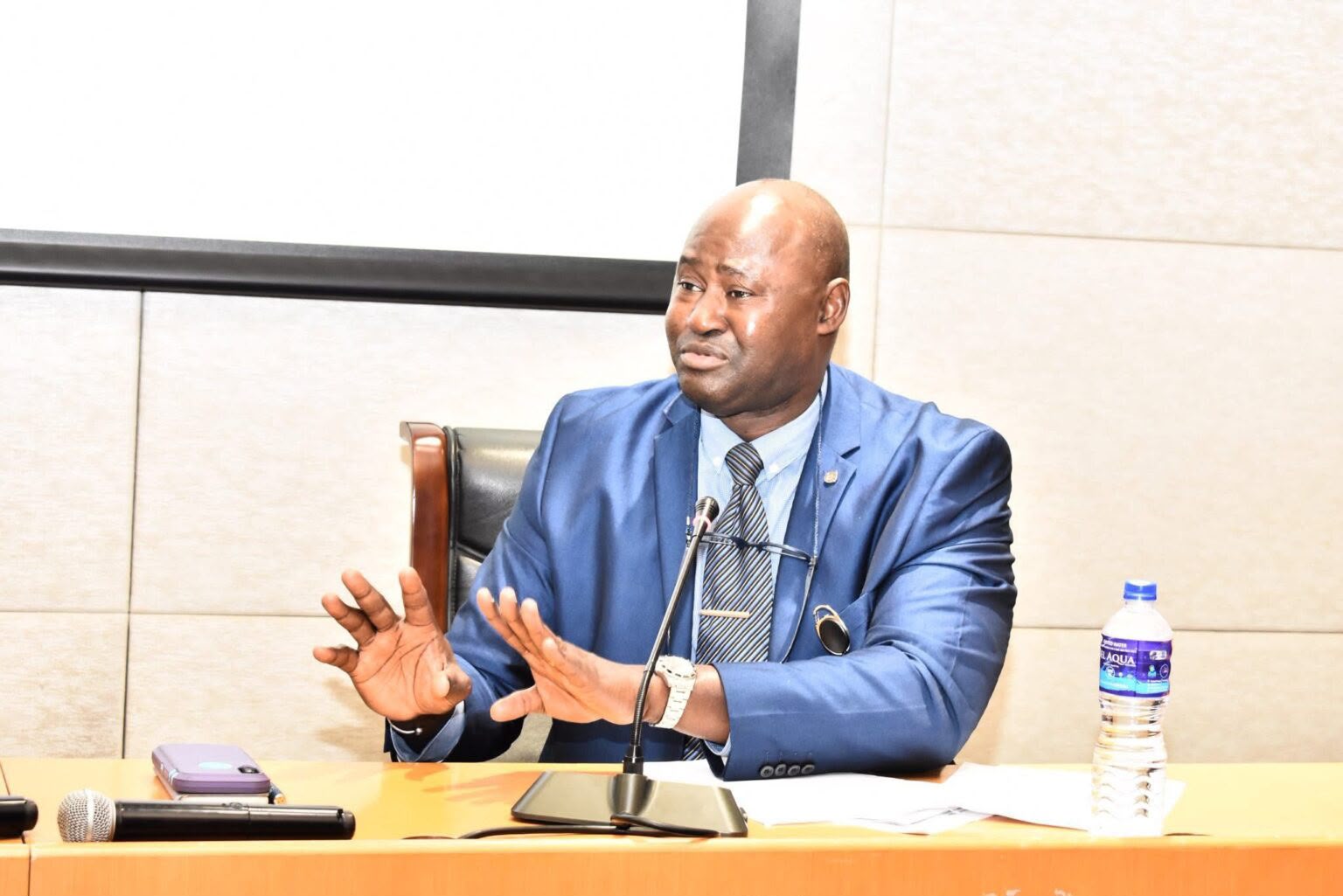
Hon. Justice Ebrima Jaiteh of the High Court of The Gambia has urged the next generation of lawyers to treat the rule of law and constitutionalism as indispensable foundations of justice, democracy, and national development.
Delivering the keynote address as Chief Guest of Honor at the handover ceremony of the Fourth Executive Council of the Law Students’ Association of the International Open University, the judge warned that elaborate laws and constitutions alone cannot secure justice if power remains unconstrained and institutions fail the people.
Addressing students, faculty, outgoing and incoming student leaders and guests on Saturday morning, Justice Jaiteh opened with a central question: what separates a society governed by justice from one governed by fear? He argued that statutes, courthouses, or even a written constitution alone are insufficient. The true test, he said, is whether power is exercised according to law, rights are protected, institutions remain accountable, and justice is accessible regardless of status, wealth, or influence.
“A nation does not become just merely because it has laws,” he told the gathering. “It becomes just when its laws are fair, its institutions are accountable, and its people can seek justice without fear or favor.”
Drawing on the famous dictum of Lord Denning that “Be you ever so high, the law is above you,” Justice Jaiteh stressed that no president, minister, judge, or public official stands above the Constitution. He distinguished the rule of law from mere “rule by law,” noting that governments can deploy statutes as instruments of control while ignoring constitutional limits and fundamental rights. True adherence, he insisted, requires legality, fairness, equality, accountability and respect for human dignity.
Turning to constitutionalism, the judge emphasized the distinction between possessing a constitution and practicing constitutional government. He cited Section 1(2) of The Gambia’s 1997 Constitution, which places sovereignty in the people, and Section 4, which affirms constitutional supremacy and voids inconsistent laws. Political authority, he said, is a position of trust that must be exercised within established limits.
“A truly constitutional government cannot do everything it wishes, but one that has the discipline to do only what the Constitution and the law permit,” Justice Jaiteh declared.
He underscored the separation of powers among the Executive, Legislature and Judiciary as an essential safeguard against the concentration of authority. Speaking as a serving High Court judge, he highlighted Section 120(3) of the Constitution, which guarantees the independence of courts and judicial officers. He stressed that judicial independence ultimately belongs to the people, not to judges. It exists so that decisions rest on evidence and law rather than political pressure or personal influence. At the same time, he cautioned that independence must be paired with integrity, competence and public accountability if courts are to retain confidence.
On human rights, Justice Jaiteh pointed to Sections 17, 24 and 33 of the 1997 Constitution, which protect fundamental rights, fair hearing and equality before the law. Quoting Lord Bingham, he noted that “the law must afford adequate protection of fundamental human rights.” The quality of a justice system, he argued, is revealed most clearly when the weak confront the powerful. Justice available only to the privileged, he said, is not justice.
Access to justice formed a major theme. Poverty, illiteracy, distance, cost and delay can prevent ordinary citizens from enforcing their rights even when those rights are formally recognized. Justice Jaiteh called for stronger legal aid, better court administration, greater use of alternative dispute resolution and more efficient proceedings. Members of the legal profession, he added, must avoid unnecessary delays and procedural abuse that erode public trust.
Reflecting on The Gambia’s constitutional journey, the judge observed that democracy and the rule of law require constant vigilance. Strong institutions, he said, outlast powerful individuals. When pursued, constitutional reform must follow prescribed legal procedures and be guided by inclusive dialogue and the public interest. The true test of constitutional fidelity is adherence to principles even when outcomes are personally unwelcome.
Addressing the law students directly, Justice Jaiteh described them as future custodians of justice who may become judges, advocates, prosecutors or public officials. Intellectual honesty, moral courage and professional integrity, he said, matter more than examination results. He urged them to study the Constitution carefully, respect court independence, and never knowingly mislead a court.
To the incoming Executive Council, he offered practical counsel: respect the association’s constitution, exercise authority transparently, remain accountable to members, and protect students’ right to express differing views. He reminded them that leadership is service, not entitlement.
In closing, Justice Jaiteh returned to the ideas of Lord Denning and Lord Bingham: power must be accountable, rights protected, justice accessible and the Constitution supreme. He said these principles underpin peaceful coexistence, responsible government, and economic confidence. He challenged students not merely to know the law but to respect it, defend the Constitution, and stand for justice even when it demands personal sacrifice.
“The Constitution must never become merely a document we celebrate. It must remain a living commitment we honor,” he concluded. “The rule of law must never become merely a principle we recite. It must become a standard by which we govern, judge, practice, and live.”