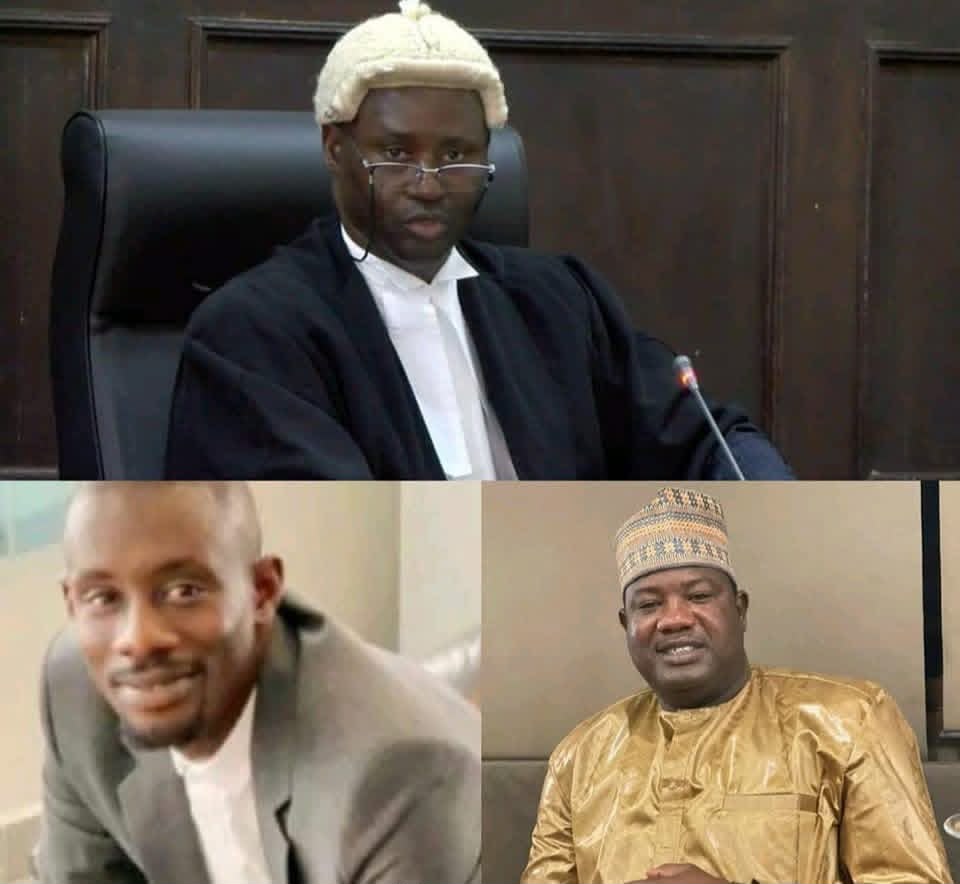
Justice 𝐄𝐛𝐫𝐢𝐦𝐚 Jaiteh of the High Court of The Gambia has granted GACH Global Trading Company Limited permission to tender audio recordings intended to challenge testimony given by Saihou Drammeh, former Managing Director of Gampetroleum, in its civil case against him and Khadijatou Kebbeh.
The high-stakes civil fraud case involving GACH Global Trading Company Limited sought to recover over D58 million allegedly misappropriated in petroleum dealings linked to the Gam Petroleum Storage Facility.
GACH Global, owned by prominent businessman Abubakary Jawara, accuses former employee Khadijatou Kebbeh (first defendant) and Saihou Drammeh, ex-Managing Director of Gam Petroleum (second defendant), of fraudulently handling funds meant for fuel supplies
Justice Ebrima Jaiteh delivered the ruling on November 12, 2026, allowing the company to pursue rebuttal evidence after both sides had closed their cases. However, he stressed that the recordings had not been admitted into evidence and their authenticity, relevance and admissibility remained subject to examination.
The application followed Drammeh’s cross-examination, during which he denied several matters put to him by the company’s lawyer, I. D. Drameh. Counsel argued that the recordings would contradict those answers and demonstrate that he had been untruthful on material issues.
The judge made clear that these allegations had not been established. He said the ruling neither determined that Drammeh had given false evidence nor resolved the merits of the substantive dispute.
Counsel for Kebbeh, L. K. Jallow, did not oppose the application and indicated willingness to receive copies of the recordings.
Drammeh’s lawyer, B. S. M. Conteh, opposed the request, arguing that the parties had filed their court processes, called witnesses and concluded their evidence. He maintained that the company should not be allowed to introduce further evidence after the defense had closed.
Although Conteh said he would accept the recordings if the court directed it, he maintained his objection and urged the judge to refuse permission.
Considering Order XXXV, rules 8 and 9 of the High Court Rules, Justice Jaiteh held that closing the defense case did not create an absolute barrier to receiving rebuttal evidence.
He explained that the rules recognize evidence in reply but leave its reception subject to judicial permission and ordinary evidential requirements. The court must distinguish genuine rebuttal from an attempt to strengthen an inadequately presented original case.
The judge therefore restricted the proposed recordings to material matters arising from Drammeh’s testimony, particularly specific denials during cross-examination. GACH cannot use the permission to introduce a new case, fill gaps in its original evidence or contradict answers concerning purely collateral matters.
To protect the defendants’ rights, the court ordered the company to provide both defense lawyers with complete, intelligible recordings in an accessible electronic format sufficiently before the next hearing.
An identical copy must be submitted to the Registrar, accompanied by a brief schedule identifying the portions relied upon and the testimony they are intended to rebut. Filing the recordings will not itself make them evidence.
At the next hearing, GACH must establish the necessary foundation through a competent witness. This includes demonstrating the recordings’ relevance and authenticity under the Evidence Act, 1994, and other applicable law.
Where conversations are in a language other than English, an appropriate English transcription or translation must be provided, subject to verification and defense objections.
The defendants retain the right to challenge the recordings’ accuracy, completeness, authenticity, relevance, and admissibility before any admission as exhibits.
If admitted, the defense may cross-examine the witness presenting them. The court may also permit Drammeh to be recalled or allow evidence strictly responding to the recordings where justice requires.
Justice Jaiteh said fairness could be preserved through advance disclosure, limited rebuttal and opportunities to challenge the material. He emphasized that procedural rules should support the fair determination of disputed issues while protecting parties against unfair surprise.
The matter was adjourned to the next scheduled hearing for the proposed recordings to be tendered, subject to compliance with the orders and determination of objections. The ruling did not specify a hearing date or decide liability in the underlying civil action between the named parties.