By: Abdoulie John
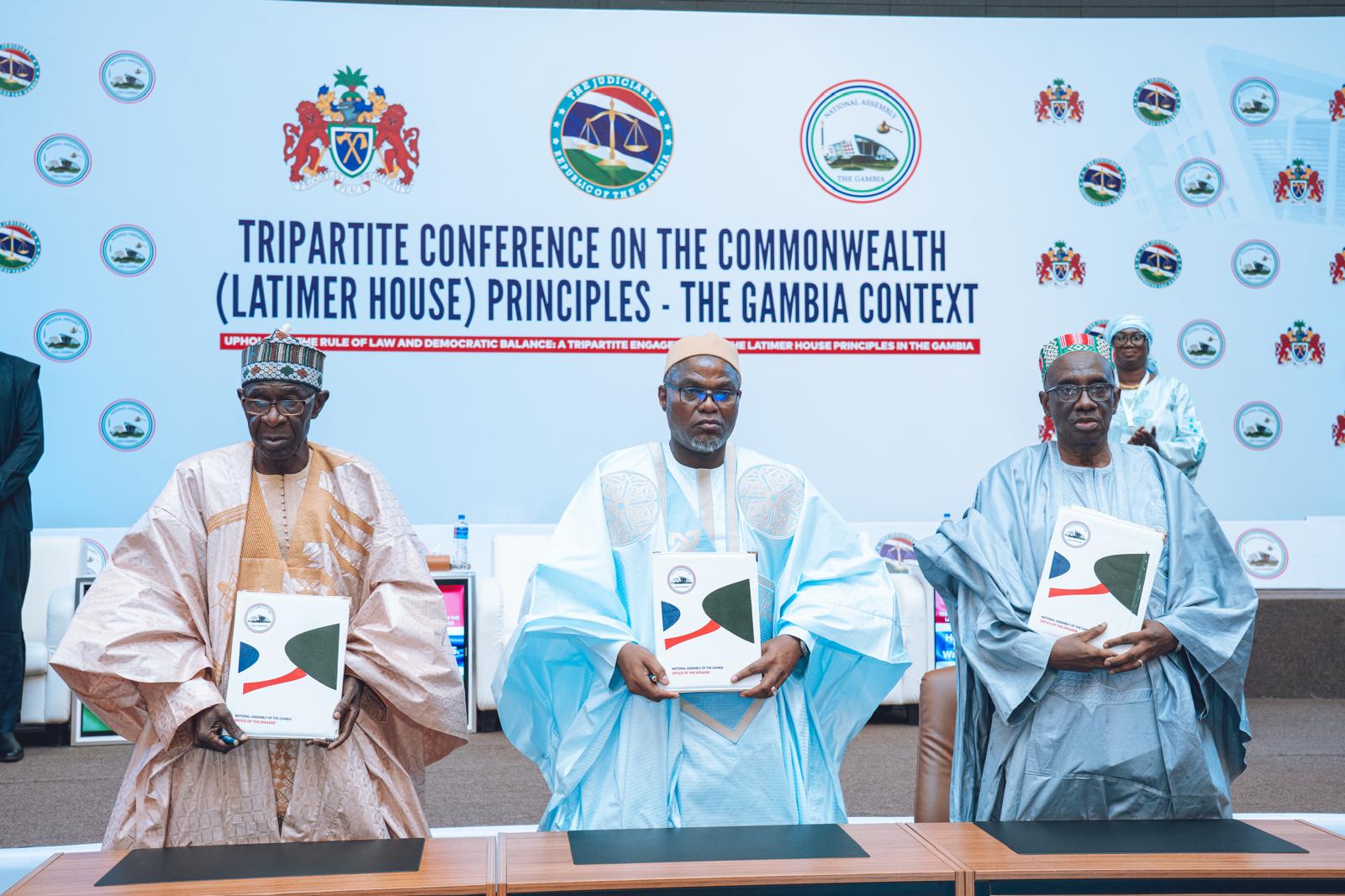
The first-ever tripartite conference of The Gambia’s executive, legislature and judiciary closed Friday with a firm renewed commitment to the Commonwealth Latimer House Principles, signaling stronger cooperation among the three organs of government.
Vice-President Muhammad B.S. Jallow told participants the three-day gathering left him with “a deep sense of accomplishment.” He said the deliberations had deepened understanding of the Latimer House Principles and “reignited” commitment to democracy and the rule of law.
“This gathering has been a solemn reminder that democracy is sustained not by words alone, but by the actions of institutions and the integrity of those who serve within them,” Jallow declared.
National Assembly Speaker Fabakary Tombong Jatta stressed that separation of powers must never become a source of conflict. “It is not a recipe for institutional conflict but a blueprint for institutional harmony,” he said. The Assembly, he added, must exercise its mandate “not as an instrument of obstruction but as a constructive catalyst for national progress.”
Outgoing Chief Justice Hassan Bubacarr Jallow gave the judiciary’s assurance of full commitment to working “in complete harmony” with the other branches. “The key, of course, is implementation,” he emphasized, calling for regular dialogue and continuous cooperation among the three arms of government.
The conference culminated in the signing of a Memorandum of Understanding and the adoption of a National Action Plan (2026–2029) for implementing the Latimer House Principles. A final communiqué described the meeting as “a historic conference” and “a dedicated high-level tripartite platform” that brought leadership from all three organs together with the shared goal of strengthening good governance.
The event took place against the backdrop of The Gambia’s democratic transition that began after the end of a two-decade dictatorship in 2016. Organizers and participants framed the outcomes as practical steps to convert dialogue into institutional practice, ensuring the separation of powers serves national progress rather than rivalry.
Officials said the MoU and action plan will now guide concrete follow-up mechanisms to keep the three organs in regular contact and aligned on the rule of law.