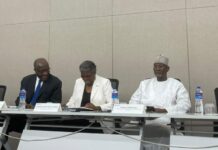
Omar Saine has become the first Gambian-qualified lawyer to secure an exemption from the Solicitors Qualifying Examination 2 (SQE2), marking a landmark step towards qualification as a solicitor of England and Wales and opening a clearer route for other lawyers from The Gambia.
Saine, a Barrister and Solicitor of the Supreme Court of The Gambia, obtained the exemption after an individual application to the Solicitors Regulation Authority (SRA). When he began the process, The Gambia was not among the jurisdictions with an established SQE2 exemption pathway. He therefore had to submit extensive evidence that his legal education, training and practical experience met the competencies assessed by SQE2.
The application was supported by references from senior members of the Gambian legal profession, including Lamin S. Camara of Dandimayo Law Chambers, Lamin Darboe of Emily Joel Chambers, Abdoulie Fatty of Fatty & Co., and Mass Ndow Njie of 7BR Chambers, as well as colleague Baboucarr Badjie.
During its assessment, the SRA contacted the General Legal Council (GLC) of The Gambia for information on the country’s professional qualification, training and admission framework. The GLC’s response enabled the assessment to proceed. After that regulatory exchange, The Gambia was added to the SRA’s jurisdictional framework for SQE exemptions, creating a more defined pathway for other eligible Gambian lawyers.
Saine’s application was granted. The Gambian Bar Association has called the outcome a “monumental achievement,” noting that his success was followed by The Gambia’s inclusion among jurisdictions whose qualified lawyers may seek the relevant exemption.
The development goes beyond one lawyer’s career. It potentially allows Gambian practitioners to pursue solicitor status in England and Wales without repeating competencies they have already demonstrated through training and practice at home. The SRA states that SQE exemptions are available to qualified lawyers whose existing qualifications and professional experience meet its standards. For SQE2, applicants must show relevant practicing rights, sufficient legal experience and the skills the exam assesses.
Saine was admitted as a Barrister and Solicitor of the Supreme Court of The Gambia on 23 November 2020. After moving to the United Kingdom, he continued to build experience in the English legal environment while completing an LLM Law Conversion with SQE1 at BPP University as part of his dual-qualification journey.
Reflecting on the result, he said: “I am extremely grateful that what began as a personal professional objective has developed into something that may also benefit other Gambian lawyers. When I commenced the process, The Gambia did not have the pathway that is available today, so my application required an individual assessment of my qualification and professional experience and ultimately direct engagement between the SRA and our General Legal Council.
“For me, the greatest satisfaction is not simply receiving the exemption, but knowing that the process may have helped make the pathway clearer for Gambian lawyers who come after me. I hope it demonstrates that the training, experience and professional competencies acquired by Gambian lawyers are capable of being recognized and assessed against international professional standards.”
He has described the exemption as both a personal milestone and a reflection of the quality of legal training and practice in The Gambia. Saine thanked the General Legal Council, the senior practitioners and colleagues who supported the evidential process, and his wife, Sainabou Laye Ndure, for her encouragement.
He has published a detailed account of the process, titled “From The Gambia to the SQE: Reflections on My SQE2 Exemption Journey and Its Significance for Gambian Lawyers Seeking Qualification in England and Wales,” on LinkedIn.
The case illustrates how individual applications can prompt wider regulatory recognition. By requiring the SRA to examine Gambian professional standards in detail, Saine’s file led to formal contact with the GLC and, subsequently, to The Gambia’s inclusion in the exemption framework. That sequence may reduce uncertainty for later applicants who can now point to an established jurisdictional listing rather than starting from a blank slate.
For Gambian lawyers considering practice in England and Wales, the change is practical as well as symbolic. SQE2 tests skills such as client interviewing, advocacy, legal research, writing and drafting. Lawyers who already exercise those skills under Gambian practicing rights may now argue that they should not sit the full skills assessment again, provided they meet the SRA’s evidence thresholds.
Saine’s own path combined Gambian qualification, UK academic conversion and targeted professional experience. His success does not automatically grant exemption to every Gambian lawyer; each application still depends on individual evidence of competence. It does, however, establish that such evidence can be accepted and that the two regulators can work together to assess it.
Other common-law jurisdictions whose lawyers seek similar recognition are likely to watch closely. For The Gambia, it is presented as confirmation that domestic training can stand comparison with international professional standards when properly documented and assessed. Saine continues his journey towards dual qualification.