By: Sainabou Sambou
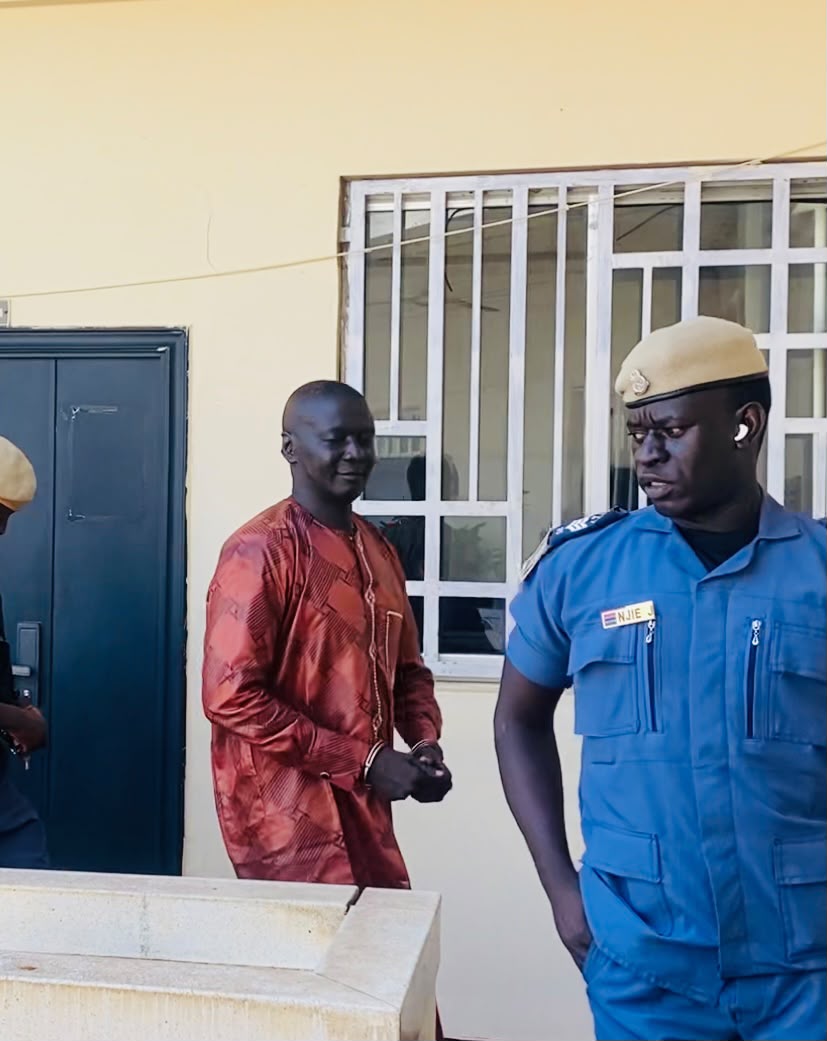
The trial of former Gambia Armed Forces officer Sanna Manjang resumed on Friday at the High Court in Banjul, where the one-time member of the notorious “Junglers” unit gave his evidence-in-chief and flatly denied allegations that he tortured Tamsir Jasseh and military officer Yaya M.S. Darboe in March 2006.
Justice Sidi K. Jorbateh presided over the proceedings. Under an amended indictment, Manjang faces two counts of assault causing actual bodily harm, contrary to Section 228 of the Criminal Code. The charges stem from alleged assaults on Jasseh and Darboe at a time when Manjang is accused of belonging to a group commonly known as the “Junglers” or “Black Blacks,” a unit linked to the former regime of Yahya Jammeh and widely associated with extrajudicial killings, disappearances, and torture.
Prosecution counsel E.R. Durgan and A. Badjie appeared for the State, while S.K. Jobe and M. Bah represented the accused. Defense counsel Bah led Manjang through his examination-in-chief as he opened his defense, detailing his military service and insisting he had no role in the arrest or mistreatment of the two men.
Manjang told the court that Kanilai, the hometown of former President Jammeh, was his posting area. He said he conducted patrols along the border and in surrounding villages solely to protect lives and property. He explained that military clerks handled soldiers’ training and deployment to different locations, and that every soldier operated within a clearly defined area of responsibility.
Asked about the alleged 2006 coup plot linked to Ndure Cham, Manjang said he became aware of it through a signal message circulated within the military. He confirmed that both Tamsir Jasseh and Yaya M.S. Darboe were among the names mentioned in connection with the plot. However, he maintained that a separate patrol team operated in the Greater Banjul Area under the direct command of State House and received its operational instructions there. He identified Nuha Badjie as the head of that team and named Momodou Jarju (also known as Rambo), Michael Correa, Fansu Nyabally, Mustapha Sanneh, and Sulayman Sambou as other members he could recall. Manjang insisted he never worked with the Banjul-based team because he remained stationed in Kanilai throughout the relevant period.
He told the court that the Banjul patrol team was referred to by some members of the public as the “Black Blacks” or “Junglers,” but stressed that these were not official military designations. He said he only became familiar with the names during the Truth, Reconciliation and Reparations Commission (TRRC) proceedings and had never interacted with or associated with the group’s members. He claimed he was unfamiliar with how they operated.
On the specific allegations against him, Manjang said he first heard the names of Jasseh and Darboe when reports of the alleged coup emerged. He denied any role in their arrest, saying personnel that State House carried out the arrests while he was in Kanilai. He said he learned of the arrests through a signal message and understood that the men would likely be taken to the National Intelligence Agency (NIA) or Mile 2 Prison. He rejected any suggestion that a unit based in Kanilai could carry out operations in Banjul, emphasizing that the two units functioned within their respective areas of responsibility.
Manjang further testified that he last visited Mile 2 Prison in 2000, when he was stationed at Fajara Barracks and performed guard duties. Regarding the NIA, he said he knew its entrance but had no official business there. He strongly denied inflicting any injuries on either man.
Speaking about Darboe, Manjang said the officer had trained as a recruit and graduated, but he did not know him personally. He explained that the large number of recruits joining the armed forces made it impossible for him to know every soldier individually. “Yaya has never worked directly or indirectly under me before. I can’t remember where he worked under me,” he told the court.
He added that his regimental powers included disciplining soldiers and that recruits might have known him by reputation because of his position, even if he could not personally identify them all.
On Jasseh, Manjang claimed he learned only during the TRRC hearings that the man knew his name. He alleged that Jasseh did not mention him in his testimony before the commission but only included his name in the allegations after Manjang’s arrest several months ago. “Tamsir Jassey has mentioned names of several people at the TRRC without my name. So it is only when I was arrested by the Gambia Armed Forces Tamsir came up with all these allegations,” he said.
When defense counsel Bah asked why Jasseh would testify against him if the claims were false, Manjang replied that Jasseh only mentioned his name after hearing people talk about him following his arrest. He maintained throughout that he had never participated in the arrest or torture of either man. “My Lord, the allegations leveled against me by both victims are false because I have never participated in their arrest or torture during their detention,” he stated.
During cross-examination, Manjang said he served in the Gambia Armed Forces from 1995 to 2017 and was stationed in Kanilai from 2003 to 2017. He recounted joining as a private after training at Fajara Barracks in 1995 and rising through the ranks to lieutenant colonel, explaining that promotions depended on dedication to duty and qualifications. He described normal working hours in Kanilai as running from 8 a.m. to 4 p.m., though his responsibilities meant he had no fixed closing time. He said his family lived in Brikama and that his schedule left him little time with his daughters. “My daughters are in court at present. I could not spend time with them when they were young because of my busy schedule at the border. I spent less time with them,” he testified.
He confirmed that Kanilai was Jammeh’s hometown but said the former president lived in Banjul and only visited Kanilai when he wished. When asked which witnesses had mentioned his name before the TRRC, Manjang identified Malick Jatta and Omar Jallow, but could not recall others. He continued to deny any involvement in the alleged torture.
At the close of questioning, the prosecution indicated it had no further questions but intended to file a motion of execution before the next sitting. Justice Jorbateh directed the prosecution to serve the defense with the motion on or before October 23, 2026. The case was adjourned to Friday, November 6, 2026, at 9:30 a.m. to hear the motion.