By Alieu Ceesay
Coalition 2026 formally sealed an alliance with key political stakeholders on Thursday, positioning itself as a united front to challenge the incumbent administration in the December presidential election.
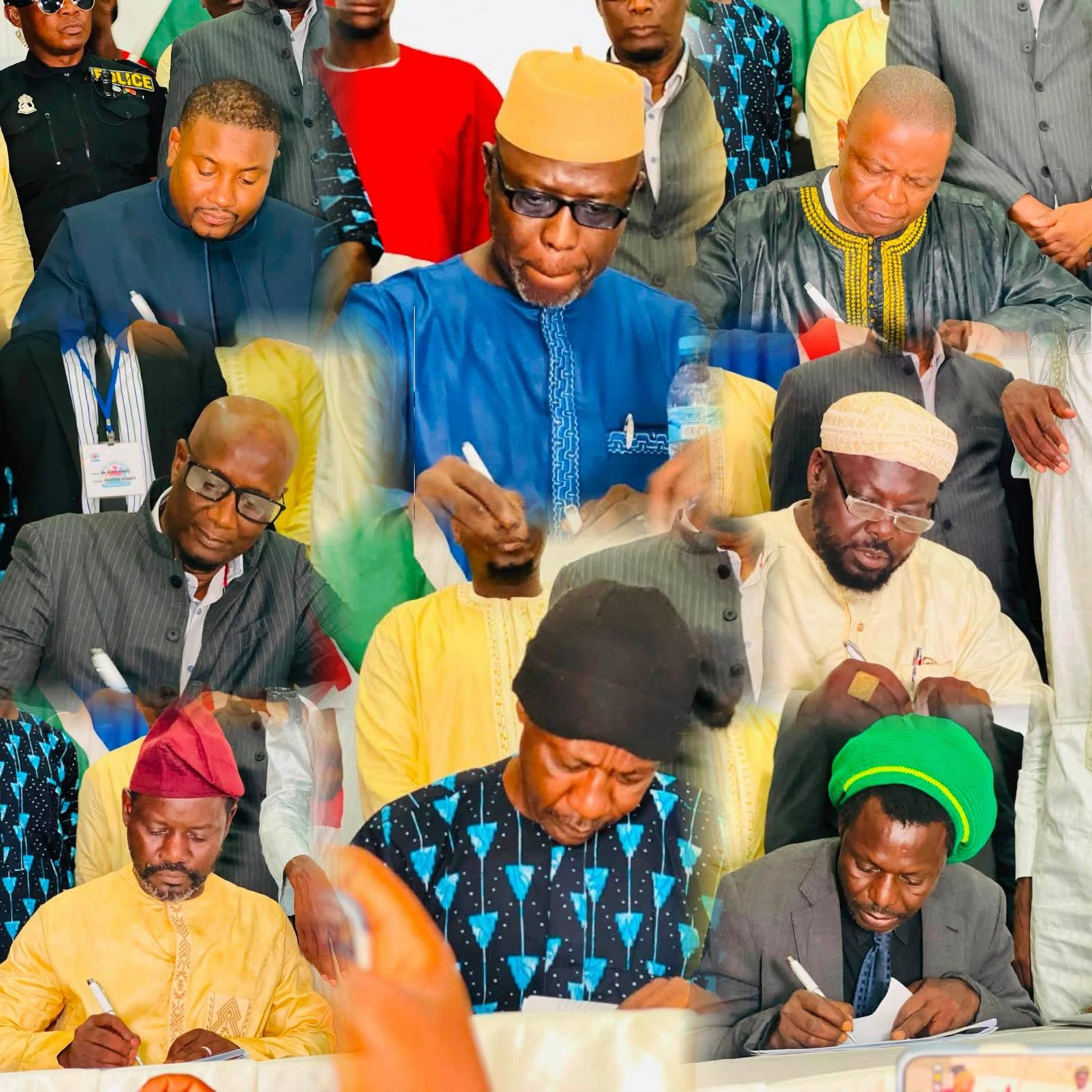
The Memorandum of Understanding was officially signed at Penchamin Hall in Kololi, where supporters and officials from the participating groups gathered to witness the ceremony. The coalition brings together the Unite Movement for Change (UMC), the National Unity Party, and several other political movements that have pledged their full commitment to the joint ticket.
Talib Ahmed Bensouda, the coalition’s flagbearer, used the occasion to outline a firm agenda focused on national security, social cohesion and economic renewal. In his opening remarks, he declared that a Coalition 2026 government would show zero tolerance for criminal gangs and the politics of division.
“We will change government. We will be tough on crime. We will criminalize tribalism. And we will unite the people for progress, peace and prosperity,” Bensouda told the audience.
Accepting the role of flagbearer, he struck a note of humility while emphasizing the collective stakes of the moment. “Today I accept the responsibility of serving as flagbearer of 2026 with humility and determination. This moment is bigger than any individual; it is bigger than any political party or movement. It is about the future of the Gambians,” he said.
Bensouda laid out a clear economic vision centered on job creation, higher incomes and expanded opportunities, particularly for the country’s youth. He argued that young Gambians need concrete pathways, not empty promises.
“Our young people don’t need speeches about the future; they need a pathway into it. That means investments in skills, apprenticeships, technology, agriculture, tourism, manufacturing and an economy where the private sector can create jobs at scale,” he stated.
Energy security also featured prominently in his address. The UMC leader pledged to that reliable electricity as a foundational requirement for education and development. “Coalition 2026 will therefore treat reliable electricity as an essential part of education. We will invest in dependable generation and distribution, expand renewable energy solutions in schools and communities, and ensure that our schools have the infrastructure required for modern learning,” he said.
Throughout the ceremony, speakers underscored the coalition’s determination to present a credible alternative to the current government. Bensouda closed by inviting other political parties still outside the alliance to join the movement, framing the December contest as an opportunity to unseat incumbent President Adama Barrow and deliver a new direction for the country.
Supporters present at the Penchamin Hall described the signing as a significant step toward political realignment, expressing optimism that the unified platform would strengthen the opposition’s chances at the polls. Coalition leaders emphasized that the agreement reflects a shared commitment to tackling insecurity, ending ethnic division and building an inclusive economy capable of delivering tangible results for ordinary Gambians.
With just months remaining before voters go to the polls, Coalition 2026 has formally entered the campaign arena with a message that combines toughness on crime, a ban on tribal politics and an ambitious program of job creation and infrastructure investment.