By: Alieu Ceesay
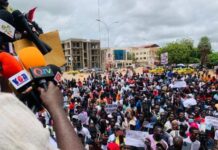
Young environmental advocates in The Gambia took to the streets in a climate justice march to give youth a platform to voice fears, demands, and expectations about the climate crisis.
Protesters carried banners and flyers reading: “We got more debt; that’s a red flag. Take action. Demand cancellation of unjust debt.” The messages were directed at Gambian authorities and framed climate action as inseparable from debt relief.
Activists also argued that reliance on certain energy sources continues to drive atmospheric pollution, particularly in wealthier countries, and that poorer nations should not bear the heaviest burden.
“As a young man, we will not give up until the change we desire is achieved,” said Ousman Baldeh of Global Platform The Gambia. Climate justice, he added, means recognizing that The Gambia did not contribute equally to the crisis and that the global north should pay more for climate damages.
Advocacy is also moving beyond the streets. ActionAid International The Gambia has engaged lawmakers to push for stronger climate action, sustainable agricultural policies, and greater accountability for national commitments.

Discussions have focused on the Maputo Protocol, agricultural investment, and civil society demands.
Daniel Carlos, speaking on behalf of the clerk of the National Assembly, highlighted the Maputo Declaration on Agriculture and Food Security, which the African Union adopted in 2003. It urged member states to allocate at least 10 percent of national budgets to agriculture and rural development as a path to poverty reduction, food security, and inclusive growth.
“The National Assembly has a crucial role in translating this continental commitment into national reality through budget approval, oversight, and engagement with citizens,” he said. He urged lawmakers to assess progress and strengthen the Select Committee’s ability to track agricultural spending, question gaps, and press for resources farmers need.
Honorable Omar Darboe, Chairperson of the National Assembly Select Committee on Agriculture, said the 2026 National Budget offers a useful test of that commitment. According to the Ministry of Finance and Economic Affairs’ 2026 Citizens’ Budget and the approved parliamentary budget, agriculture is projected to receive 7.10 billion dalasis, or 11.97 percent of the total.
“The key issue is not simply whether the budget meets the targeted figures on paper,” Darboe said. “We must also ask whether resources reach farmers and agricultural communities and whether they produce results in productivity, irrigation, mechanization, climate resilience, and food security.”