By Sainabou Sambou
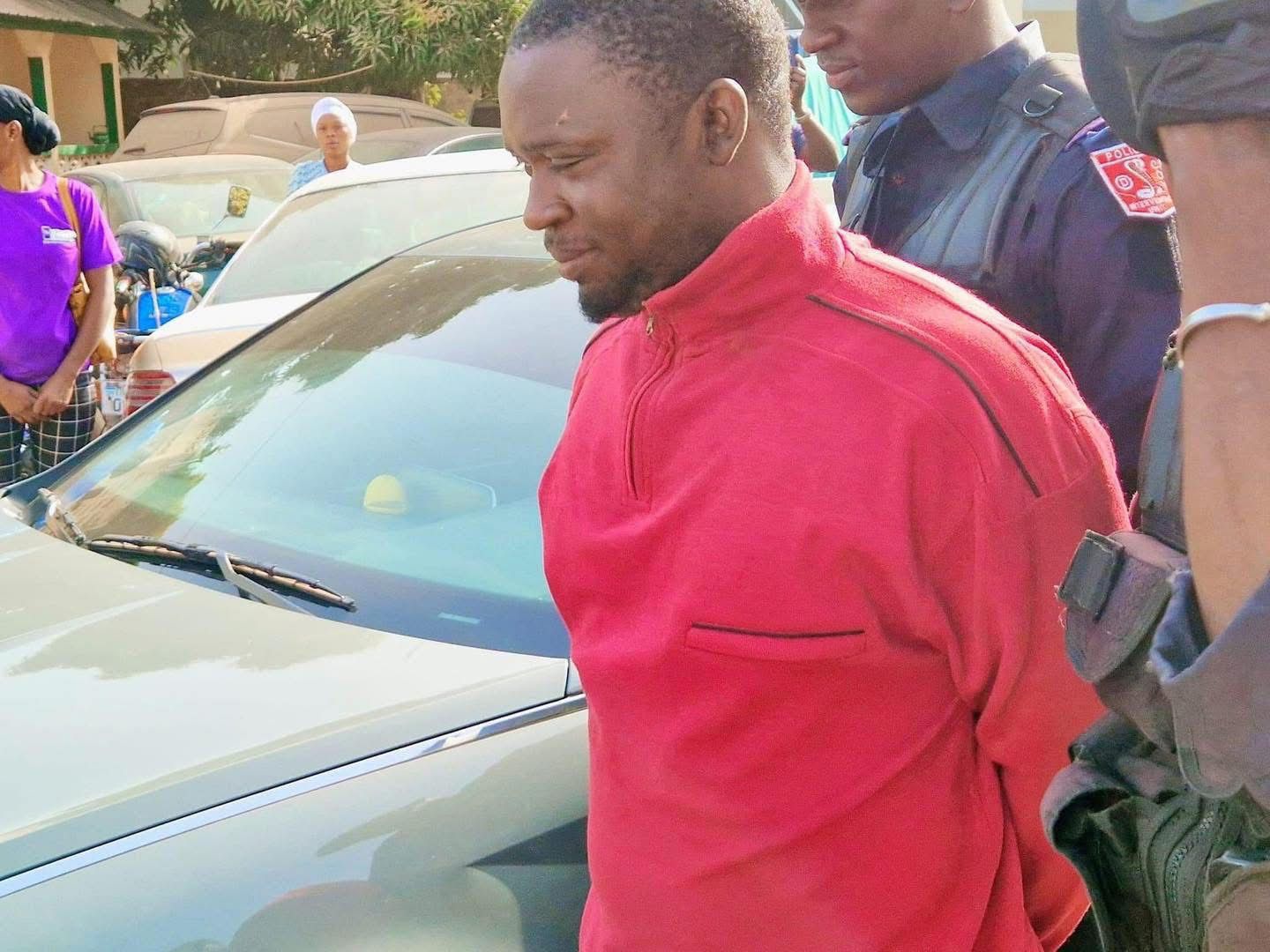
In a dramatic session at the High Court in Banjul, Arona Tin, the Senegalese national standing trial for the alleged murder of Fatoumata Karbo, took the witness stand on Tuesday and passionately denied any involvement in the 19 January 2024 stabbing that claimed the woman’s life.
Testifying under oath as the first defense witness (DW1), Tin swore repeatedly on the Holy Quran that he was himself a victim of a brutal attack by unknown assailants and an enraged mob, insisting he never touched the deceased.
Presiding over the case, Justice Ebrima Jaiteh listened intently as Tin recounted a sequence of events that he described as turning a routine money transfer into a nightmare of violence, unconsciousness, and wrongful accusation. State Counsel A. Gibba represented the prosecution, while defense counsel Samuel Ade led the accused’s testimony.
Tin, a technician who has lived and worked in The Gambia since 2013, told the court he left his location that fateful day to send money to his brother, Mbaye Tin, in Dakar, Senegal. Upon entering the money transfer bureau, he greeted the woman inside – whom he identified as Fatoumata Karbo – and explained that he intended to use Wave for the transfer. According to his account, Karbo informed him she did not handle Wave transactions to Senegal but had a friend who did. Tin handed over the cash and his brother’s phone number, intending to wait for confirmation of receipt.
As they discussed the transaction, three men entered the bureau. One positioned himself to Tin’s right, another to his left, and the third at the entrance. Tin testified that the man on his right inquired about Small World transfer services. Karbo confirmed that she had offered the service but indicated that she was attending to Tin first. The man then pleaded with Tin to allow them priority due to an urgent matter. Tin said he graciously agreed to wait.
Moments later, the man on his left asked for the time. As Tin, wearing an automatic wristwatch, checked it, he was suddenly struck above the eyebrow with a heavy object. “The blow was so heavy that I could not know whether it was a stone or something else,” he told the court. The impact caused him to collapse instantly and lose consciousness.
When Tin regained his senses, he saw Karbo running outside the bureau. He followed and stood by the glass door, observing her pointing before she fell to the ground. Soon after, he heard shouts that someone had been stabbed. A knife lay on the floor near the woman. By then, a crowd had gathered, accusing him of the crime and threatening to kill him.
Fearing for his life, Tin picked up the knife. “When the crowd threatened to kill me, I picked up the knife and warned that before they killed me, I would kill myself,” he testified. He placed the blade on his throat, inflicting a deep wound that caused heavy bleeding. The sight of blood reportedly caused the mob to retreat. Tin then re-entered the bureau, pushed the door shut, and collapsed once more.
He next awoke at Ndemban Clinic, surrounded by people and the whir of ceiling fans. Police Intervention Unit officers informed him he had “encountered a problem.” Doctors treated his injuries, warning they would need to stitch wounds and administer injections. Later that day, he was transferred to a hospital in Banjul. Medical staff told him he had lost a significant amount of blood. His wife was contacted, and blood was secured through the Jammeh Foundation for transfusion.
Tin further revealed he had been carrying D110,000 when he entered the bureau. While he was receiving treatment at Ndemban Clinic, a CID officer presented him with a bag supposedly his. Upon inquiring about the money, the officer reportedly said none was found. Tin described the exact amount missing: five bundles of D20,000 and two of D5,000. He was later moved to Serekunda Police Station after 9 p.m., placed in a cell despite his injuries, and had his prescribed medication removed following a confrontation with officers, including one named Landing.
Under questioning by his counsel, Tin vehemently denied stabbing Fatoumata Karbo. Swearing on the Holy Quran, he declared: “I have sworn on the Holy Quran. I did not touch Fatoumata Karbo and we were not even close.” He stated that 19 January 2024 was the first time he had ever seen her or entered the bureau.
Tin explained his familiarity with the area stemmed from frequent visits to a nearby Indian-owned building materials shop, where he purchased supplies as a technician. Many Gambians knew him through his work. He identified himself as Senegalese but emphasized deep ties to The Gambia: “What I have here, I do not even have in Senegal. My business is here and I have everything here. I can even say that I am Gambian.”
The court heard how Tin first arrived in The Gambia in 2013 on a contract with Gambega Company Limited. He later worked for Alhaji Conteh of Darwana Electrical from 2013 to 2018, receiving accommodation in Wulikama. He listed prestigious clients including the American Embassy, World Bank, Gambia Revenue Authority, and various hotels, insisting he had never had conflicts.
Tin described the accusations as deeply painful. He displayed scars on his wrist from the incident and noted it was the first time he had been handcuffed. He maintained he had never fought anyone in The Gambia or Senegal and continued supporting his family financially even from prison, sending money including “fish money” to his wife. He expressed gratitude to The Gambia for the opportunities it had provided.
The accused also confirmed knowing the bureau owner, Pateh Jallow, with whom he shared attaya and trips to Senegal. Jallow had previously testified and was present in court. Tin lamented the ongoing similar attacks in the country, as reported in the media, and appealed to the court to clear his name so he could resume his life and business.
During cross-examination, State Counsel A. Gibba challenged Tin’s claim of never having been to the bureau. Tin clarified he had never entered it prior to the incident. The matter was adjourned to 1st July 2026 for the continuation of the cross-examination of DW1 Arona Tin.