By Sainabou Sambou
President Adama Barrow has described ongoing development projects in the Lower River Region as a complete revolution, saying communities that waited for decades are finally seeing significant improvements in roads, agriculture and healthcare.
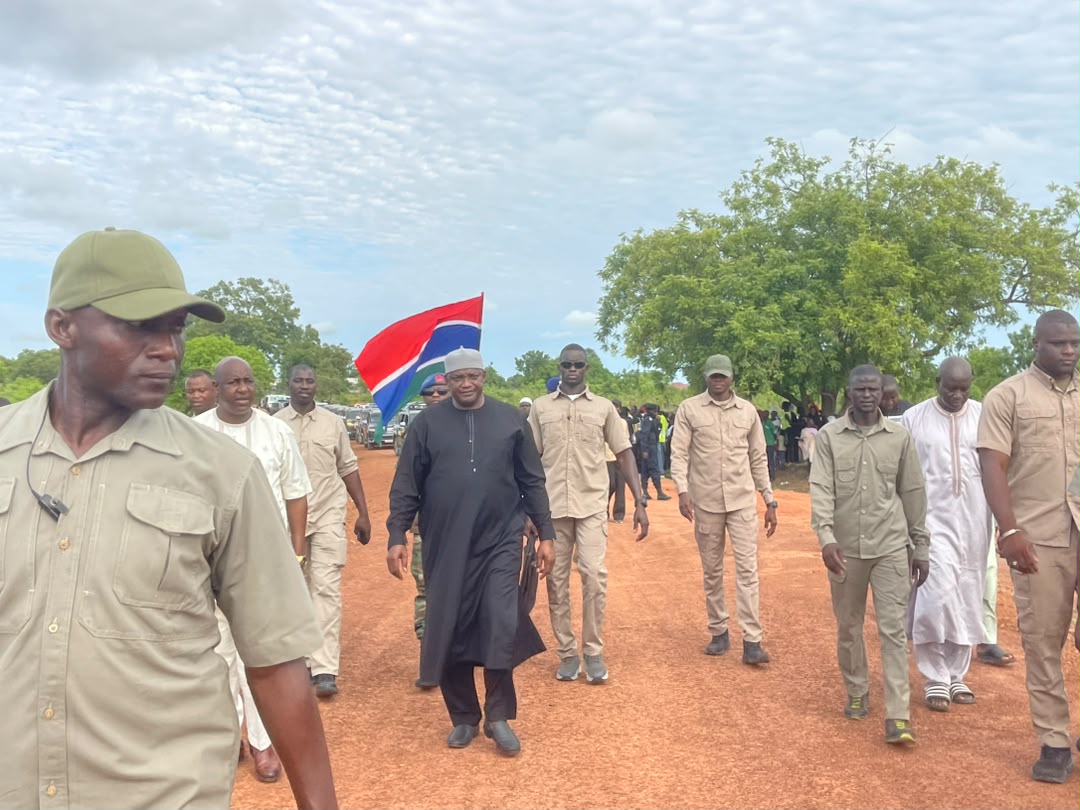
The President made the remarks on Friday, 14 August 2026, during an official visit that included the foundation stone laying ceremony for the new Governor’s Residence and Office Complex in Mansakonko.
Speaking during the tour, President Barrow said he felt deeply honored and pleased to witness the laying of foundation stones and the completion of several projects across the region. “For me, I am deeply honored and very, very happy to lay the foundation and witness the completion of these projects. I think it is a big achievement,” he said.
He singled out road construction, noting that about 93 kilometers of new roads represent a breakthrough for local communities. Residents, he said, had waited patiently for between 52 and 60 years while continuing to pay taxes without seeing corresponding development. “For a long time, over 52 to 60 years, they have been very, very patient. They waited so long and paid their taxes, but there was no reward. But now, it is their time, definitely,” President Barrow stated.
The President praised one contractor for finishing work ahead of schedule and declared that the progress across the country shows The Gambia is truly moving forward with no turning back.
He credited his ministers and technical teams for the results, highlighting the commitment of figures such as Health Minister Dr Ahmadou Lamin Samateh. “I have a team. The team is very, very strong… Without the team, it will not work,” he said. He also thanked the media, ministers and contractors for their contributions.
As part of the visit, President Barrow inspected land development works under the Resilience of Organizations for Transformative Smallholder Agricultural Project (ROOTS) at Genieri. Mr Imed Gharbi of PACE Consultancy, the supervising engineering firm, explained that water from the opposite side of the highway is being utilised, with 14 to 15 hectares already identified. While the initial plan targeted about 35 hectares, the site could expand to approximately 45 hectares, creating a positive opportunity for agricultural production.
ROOTS Project Director Mr Famara Trawally noted that large sections of the land had lain idle for years because of salt intrusion. The project employs a micro-catchment and cascading system that collects rainwater to dissolve and flush out salt. “All these sides have not been under production for so many years… when salt dissolves, we open these gates so that salt water is flushed,” he explained. The land is expected to be ready for cultivation next year and will not require irrigation during the rainy season. The initiative also includes gardens for women to farm during the dry season, complementing the larger fields.
The President further inaugurated the Madina Sancha and Madina Angalleh Health Posts to improve access to basic healthcare. The ROOTS Project operates eight sites across the Lower River, North Bank and West Coast regions—Genieri, Burung, Jurunku, Bakang, Kandunku, Battanding, Ndeban Jola and Lamin Wayoto—developing a total of 388 hectares, of which Genieri accounts for 30.36 hectares. The International Fund for Agricultural Development (IFAD) is funding it. Longjian Roads and Bridge Company Limited is the contractor, with PACE JV CETEQ and GAMWORKS providing consultancy and supervision.

President Barrow expressed satisfaction with the overall progress. “Overall, I am very, very happy,” he said, thanking all involved for a “very, very good job.” The visit formed part of the government’s broader programme of infrastructure, agricultural and health investment in the region.