By: Alieu Ceesay
A broad opposition coalition led by the country’s largest opposition party, the United Democratic Party (UDP), has formally united to challenge incumbent President Adama Barrow in the December 5, 2026, presidential election, pledging to restore public trust, combat corruption, and improve ordinary Gambians’ livelihoods.
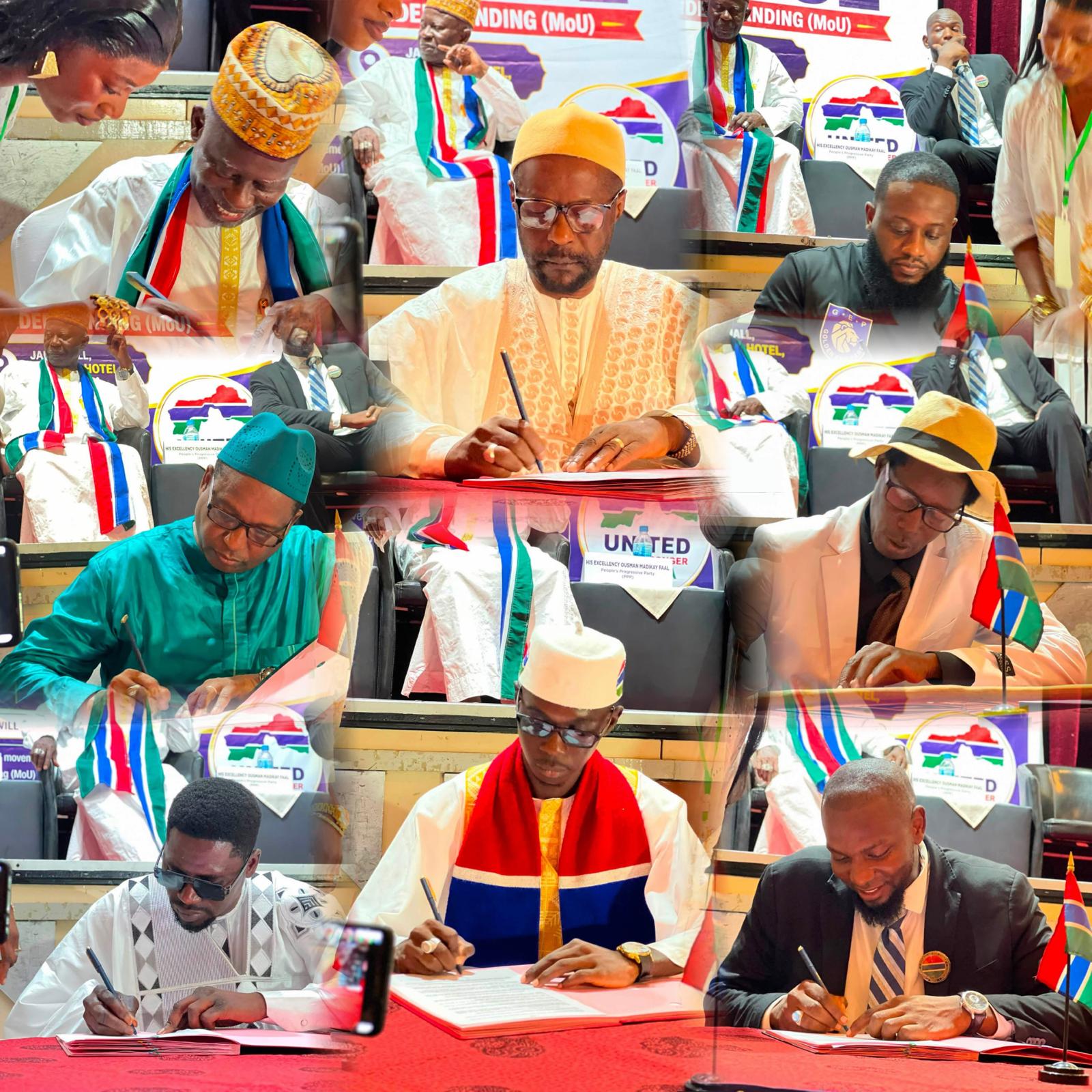
On Friday evening, five political parties and two political movements signed a Memorandum of Understanding at a ceremony that marked a significant realignment in Gambian politics. The signatories joining the UDP are the Alliance for Democracy and Development (ADD), Citizens’ Coalition for Change (CCC), Gambia Alliance for National Unity (GANU), Gambia for All (GFA), Gambian People’s Advancement Party (GPAP), Golden Era Party (GEP) and the People’s Progressive Party (PPP). Of these, ADD, GANU, GFA, GPAP and PPP are registered parties, while CCC and GEP operate as movements. The Golden Era Party was the first to endorse the UDP ahead of the polls publicly.
UDP flagbearer Ousainou Darboe told the gathering that Gambians deserve a new government in 2026. “A new government in 2026 is what our citizens deserve,” Darboe said in his opening remarks. “Gambians will have a government that will fight against corruption and a government that will respect the law.”
Coalition chairman Momodou Satou Dibba said the partners had been carefully selected based on shared structures, policies and, above all, a common objective. “They have two important things in common… The most and foremost important objective is the common objective of replacing the Adama Barrow government,” Dibba stated. He expressed optimism that more groups would soon join, noting that consultations were underway with four or five other organizations that share similar goals.
Papa Faal, speaking on behalf of the coalition, focused on the economic pressures facing ordinary citizens. He said the cost of living had become unaffordable for the average Gambian family. “Our youths are desperate and have resorted to illicit drugs, crime, and backbiting because of hopelessness and lack of a promising future. Because of a poor healthcare system in this country, basic illnesses become chronic and life-threatening,” Faal said.
Turning to agriculture, traditionally regarded as the backbone of the economy, Faal argued that the sector had failed to deliver food self-sufficiency because of low productivity and weak practical support. He called for the full utilization of the country’s maritime waters and land resources so that food would be affordable, available and accessible to citizens rather than being outsourced to external interests. Natural resources and human capital, he added, currently benefit only a few individuals.
Faal concluded by urging the introduction of a skills-based education system that would equip young people to become self-reliant and productive citizens.
The coalition’s formation comes amid widespread concern over economic hardship, youth unemployment and institutional credibility. While the formal MoU centers on uniting to unseat the incumbent, speakers repeatedly linked political change to concrete improvements in daily life—fighting corruption, enforcing the rule of law, creating opportunities and restoring faith in public institutions.
With the December election still months away, the newly formed alliance presents itself as a united front determined to offer Gambians an alternative vision of governance focused on accountability, economic opportunity and national renewal. Further announcements on additional partners and a detailed policy platform are expected in the coming weeks as the coalition seeks to broaden its base and translate its pledges into a winning electoral strategy.