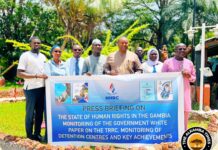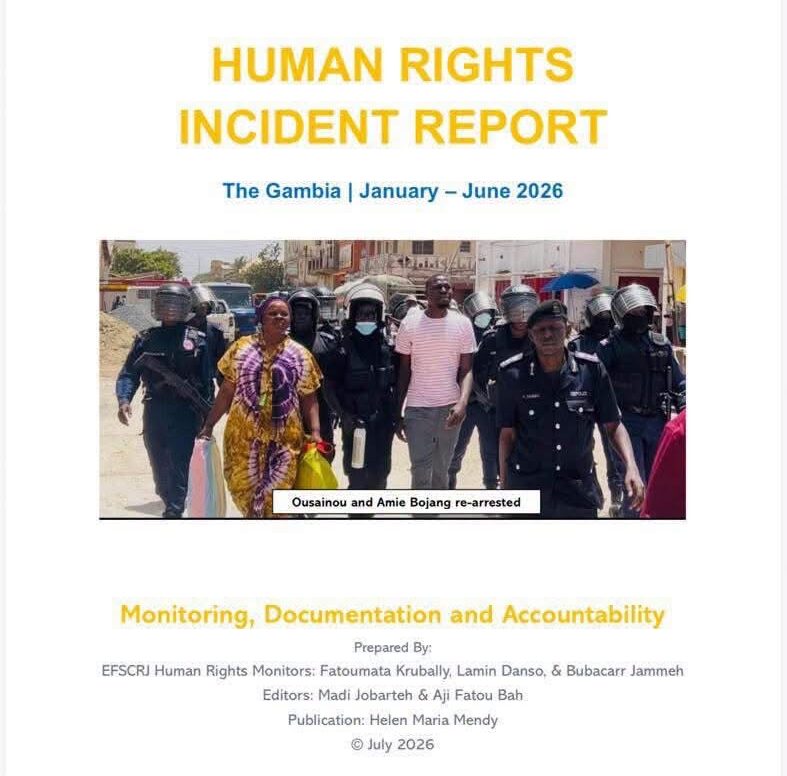
The Edward Francis Small Centre for Rights and Justice (EFSCRJ) on Friday released its Human Rights Incident Report for January to June 2026, documenting 17 cases that raise serious concerns over arbitrary arrests, police conduct, child protection and institutional accountability in The Gambia.
The report covers alleged arbitrary arrests, police brutality, restrictions on peaceful assembly, child abuse, rape, fatal interpersonal violence, unexplained deaths, road traffic fatalities, fire outbreaks and unsafe migration. Six incidents occurred in June and five in May: at least nine involved death, serious injury or grave threats to life.
Of particular concern, the centre said, was the re-arrest of Ousainou and Amie Bojang immediately after their acquittal and release by the High Court. It also highlighted the arrest of members of Gambians Against Looted Assets (GALA) during an 8 May commemoration at Westfield and the alleged excessive force used against GALA member Alieu Bah. These cases, EFSCRJ stated, “raise fundamental questions about respect for judicial authority, personal liberty, peaceful assembly, physical integrity, and accountability within the security services.”
The report further documented the alleged abuse of a child in Tujereng and the alleged rape of a nine-year-old girl in the Coastal Road area. Such cases, it said, underline the urgent need for stronger child-protection systems, survivor-centered medical and psychosocial services, prompt investigations and child-sensitive justice.
Deaths and serious injuries from violent attacks and road crashes equally demand action. “Every death must be promptly, independently, and effectively investigated,” the centre stressed. Victims and families have a right to truth, justice, protection and timely information on the outcome of inquiries.
While the report is not exhaustive, the documented cases reveal recurring weaknesses in prevention, protection, investigation, accountability and transparency.
EFSCRJ called on the Government to strengthen human rights protection, road safety, child protection, emergency response and victim-support systems. It urged the Gambia Police Force to ensure every arrest has a lawful basis and that the policing of peaceful assemblies follows the principles of legality, necessity and proportionality.
The National Human Rights Commission should independently investigate and publicly report on allegations of arbitrary arrest and excessive force. The Department of Social Welfare and health authorities must provide confidential, survivor-centered support to children affected by abuse and sexual violence. Relevant authorities should publish timely updates on investigations, prosecutions, inquests and institutional responses.
“Human rights protection cannot end with arrests and official announcements,” the statement said. “It requires prevention, professional investigations, protection of victims and witnesses, fair trials, effective remedies, and accountability for every perpetrator, including state officials.”
EFSCRJ pledged to continue monitoring the incidents and holding institutions accountable, declaring that the life, dignity, liberty and safety of every person must remain at the centre of governance.