By: Alieu Ceesay
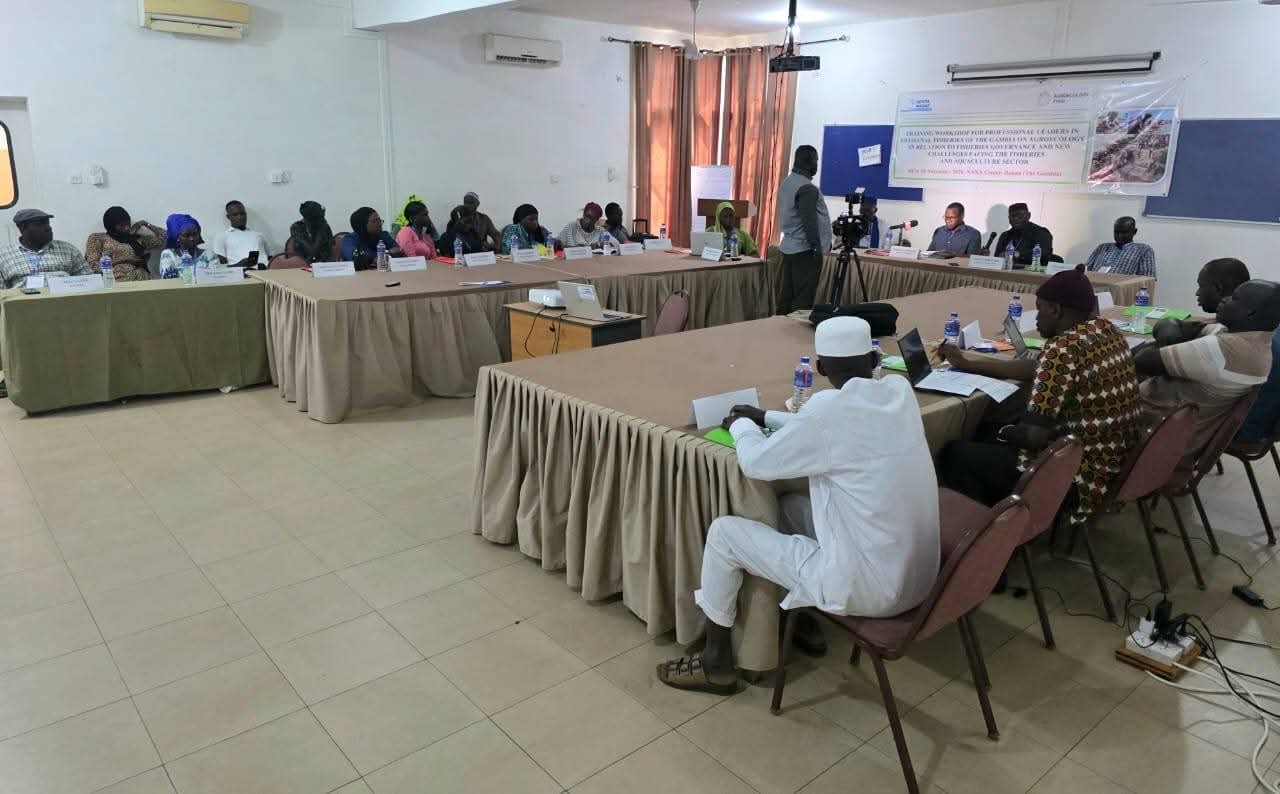
The Ministry of Fisheries, Water Resources and National Assembly Matters has reaffirmed its commitment to sustainably managing The Gambia’s artisanal fisheries sector during a two-day national training workshop on agroecology applied to fisheries.
The workshop, held at the NANA Conference Hall in Bakau, convened artisanal fisheries leaders, civil society representatives, development partners and stakeholders from across The Gambia and Senegal. Discussions centered on fisheries governance, resource management and alternative livelihood options.
Speaking at the opening on behalf of the Ministry and the Department of Fisheries, Momodou Sidibeh described artisanal fisheries as a cornerstone of food security, employment and economic stability in The Gambia and the wider West African sub-region. He warned, however, that the sector faces mounting pressure from over-exploitation, environmental degradation and climate change.
“To safeguard our resources for future generations, we must adopt holistic ecosystem-based solutions, integrating agroecological principles into fisheries—what we refer to as fisheries ecology—to provide transformative approaches to sustainability,” Sidibeh said.
The training forms part of a regional project titled Agroecology, Sustainable Artisanal Fisheries Resilience Food Systems in Senegal, The Gambia and Guinea. The initiative is supported by a grant from the Global Greengrants Fund, following a recommendation from the Agroecology Fund. It is implemented in collaboration with the West Africa Association for the Development of Artisanal Fisheries (WADAF).
Sessions cover the status and governance of fisheries resources, sustainable practices, alternative livelihoods, communication, leadership and policy advocacy. Participants are examining agroecological approaches to artisanal fisheries, sustainable processing methods and integrated aquaculture systems intended to ease pressure on wild stocks.
Sidibeh stressed that effective governance requires cooperation beyond government institutions. “Effective governance cannot be achieved by government policy alone. It requires genuine co-management, continuous dialogue and strong partnership with artisanal fisheries organizations, women processors and coastal communities,” he said. The Ministry pledged to align national fisheries policies with agroecological practices, protect critical habitats and strengthen coastal resilience.
Fatou Janha, Chief Executive Officer of the Tri-Oyster Women’s Association, said the workshop offers a valuable opportunity to strengthen the knowledge and leadership capacity of women and young people involved in oyster production. The association supports oyster-harvesting communities across the Tanbi Wetland through organization, capacity-building and other assistance.
Janha noted that the group is increasingly focusing on young, educated daughters of oyster harvesters to elevate oyster production and related activities. “Right now, we are concentrating on the young girls. These are the daughters of the women who are doing oysters, and they are educated. And we want to bring the oyster production to a higher level,” she said.
She added that collaboration with WADAF will expose participants to new knowledge in leadership, good governance, transparency and aquaculture, while also introducing young women to beekeeping and mangrove honey production—an alternative livelihood the association hopes to adapt from Senegal. Janha emphasized that capacity building must be continuous. “Training is capacity building; it’s a continuous process. You don’t just do it once and then it’s over. We have to sustain and continue gathering knowledge. That is never enough,” she said.
Organizers expect the workshop to strengthen collaboration among fisheries organizations in The Gambia, Senegal, and Guinea while equipping local leaders with practical knowledge to support sustainable artisanal fisheries and more resilient coastal communities.