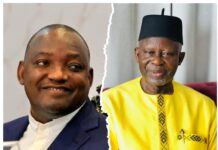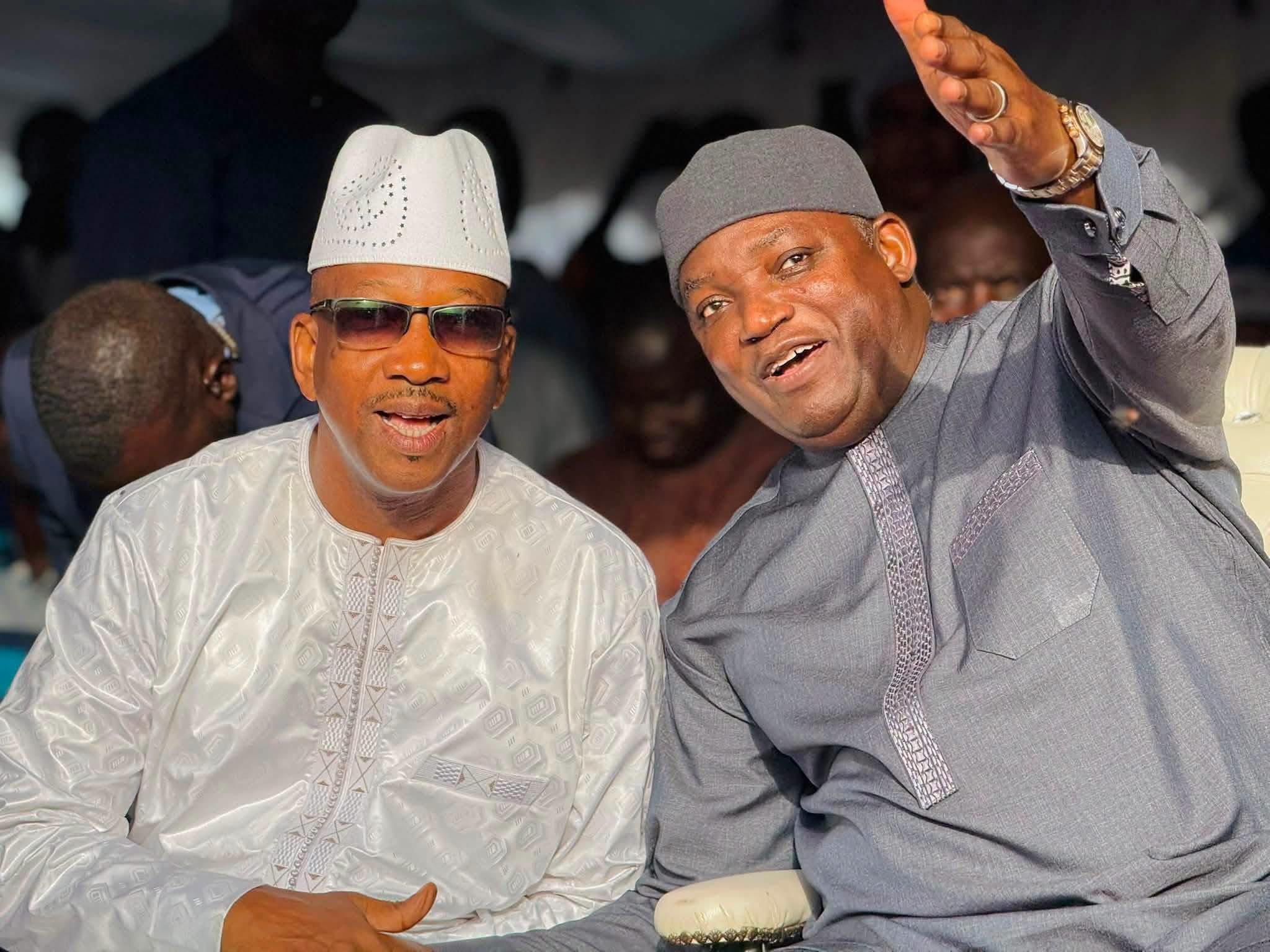
The political chessboard in The Gambia shifted decisively this week. Gambia Democratic Congress leader Mama Kandeh has formalized an alliance with President Adama Barrow’s National People’s Party, endorsing the incumbent’s bid for a third term in the 5 December 2026 presidential election. At almost the same moment, the United Democratic Party—the largest opposition force—withdrew from the Coalition 2026 talks. What was already a fragile effort at opposition consolidation has suffered another, perhaps fatal, setback.
Gambians who hoped for a competitive contest that could hold power to account now confront a landscape of fragmentation, opportunism and diminished democratic choice.
Kandeh’s decision was not entirely surprising. For months he had signaled openness to partnerships with any party, including the ruling NPP, provided the arrangement served what he called ‘national interest’. He had long ruled out joining any UDP-led arrangement, citing the latter’s insistence on leading any coalition. Yet the formal step of signing a memorandum of understanding and publicly endorsing Barrow marks a profound realignment. The GDC, which once positioned itself as a distinct alternative drawing significant votes in 2016 and 2021, has chosen the governing tent. Reports of internal dissent—four senior executives walking out of an executive meeting in protest—underscore that the move was neither unanimous nor cost-free for the party’s cohesion.
The implications for December are straightforward and troubling. Barrow enters the campaign with an expanded coalition that absorbs part of the opposition vote that previously contested his dominance. GDC’s organizational presence and residual support base, particularly in certain rural areas, add numbers and legitimacy to the incumbent’s machinery. In a first-past-the-post system, even modest shifts can prove decisive. The alliance also sends a clear signal: the center of gravity remains with State House. Political survival and access to resources appear to have outweighed the harder path of sustained opposition.
This is not mere pragmatic coalition-building of the kind that produced the 2016 victory over Yahya Jammeh. That earlier effort united disparate forces around a shared objective of democratic transition. Today’s maneuver looks more like absorption. When a party that contested the last two presidential elections as an independent force suddenly endorses the sitting president, questions of principle inevitably arise. Has the GDC concluded that genuine change is unattainable outside the NPP orbit, or has personal and party calculation prevailed? The public deserves clearer answers than vague appeals to “national development.”
Simultaneously, the UDP’s withdrawal from Coalition 2026 talks compounds the damage. The country’s strongest opposition party stepped back over fundamental disagreements about structure: whether the alliance should be party-led, with UDP asserting its electoral weight, or candidate-led under an independent figure. Ousainou Darboe has insisted the process must not be skewed against his party and that constitutional clarity and accountability matter more than expediency.
Those concerns are legitimate. Yet the practical result is the same: the largest opposition bloc has exited the main unity platform at a critical juncture. Smaller parties and movements are left scrambling, while the window for presenting a single, credible alternative narrows rapidly.
Opposition coalition-building in The Gambia has a chequered recent history. Ego, leadership claims and mutual distrust have repeatedly undermined efforts that begin with high rhetoric about national interest.
The current process has followed the familiar pattern—initial goodwill, followed by procedural disputes, public recriminations and eventual fracture. UDP’s size gives it leverage, but leverage unused or used only to walk away does not defeat incumbents. Other parties’ preference for an independent candidate may reflect genuine fear of UDP dominance, yet it also risks producing a vehicle without organizational muscle. The net effect is a divided field that advantages the well-resourced ruling party.
Voters should not romanticize either side. The NPP under Barrow has governed for nearly a decade. Its record on governance, economic management, constitutional reform and institutional integrity remains open to legitimate scrutiny. An alliance that expands its tent without corresponding commitments to transparency or term-limit discipline does little to address those concerns. At the same time, an opposition that cannot subordinate individual and party ambitions to a shared electoral strategy offers Gambians little more than protest without power. Democracy requires viable alternatives, not merely vocal ones.
The months ahead will test whether residual opposition forces can still construct a coherent challenge, whether through a reconstituted coalition, parallel alliances or independent candidacies capable of mobilizing genuine discontent. They will also test the maturity of the Gambian electorate. Citizens have the right—and the duty—to demand more than late-stage political marriages of convenience and procedural walkouts. They should interrogate the terms of the GDC-NPP pact, the substance of any future opposition platform, and the consistency of leaders who once spoke of change.
Kandeh’s alliance and the UDP’s withdrawal do not predetermine the December outcome. Politics retains its capacity for surprise. But they do tilt the field further toward continuity. For those who believe The Gambia still needs robust checks on executive power and genuine competition of ideas, the week’s events represent a setback. The responsibility now falls on remaining opposition actors to demonstrate that fragmentation is not destiny—and on voters to reward substance over spectacle when they finally mark their ballots.