As The Gambia approaches the December elections, a major new opinion poll has painted a picture of an electorate grappling with severe economic pressures while holding firmly to democratic principles. The Center for Policy, Research and Strategic Studies (CepRass) has quietly shared its Second Series Issue-Based Opinion Poll with media outlets, providing a nationally representative snapshot of public sentiment on key national issues.
Conducted with support from the National Endowment for Democracy (NED) under the project “Assessing and Strengthening Democracy,” the survey interviewed 1,245 respondents across all Local Government Areas using multi-stage stratified random sampling and face-to-face digital methods. The findings highlight widespread dissatisfaction with the economy and governance performance, even as citizens strongly affirm their right to criticize leaders and engage in civic life.
The poll comes without any formal launch event, press conference, or public briefing. CepRass described the release as a direct distribution to journalists, editors, and media houses to support accurate, evidence-based reporting and informed public debate ahead of the December 2026 presidential election.
Economic hardship emerges as the dominant concern. According to the report, a striking 76% of respondents rated the national economy negatively, while 75% expressed dissatisfaction with the government’s handling of prices. Rising prices topped the list of economic problems for 42% of those surveyed, far outpacing other issues. These figures underscore how inflation, affordability challenges, and daily household struggles are shaping broader judgments about national direction and leadership effectiveness.
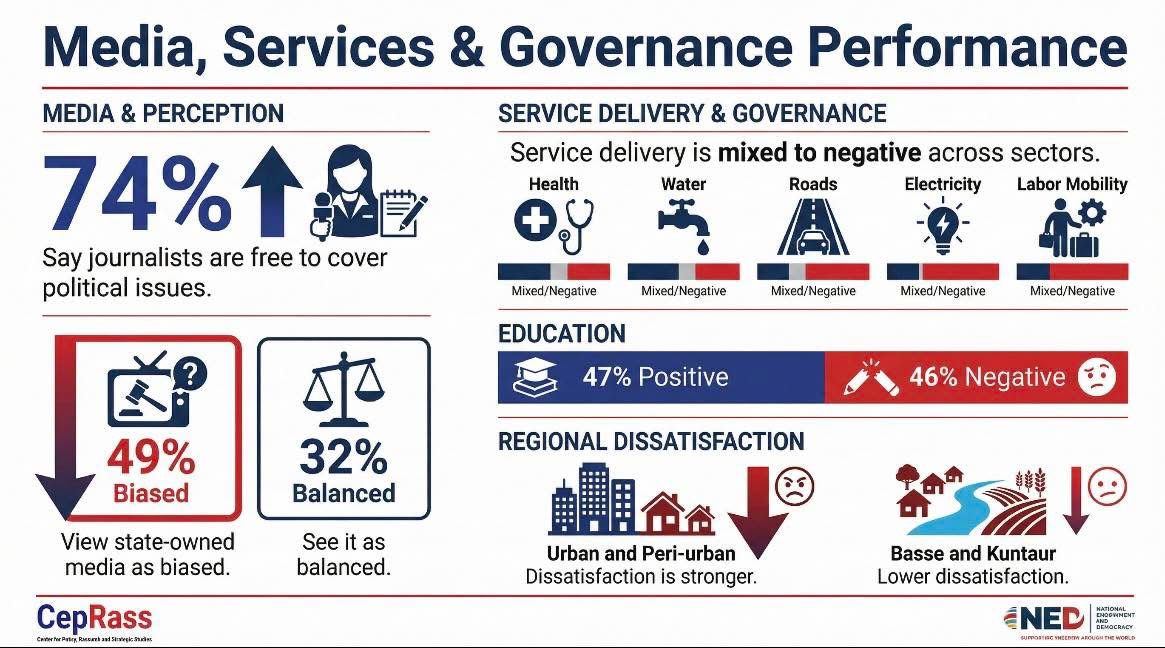
Governance and democratic satisfaction also scored poorly. 56% of respondents said they were dissatisfied with the current state of democracy in The Gambia, and 62% rated overall governance performance as poor. Many citizens appear to question whether institutions and leaders are sufficiently responsive to ordinary people’s needs, particularly amid visible economic strain.
Institutional trust remains fragile. The survey found that 52% of Gambians have little or no trust in the police, while 68% believe corruption is being handled badly. These results point to deeper worries about accountability, transparency, and the credibility of public institutions charged with delivering services and enforcing rules.
Despite these critical assessments, the data reveal a robust commitment to core democratic values. An overwhelming 90% of respondents supported citizens’ right to criticize the government, and 71% said recent protests were justified. The report portrays a citizenry that is politically attentive, informed, and engaged — not apathetic — but increasingly demanding when it comes to performance and results.
CepRass emphasized that the survey reflects public perceptions rather than official performance metrics. The nationally balanced sample, covering variations in gender, age, education, and geography, offers a broad view of national mood rather than regional or partisan perspectives. Analysts note that the combination of strong democratic ideals alongside sharp criticism of economic and governance delivery forms one of the report’s central messages.
Media organizations have been encouraged to cite the findings clearly as the “CepRass x NED Second Series Opinion Poll” and to provide context, noting the sample size and methodology.
The release arrives at a sensitive moment. With the 2026 elections drawing nearer, issues of cost of living, public service delivery, institutional integrity, and citizen voice are expected to dominate political discourse. The poll suggests that while many Gambians continue to value the freedoms gained after the country’s democratic transition, frustrations over everyday realities could prove politically consequential.
CepRass positioned the report as a tool to enrich national dialogue, encouraging responsible use in news stories, features, talk shows, and analysis. The organization stressed that the data should contribute to a nuanced understanding: a public that remains committed to democracy and participation, yet increasingly vocal about shortcomings in governance and economic management.
This quiet media distribution of the comprehensive report is intended to place credible, ground-level evidence directly into the hands of professionals shaping public conversation.