
The Gambia officially launched the Automated Fingerprint Identification System (AFIS) for criminal investigations on Tuesday, 28 April 2026, marking a major milestone in modernizing its law enforcement capabilities.
Under the patronage of the Minister of Interior and the Minister of Justice, national authorities and partners of the AFIS Project within the Western African Police Information System (WAPIS) Programme inaugurated the system at a ceremony that also included the opening of renovated premises for the Criminal Records Office/Scientific Support Unit (CRO/SSU).
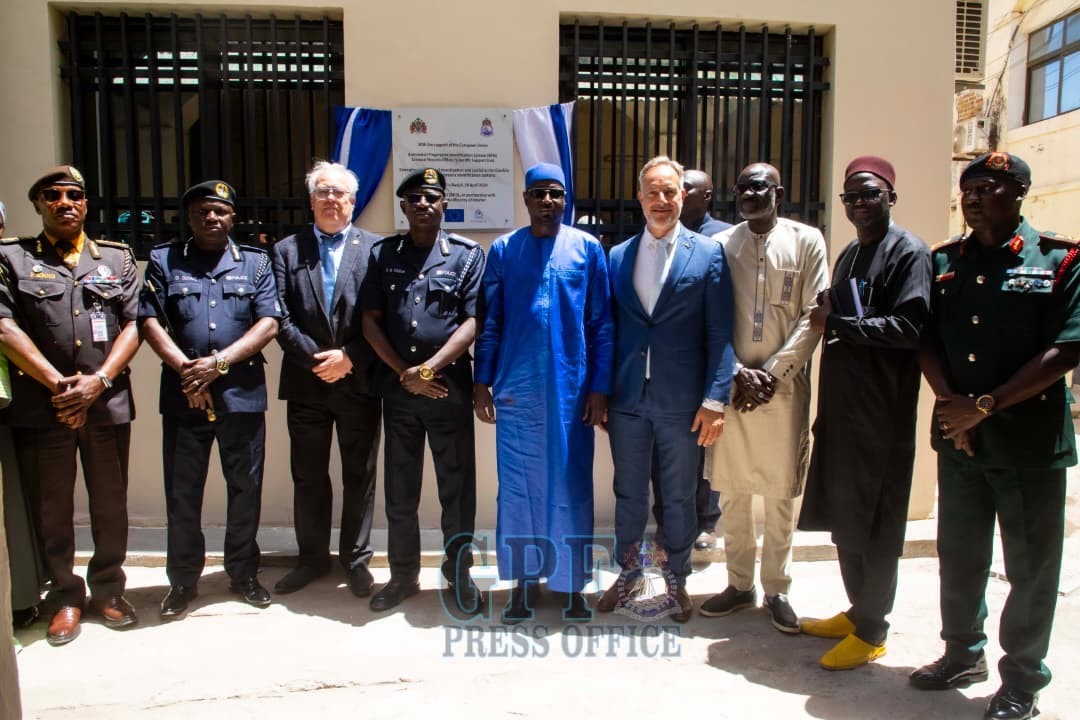
The European Union-funded initiative aims to enhance criminal identification and case resolution at national, regional, and international levels.
The deployment of AFIS marks the culmination of several project components, including legal reforms for biometric data processing, capacity-building, infrastructure renovation, and equipment provision. It integrates fingerprint and latent print data from crime scenes with the existing national WAPIS system, enabling faster suspect identification and case linkages.
Assistant Inspector General of Police for Crime Management, Amie Nyassi, highlighted the system’s transformative potential: “Crime scene evidence is no longer isolated; it becomes part of a connected national system capable of linking cases, identifying repeat offenders, and guiding investigators with precision.”
INTERPOL representative Mark Branchflower noted that AFIS complements nominal data in WAPIS with biometric information, boosting identification and resolution rates both locally and through international channels.
Deputy Head of Mission of the European Union in The Gambia, Raphaël Brigandi, underscored the EU’s commitment as the major donor: “The objective is to strengthen the fight against crime, in full respect of human rights and data protection standards. With AFIS, investigations in The Gambia will become faster and more reliable. This is a concrete investment in the security sector that will reinforce public trust.”
Inspector General of Police Seedy M. Touray declared that AFIS turns criminal records into a dynamic investigative tool. “The Gambia is no longer a safe haven for criminals to perpetrate transnational organized crime,” he said, assuring citizens and residents that justice will now be backed by “science, professionalism, and unwavering resolve.”
Principal Secretary of the Ministry of Interior, Kebba Nfally Darboe, described AFIS as a truly national system extending across security institutions. He reaffirmed the government’s commitment to its long-term sustainability, stating that investing in forensic science and biometrics strengthens both security architecture and public confidence.
The event featured a live demonstration of the AFIS system and a crime scene reconstruction by recently trained officers. The project has trained nearly 300 law enforcement personnel through a pool of 10 national trainers and equipped the CRO/SSU with modern forensic tools for crime scene response, chemical processing, and photography.
The AFIS Project forms part of the broader WAPIS Programme, implemented across ECOWAS Member States and Mauritania with support from ECOWAS, funding from the European Union, and implementation by INTERPOL.