By Fatou Dahaba
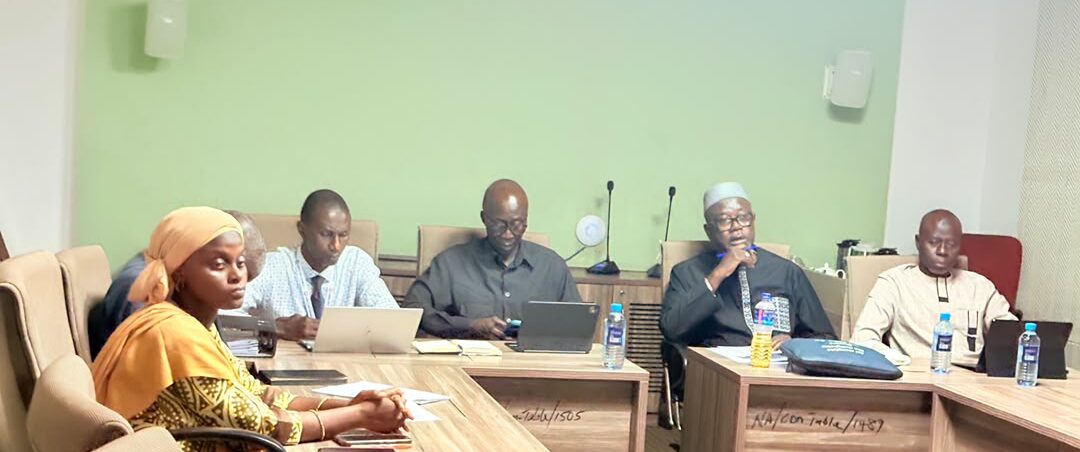
National Assembly lawmakers on Tuesday expressed serious concerns over significant governance lapses, missing documentation, tax compliance failures, and substantial delays in the Gambia Ports Authority (GPA) Banjul Port 4th Expansion Project during a review of its audit reports for the year ended December 31, 2025.
The Public Enterprise Committee grilled project officials and auditors on weaknesses detailed in the management letter, despite the project’s financial statements receiving a clean, unqualified audit opinion.
Auditors confirmed that the accounts fairly presented receipts, payments, and fund sources and uses in accordance with International Public Sector Accounting Standards on a cash basis.
Financial highlights presented to the committee showed the project received grant income totaling D528,091,030.80 (approximately US$7.27 million), while total expenditure reached D512,369,328.98 (US$7.05 million), leaving a balance of D15,721,701.82 (US$216,335.94). Major expenses included D476,671,198.91 (about US$6.56 million) for construction works, along with consultancy payments of D3,447,017.28 (US$47,440) and D9,207,992.40 (US$127,140). The project recorded an opening cash balance of D250,165.40, resulting in a year-end closing balance of D15,971,867.52 (US$219,915).
A key red flag raised by auditors was the failure to close two project accounts at the Central Bank of The Gambia. Despite instructions to close them, the accounts remained active as of March 18, 2026. Project officials assured the committee that closure requests had been sent, explaining the accounts stemmed from earlier advance funding arrangements. Auditors urged management to follow up and provide proof of closure.
Documentation gaps drew sharp criticism. Auditors revealed they received only one attendance list and a single set of Project Steering Committee minutes dated August 26, 2024. They stressed that all steering committee meetings must be properly documented. Officials acknowledged the shortfall and committed to improved record-keeping.
Similarly, only one set of internal management meeting minutes from September was provided. In response, project leaders said monthly management meetings have been instituted since December 2025.
The audit also flagged the inappropriate use of the GPA’s accrual accounting manual for a project required to report on a cash basis. Officials informed lawmakers that a dedicated cash-basis manual has since been developed.
Implementation delays were another major concern. The project missed its original completion date, with some components still unfinished, prompting an extension to November 3, 2027.
Tax issues further compounded the problems. Auditors noted that D491,740 in withholding tax on supplier payments and D7,200 on contract staff salaries had not been remitted to the Gambia Revenue Authority.
Lawmakers emphasized a stark contrast between the clean financial opinion and the underlying governance and compliance deficiencies. They vowed to keep missing minutes, unclosed accounts, tax arrears, and project delays under scrutiny as the committee continues its oversight.