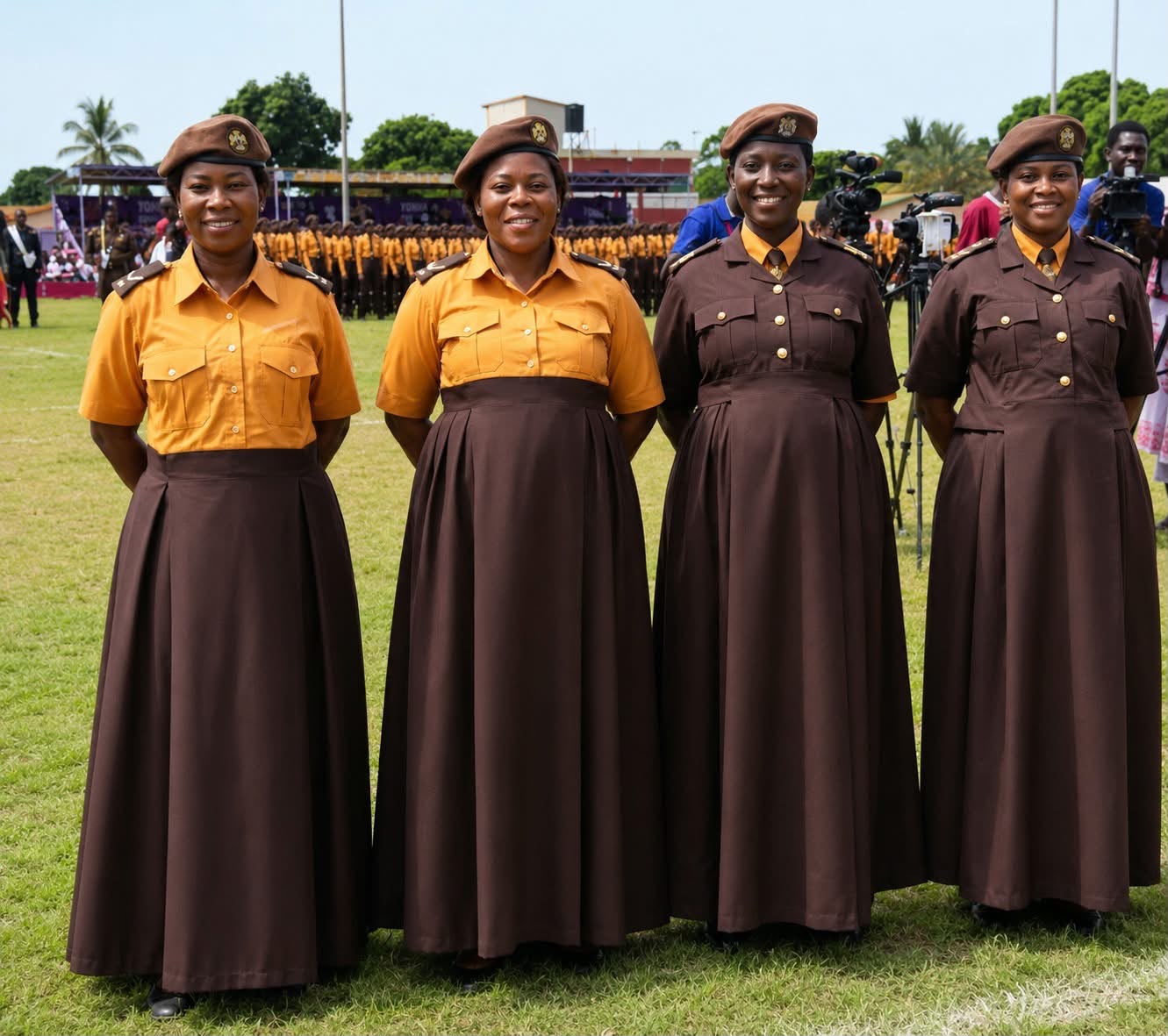
The story of how four maternity uniforms revealed a much larger transformation.
By: David Kujabi
On 4 July 2026, the Gambia Immigration Department reached a milestone that reflected how far the institution has traveled in less than a decade. Intake 16, comprising 599 recruits, marched onto the parade square before government officials, families and guests. It was the largest passing out parade in the department’s history, a public display of an institution expanding its capacity to meet the growing demands of border governance and national security.
The parade carried all the hallmarks of military tradition. Commands rang across the square with precision. Boots struck the ground in unison. Families watched with pride as sons and daughters completed months of demanding training and prepared to begin careers in public service.
Then something unexpected happened. As the ceremony progressed, four female officers entered the parade ground wearing uniforms unlike any the audience had seen before. Their outfits were longer and tailored differently, and their visibly pregnant figures immediately drew curious looks from the crowd. Some spectators smiled, believing the appearance formed part of the day’s entertainment. Others looked on with quiet uncertainty until it was announced that the officers were presenting the department’s newly introduced maternity uniform.
The announcement lasted less than a minute, yet it lingered in my mind long after the parade had ended. Like many others, my first reaction leaned towards scepticism. At a time when security institutions continue to grapple with operational demands, legislative reform and resource constraints, I wondered whether a maternity uniform deserved the attention it was receiving.
The more I reflected on it, the more I realised that reaction revealed something about how many of us understand institutional reform. We often measure reform by what is easiest to count: new legislation, increased budgets, modern infrastructure, vehicles, equipment, recruitment figures. Those indicators matter because they strengthen the capacity of institutions to carry out their mandate. But they tell only part of the story. The true measure of reform lies equally in how an institution treats the people who serve within it.
Security institutions ask a great deal of their personnel. Officers serve in difficult environments, spend long periods away from their families and carry responsibilities that extend far beyond ordinary working hours. Yet the men and women behind the uniform remain human. They become parents. They care for ageing relatives. They face the ordinary transitions of life that no profession can suspend.
The question, therefore, is not whether pregnancy belongs in a security institution. Women have served in uniformed services for generations. The more important question is whether institutions recognise pregnancy as a normal stage in a professional career rather than an inconvenience officers must quietly navigate on their own.
Viewed from that perspective, the maternity uniform assumes a different meaning. It is no longer simply a modification to a dress code. It reflects an institution acknowledging that professionalism and humanity are not competing values; one strengthens the other. I must add, though, that the uniform paraded needs adjustment in design, but for now let us focus on the idea.
This shift in perspective explains why the introduction deserves closer attention. It did not emerge as an isolated administrative decision or a symbolic gesture designed for a parade. It forms part of a broader reform journey that has gradually reshaped the Gambia Immigration Department since 2017, touching legislation, leadership, operational capacity, gender equality, professional standards and institutional culture. Some of those reforms have attracted national attention. Others have unfolded quietly inside meeting rooms, training centres and administrative offices, far from the public eye. The maternity uniform brought one of those quieter reforms onto the parade square, and reminded us that institutional change does not always announce itself through sweeping legislation or dramatic restructuring. Sometimes it appears in the way an organisation responds to the everyday realities of the people who wear its uniform.
The Reform Journey Behind the Uniform
To understand why the maternity uniform matters, one must look at the wider transformation taking place within the department. That process began in earnest after the political transition of 2017, when The Gambia embarked on an ambitious programme to reform its security sector. The objective extended beyond modernising institutions; it sought to redefine the relationship between security services and the citizens they serve. The National Security Policy and the Security Sector Reform Strategy placed professionalism, accountability, democratic governance, human rights and gender equality at the centre of that vision, and challenged security institutions to build workplaces that reflected those values in policy and in practice.
The Gambia Immigration Department has responded across several fronts. Perhaps the most significant has been the ongoing review of its legal framework. The proposed Immigration Bill, which received its first reading at the National Assembly in June 2026, seeks to replace the Immigration Act of 1965, a law enacted before the current constitutional order and before contemporary approaches to migration governance, border security and human rights became central to immigration management. Once enacted, the new legislation will provide a stronger legal foundation for an institution whose responsibilities have expanded considerably over the past six decades.
Legal reform alone does not transform an institution. An organisation also changes through the systems it creates and the standards it adopts. Recognising this, the department established the Human Rights and Professional Standards Unit to strengthen accountability, promote ethical conduct and reinforce professional standards across the service. It also established a dedicated Gender Unit, an institutional development that deserves greater public attention than it has received. Gender mainstreaming does not happen because a policy exists on paper. It requires leadership, coordination, monitoring and sustained engagement across every level of an organisation, and the Gender Unit provides that focus, helping to ensure gender considerations are integrated into recruitment, training, policy development and workplace practices rather than treated as isolated activities. Its work has been reinforced through the adoption of the Gender Mainstreaming Policy and the Policy on Sexual Harassment, Exploitation and Abuse, frameworks that seek to create a workplace where officers are judged by their professionalism while establishing clear standards of conduct that protect the dignity of all personnel.
Progress is also evident in the department’s leadership profile. Women now account for 46.4% of the department’s total staff strength, one of the highest levels of female representation within the Gambian security sector. While women currently make up 14.9% of the uniformed officer corps, the department has continued to expand opportunities through recruitment, professional development and leadership training. The appointment of Hulay Jallow as Deputy Director General and Olimatou Jammeh as Assistant Director General reflects this steady progression, and demonstrates that leadership within the department is increasingly shaped by competence and experience rather than traditional assumptions about gender.
The department has also invested in the skills required for a modern immigration service, with officers receiving specialised training in leadership, results-based management, human rights, gender equality and integrated border management, while female officers have taken part in the Gender Promotion Initiative to strengthen leadership skills and prepare more women for positions of greater responsibility. Operational reform has advanced alongside these changes: the department has strengthened integrated border management, improved cooperation with neighbouring countries, expanded border infrastructure, and supported the introduction of a new generation of national identity cards. The passing out of Intake 16 provides another measure of this evolution. Recruiting and training 599 officers in a single intake reflects an organisation investing in the people needed to meet increasingly complex responsibilities, from border security to the fight against transnational organised crime.
Viewed individually, each of these initiatives addresses a different institutional need. Taken together, they reveal a department pursuing reform on multiple fronts at once: legal reform strengthens the foundation, professional standards strengthen accountability, leadership development strengthens management, operational reforms strengthen service delivery, and mainstreaming strengthens inclusion. Against that landscape, the maternity uniform no longer appears as an isolated decision. It fits naturally within an institution that has increasingly recognised that organisational effectiveness depends not only on equipment, legislation and infrastructure, but also on the wellbeing, dignity and professional growth of its personnel. The maternity uniform did not begin the reform process. It is one of its latest expressions, signalling an institution that has begun to understand that strengthening borders and strengthening the people who protect them are complementary goals, not competing priorities.
Looking Beyond Our Borders
The introduction of a maternity uniform raises another question: is the department breaking new ground or following a path already travelled by other security institutions? The answer lies somewhere in between. Across the world, uniformed services have spent the past decade rethinking how they support women during pregnancy, a discussion that has never been about fashion but about ensuring pregnancy does not force officers to choose between their careers and their wellbeing.
In the Solomon Islands, the Royal Solomon Islands Police Force introduced maternity uniforms in 2024, part of a broader effort to improve workplace conditions for female officers. In Kenya, the government announced plans in September 2025 to introduce maternity uniforms for police officers, chiefs and county commissioners, following years of concern from female officers who reported wearing oversized uniforms or civilian clothing during pregnancy because no official attire existed. The United States Air Force redesigned its own maternity dress uniform in 2025, replacing a design that had been in use for more than three decades.
These examples place the Gambia Immigration Department within a growing international movement that recognises an important truth. Professional security institutions do not become weaker when they respond to the needs of their personnel. They become stronger, because they create conditions that enable experienced officers to remain productive throughout their careers. The comparison also challenges a common assumption in The Gambia that innovation flows only from larger or wealthier countries. Good institutional ideas are not defined by the size of a country’s economy. They are defined by the willingness of leaders to identify a practical problem and respond with a practical solution.
Beyond Symbolism
Some readers will still ask whether a maternity uniform deserves this much attention. It is a fair question. A maternity uniform will not solve every challenge facing women in the security sector. It will not replace fair promotion systems, equal access to specialised training, family-friendly workplace policies, protection from harassment or continued investment in leadership development. Those reforms remain essential if security institutions are to attract and retain talented women.
The uniform addresses something more specific: it acknowledges that pregnancy should not interrupt professionalism. For years, many pregnant officers across different jurisdictions continued to wear uniforms that no longer fitted properly, or left active duty earlier than necessary because no suitable alternatives existed. Those experiences often created discomfort, reduced confidence, and sent an unintended message that pregnancy was an exception the institution had not planned for. The Gambia Immigration Department has chosen a different approach. It has recognised pregnancy as a normal part of professional life and responded with a practical solution that allows officers to continue serving with comfort, dignity and pride. This is not simply a welfare issue. It is also an operational one.
The Measure of Reform
Security sector reform often attracts attention when governments pass new legislation, launch new strategies or commission new infrastructure, and rightly so, since these developments shape the future of national institutions. But reform does not end when a law is enacted, or a policy is adopted. Its success depends on whether those decisions improve the daily functioning of institutions and the lives of the people who serve within them.
That is why the image of four pregnant officers on the parade square deserves to be remembered alongside the 599 recruits who graduated that day. The recruits represented growth. The maternity uniform represented maturity. One reflected an institution expanding its numbers. The other reflected an institution expanding its understanding of what professionalism requires.
The Gambia Immigration Department still has work ahead. Like every public institution, it faces expectations for stronger service delivery, continued legal reform, greater operational capacity and sustained investment in its workforce. Reform is never complete, because institutions must continue to respond to changing national priorities and emerging challenges. There is value, though, in recognising progress when it appears.
Four pregnant officers walked across a parade square wearing uniforms the public had never seen before. They were not simply introducing a new uniform. They were offering a glimpse of what institutional reform looks like when it reaches the people it is meant to serve.