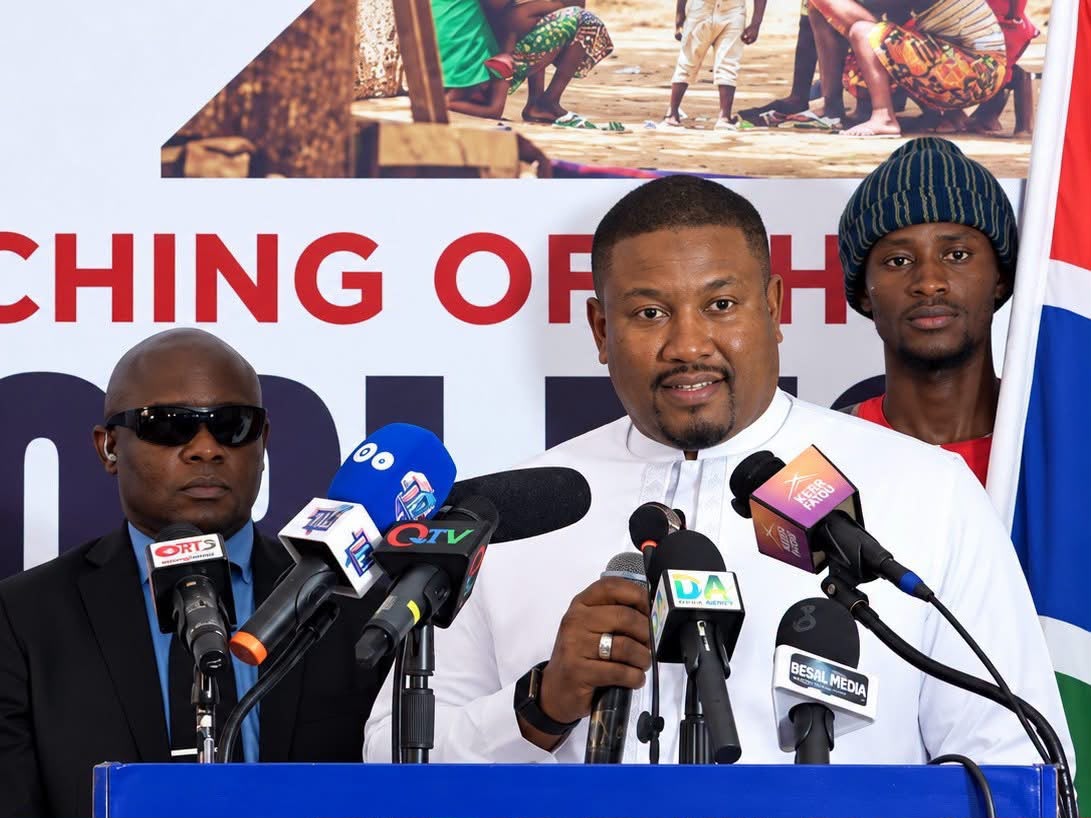
Coalition 2026, led by its presidential flag bearer, Talib Ahmed Bensouda, launched an ambitious political manifesto in Banjul today, Thursday, October 22, outlining a five-year program to transform The Gambia through constitutional reforms, economic restructuring, improved public services, and greater government accountability.
The 62-page manifesto, titled Coalition 2026 Manifesto, carries the slogan “Together, Change Is Possible” and presents what the coalition describes as a comprehensive roadmap for national renewal, built around three central pillars: Governance and Trust, Human Development, and Economic Integrity.
The policy document sets out Bensouda’s vision for a more accountable, productive and self-reliant Gambia, with an ambitious target of achieving middle-income status within ten years of implementing the proposed development programme.
The coalition argues that nearly a decade after The Gambia’s historic 2016 political transition, many expectations for democratic reform, institutional accountability and economic opportunity remain unfulfilled.
It identifies rising living costs, weaknesses in public administration, limited domestic production, unemployment and incomplete constitutional reforms as major challenges requiring decisive leadership.
Rather than relying on broad political promises, the coalition says its programme prioritises measurable commitments, institutional discipline and transparent implementation.
Constitutional Reform and Anti-Corruption
Among the manifesto’s most significant commitments is a pledge to revive constitutional reform and organize a national referendum within two years of assuming office.
The coalition proposes introducing a two-term presidential limit, strengthening constitutional protections and reviewing legislation affecting fundamental freedoms.
It also promises to separate the offices of Attorney General and Minister of Justice, while granting key accountability institutions greater financial and operational independence.
Under its anti-corruption agenda, Coalition 2026 proposes digitising government operations, establishing a transparent online public procurement platform and strengthening enforcement of audit findings.
The manifesto commits to launching the procurement platform within 12 months and introducing stricter asset declaration requirements for political officeholders within the first six months.
Another major proposal involves strengthening local government through predictable financial transfers, expanded fiscal authority and greater decentralisation of essential public services.
The coalition also pledges to operationalise diaspora voting before the next presidential election, alongside proposals for formal diaspora representation and investment opportunities.
Education, Healthcare and Youth Employment
Human development is the manifesto’s second major pillar, with proposals to improve education, expand healthcare access, and create employment opportunities, particularly for young Gambians.
The coalition promises to expand technical and vocational education across the country, improve teacher training and strengthen science, technology and digital learning.
A proposed national student loan scheme would support disadvantaged students seeking tertiary education, while partnerships with international universities would help position The Gambia as a regional education destination.
In healthcare, the manifesto proposes increasing financing for regional facilities, strengthening primary healthcare systems, improving medical workforce development, and reducing patients’ financial burden.
The coalition also commits to women’s economic empowerment, child protection, disability inclusion, and stronger responses to gender-based violence.
On migration, it advocates creating jobs, skills development, and structured reintegration programs for returning migrants.
Economic Transformation and Cost of Living
The manifesto’s third pillar focuses on addressing economic vulnerabilities through increased domestic production, industrial development, agricultural modernisation and reduced dependence on imported goods.
Coalition 2026 argues that The Gambia must move beyond an import-dependent economy to one that produces essential goods, supports local enterprises, and creates sustainable employment.
The coalition proposes introducing a sector-based minimum wage framework within its first year, beginning with established industries.
It also pledges reforms in agriculture, fisheries, tourism, land administration and infrastructure development.
A key proposal concerns the National Water and Electricity Company (NAWEC), which the coalition says would undergo an independent assessment, followed by restructuring and regulatory reforms to improve electricity and water services.
The manifesto additionally proposes a unified digital land registry and a 30-year national infrastructure and transport master plan to guide long-term development.
A Five-Year Program for National Renewal
Beyond individual policy commitments, the manifesto presents an interconnected approach to governance, social development and economic transformation.
It argues that effective institutions are necessary to attract investment, while better education and healthcare will strengthen the country’s workforce and increase productivity.
The coalition also emphasizes national unity, security-sector reform, community policing, and strengthening Gambian institutions to take greater responsibility for national security.
Bensouda’s political platform seeks to position Coalition 2026 as an alternative for Gambians demanding more responsive leadership, improved living standards and stronger democratic institutions.
However, implementing such an ambitious program would require substantial financing, effective institutional coordination and sustained political commitment.
The manifesto’s proposals will also face scrutiny over their affordability, feasibility and the coalition’s capacity to deliver its stated objectives within the proposed timelines.
As Coalition 2026 presents its political agenda in Banjul, the manifesto provides voters with a detailed framework against which Bensouda’s policy promises can be examined ahead of the country’s 2026 presidential election.