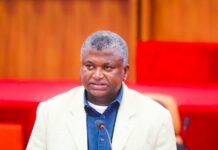
The Government of The Gambia has accepted the adverse findings of a commission of inquiry against Talib Ahmed Bensouda, Mayor of the Kanifing Municipal Council (KMC), and has ordered criminal investigations, a forensic audit to recover funds, and a process to remove him from office.
In a White Paper released after the commission’s report, the government endorsed recommendations covering economic crime, surcharge, a review of fitness for public office, improper behavior, and negligence. The commission concluded that Bensouda exercised executive influence that could have caused irregular commitments, unauthorized expenditure, and extra-statutory financial exposure, amounting to contributory liability and abuse of office.
Key findings include that Bensouda unlawfully received a D10,000 honorarium in 2018 outside the approved budget and failed to refund it. Broader honorarium payments to the mayor and councilors involved an inflated calculation of D270,000, which included the amount paid to him. The commission noted that while lawful allowances may be payable when properly approved, inflated or unsupported computations create recoverable exposure and reflect weak review by finance and approving authorities.
Bensouda’s handwritten endorsements, such as “CEO, pay” and “approved,” on vouchers and procurement documents were found to have facilitated irregular expenditure authorizations, despite his claim that he approved only “activities” rather than financial amounts. The commission also found that his office interfered indirectly in staff recruitment and contract appointments, favoring political supporters or associates, notably in the appointments of Isatou Faal and Nuru Deen Adams. Salary payments arising from these appointments were deemed unauthorized expenditure under the Local Government Finance and Audit Act 2004.
Procurement under his leadership was marked by incomplete documentation, missing committee minutes, and lack of GPPA registration evidence, with statutory requirements inconsistently enforced. Allegations of unbanked collections, deleted records, and suspected manipulation were not adequately addressed; investigations ordered by the mayor produced no reports, recoveries, or disciplinary action. The General Council received audit reports from the National Audit Office but did not consistently debate or adopt them, particularly in 2020.
A D105 million truck procurement contract was poorly drafted, with vague clauses and unclear records. Legal advice was sought only after signing, and wrongly assumed import-duty waivers led to D13.1 million in unplanned costs. Overall, the mayor was found to have exercised operational influence beyond the supervisory role contemplated under the Local Government Act 2002, weakening institutional safeguards through interventions in senior management meetings.
The government has directed the Inspector General of Police to initiate a criminal investigation into the economic crime and surcharge issues arising from the Mbalit project, with a view to establishing prima facie culpability and, if found, immediate referral to the Attorney General’s Chambers for prosecution. It has also referred the D10,000 matter to the Auditor General for a forensic audit and recovery proceedings.
On fitness for office, the government cited improper behavior, negligence, abuse of office, misconduct, and failure in supervisory duties. It has referred the matter to the Council to initiate removal proceedings under section 20(1) of the Local Government Act 2002, as amended. Bensouda’s own testimony, the White Paper notes, confirmed the exercise of executive influence even while he emphasized that the Chief Executive Officer remained the statutory accounting officer.