By: Sainabou Sambou
In a ruling that underscores the primacy of the rule of law, the High Court of The Gambia has admitted John Ebrima Carayol to bail, sharply criticizing prosecutors for charging him under a statutory provision that does not exist in Gambian law.
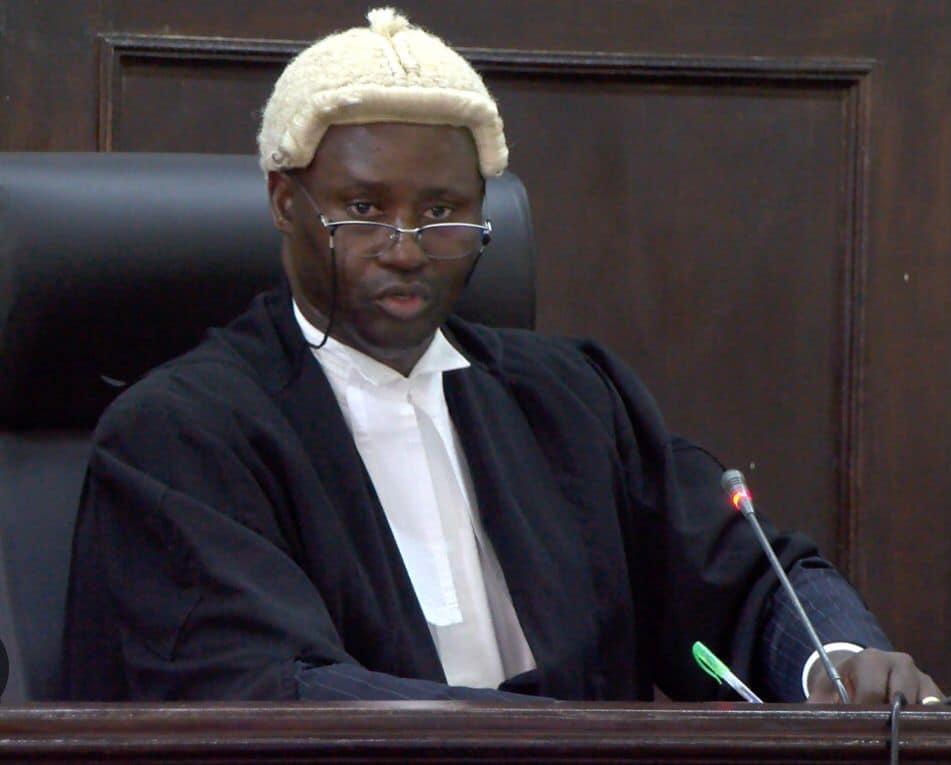
Justice Ebrima Jaiteh, presiding over the Criminal Division in Banjul, granted the bail application after the state indicated it would not oppose release, though it requested stringent conditions.
Carayol, who has been in custody, faces allegations of possessing 1 gram and 671 milligrams of cocaine, described as a prohibited drug. However, the charge sheet issued by the Drug Law Enforcement Agency (DLEAG) cites Section 45(4)(b) of the Drug Control Act 2003 – a provision Justice Jaiteh declared “unknown to law.”
“This is not a mere technical irregularity,” the judge stated in his ruling. “Criminal proceedings derive their legitimacy from strict adherence to the law. A person accused of a criminal offense is entitled to know, with certainty and precision, the nature of the accusation against him.”
The court heard the application through an Originating Summons filed on 21 May 2026, supported by a 15-paragraph affidavit sworn by Julia Jassey, with the charge sheet exhibited. Counsel A.M. Dabo represented Carayol, while Senior State Counsel S. Camara appeared for the Attorney General.
Justice Jaiteh emphasized that courts cannot speculate on what prosecutors might have intended. “To do otherwise would be to descend into the arena of speculation and deprive an accused person of the constitutional guarantees of due process and fair hearing,” he said.
The judge noted that despite the apparent defect in the charge, Carayol had remained incarcerated. He balanced the interests of justice, the need to secure attendance at trial, and constitutional protections of personal liberty under Section 19(2) of the 1997 Constitution, which safeguards against arbitrary arrest or detention.
Citing Section 126 of the Criminal Procedure Act 2026, Justice Jaiteh stressed that bail is the rule and detention the exception. No evidence was presented suggesting Carayol would abscond, interfere with witnesses, destroy evidence, or commit further offenses. The state’s lack of opposition further supported release.
Carayol was granted bail in the sum of D500,000 with two Gambian sureties, each also bound in D500,000. At least one surety must be a civil servant of Grade 10 or higher or a person of demonstrable financial means acceptable to the Registrar.
Sureties must provide valid national ID and proof of residence.
Additional conditions include surrendering any passport to the court registrar, reporting to the nearest DLEAG office every two weeks, attending court as required, and refraining from interfering with witnesses. Breach of any condition could result in revocation of bail. The prison authorities were ordered to release him immediately upon compliance.
Legal observers view the ruling as a strong affirmation of due process in Gambian courts, particularly in drug cases handled by DLEAG. The decision highlights judicial vigilance against procedural lapses that could undermine the legitimacy of criminal prosecutions.
The substantive drug case against Carayol is expected to continue, likely with an amended charge. Meanwhile, Carayol regains his liberty pending trial, subject to the court-imposed restrictions designed to ensure he remains within the jurisdiction and available for justice.