By: Kebba Ansu Manneh
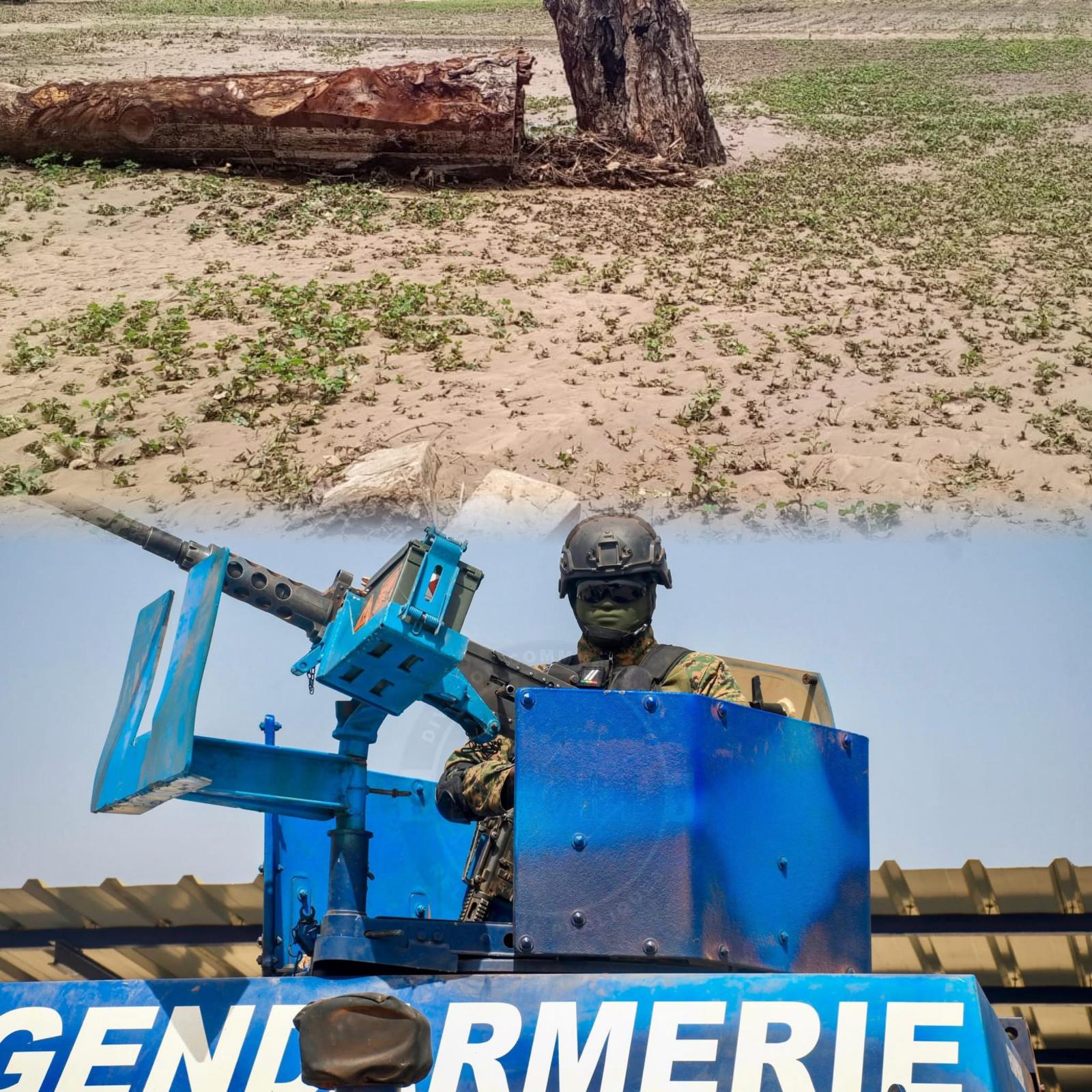
In a dramatic escalation of long-simmering border tensions, Senegalese Gendarmerie officers crossed into Gambian territory on Saturday, July 18, 2026. They demanded that farmers in Jimbala Kerr Musa in Lower Saloum district in the northern Central River Region of the Gambia immediately vacate their farmlands, threatening arrest and prosecution if they defied the order.
Accompanied by local authorities, the heavily armed officers claimed the fertile lands belong to Senegal, stunning villagers who say their families have cultivated the area for generations, long before both nations gained independence.
This comes hot on the heels of a barely a week ago, when Senegalese military personnel crossed into the disputed stretch of land at Bullock Military Camp in Foni Kansala and, under heavy security, used a bulldozer to demolish approximately 200 meters of newly constructed perimeter fencing. What began as a long-simmering border ambiguity has now escalated into the most serious physical confrontation between Gambian and Senegalese forces in recent memory.
Multiple impeccable sources close to the village confirmed the incursion to the Alkamba Times. According to eyewitnesses, the Senegalese Gendarmerie team, supported by a regional mayor, stormed Jimbala Kerr Musa and instructed residents to accompany them to the disputed farmlands. There, the head of the delegation issued a stern warning: no farming activities would be permitted this season, as the area was now considered Senegalese territory.
Musa Bah, son of the Alkalo (village head) of Jimbala Kerr Musa, described the tense encounter. “We were in the village when the Senegalese officers arrived and asked us to go with them to the farmlands,” he said. “The head officer and the mayor told us not to do any farming there, claiming it is part of Senegal. No one will be allowed to farm this year.”
The development has left the community in shock and confusion. Villagers insist the lands lie firmly within Gambian borders and have never before been contested by Senegalese authorities. “We have been farming these lands even before independence,” Bah emphasized. “This is Gambian territory.”
Babucarr Bah, another native of the village, corroborated the account. He said the Gendarmerie visited twice on Saturday—once in the morning and again in the evening—delivering the same ultimatum. “They cautioned us not to plant any crops because they say it is Senegalese territory,” he recounted. The villagers have since alerted the Chief of Lower Saloum District and Kaur Police. Still, many farmers whose plots fall within the disputed zone remain paralyzed, unsure how to proceed with the crucial planting season.
TAT learned that Kaur’s officers visited the disputed farmland on Sunday and informed the local and regional authorities about the impending land crisis.
The situation has prompted urgent appeals for government intervention. Babucarr Bah called on Gambian authorities to act swiftly: “These are our farmlands in Gambian territory. We need our government to address this before it gets worse.”
Ali Gaye Touray, Chief of Lower Saloum District, confirmed the reports and said the matter has been escalated to relevant national authorities. “We have engaged the proper channels,” he stated. Touray added that he and the Commissioner of Police for the Central River Region (CRR) plan to visit the disputed area on Monday, July 20, to assess the situation firsthand. “I can only comment further after that visit,” he noted.
The incursion in Jimbala Kerr Musa is not an isolated event. On the same day, Senegalese Gendarmerie officers also appeared in the border settlement of Panchang in Upper Saloum District, again asserting ownership of lands they claim belong to Senegal.
Ebrima Ceesay, a native of Panchang, recounted a tense confrontation at Panchang Maka Gui around 9 a.m. on Saturday. “I was working on my farm near the border with my family when three vehicles carrying more than twenty armed Gendarmerie officers arrived,” he said. The officers were carrying maps and immediately began marking territory.
When Ceesay started recording video on his phone, one officer approached him with a drawn weapon and demanded the device. Ceesay refused, leading to a scuffle that drew in his family and fellow farmers. He later reported the incident to the Police Intervention Unit (PIU) stationed at Panchang, the Chief of Upper Saloum, the Deputy Governor of CRR, and the area’s National Assembly member. By the time PIU officers reached the border, the Senegalese team had withdrawn, leaving behind litter and rubbish on the Gambian side.
Ceesay urged decisive action: “The authorities must take a strong position before this matter spirals out of control.”
The events have ignited fears of broader instability along the porous Gambia-Senegal border, a region historically marked by intertwined communities, shared ethnic ties, and occasional territorial disputes. Farmers in both Jimbala Kerr Musa and Panchang now face an uncertain agricultural season, with potential economic repercussions for families who depend on these lands for their livelihoods. Rice, millet, and groundnut cultivation are vital to the local economy in CRR, and any disruption could exacerbate food security concerns in the area.
Gambian authorities have yet to issue an official statement on this latest border incident, but sources indicate high-level diplomatic channels may soon be activated. Residents are calling for calm while demanding firm protection of national sovereignty and the rights of border communities.
As the police commissioner and district chief prepare for Monday’s inspection, the coming days will be critical in determining whether this weekend’s incursions represent a misunderstanding, a new enforcement of old claims, or the start of a more serious territorial standoff. For now, the farmers of Jimbala, Kerr, Musa, and Panchang wait anxiously, their ancestral lands caught in the crosshairs of neighboring claims.