By: Alieu Ceesay
The United Democratic Party (UDP), The Gambia’s largest opposition party, on Tuesday formally announced its withdrawal from the Coalition 2026 talks, saying the process had adopted a model that undermines constitutional order, political accountability and democratic legitimacy.
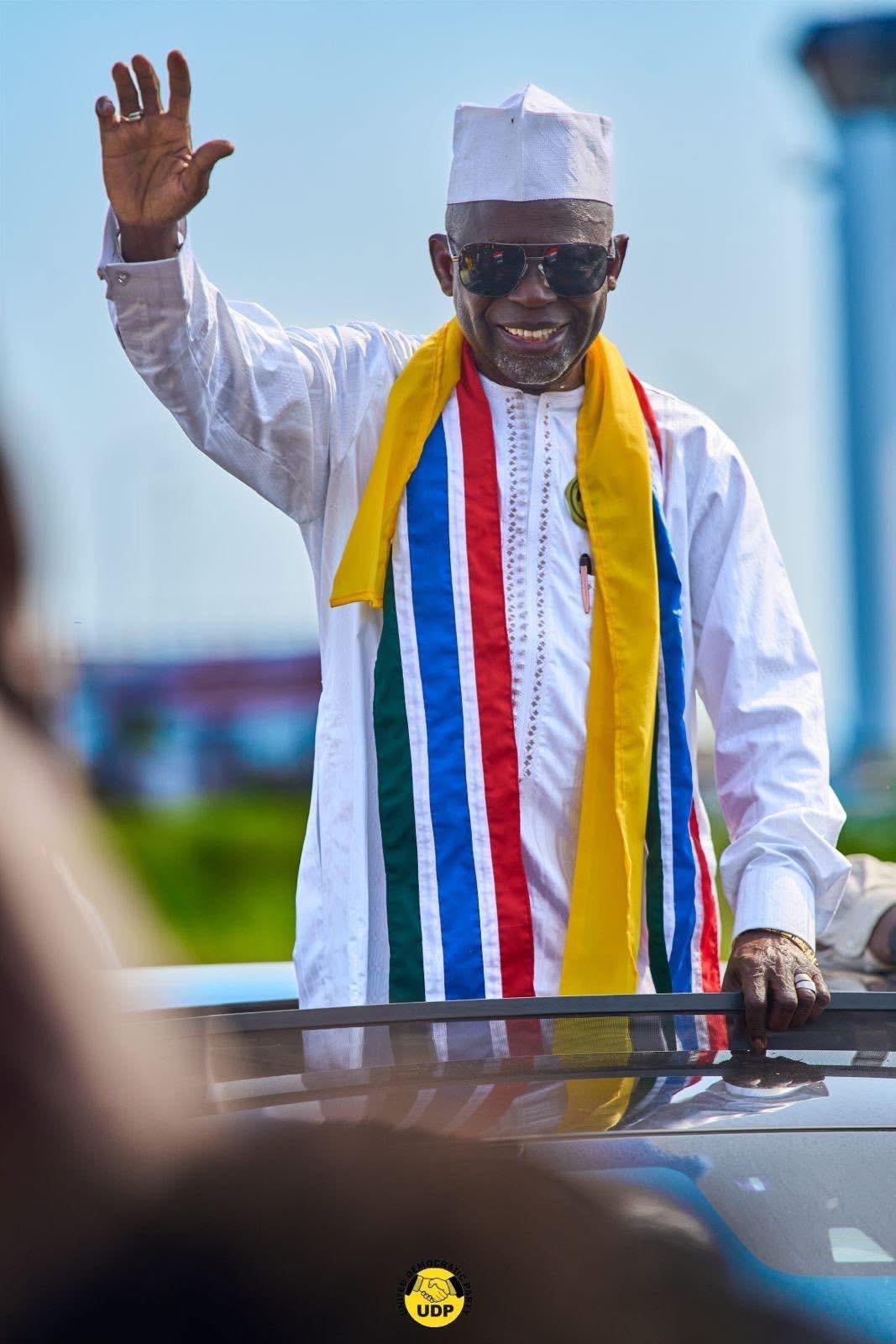
In a press conference statement delivered by party leader and Secretary General H.E. ANM Ousainu Darboe, the UDP said it had participated in the discussions “sincerely, openly and in good faith” but could no longer continue after careful reflection and internal consultations.
The Coalition 2026 process was initiated under the leadership of the Alliance for Democracy and Development (ADD) and brought together eight registered political parties, including the UDP, along with 14 civil society organizations and political movements. The stated aim was to build a broad, credible alternative to contest the 2026 presidential election amid rising living costs, unemployment, declining public trust in institutions, corruption and economic hardship.
Darboe said the discussions had revealed two competing visions. The UDP had consistently advocated a party-led coalition in which registered political parties would form the foundation. Under that model, the presidential candidate would emerge from one of the member parties through an agreed process, remain accountable to both the party and coalition partners, and exercise executive power strictly within the Constitution. The coalition’s programme, reforms and strategy would be jointly designed and implemented.
The majority of participants, however, favoured a candidate-led model. Prospective presidential candidates would apply to a Coalition Mediation Committee for vetting and selection. The chosen candidate would then resign from their party and contest as an independent. The UDP rejected this approach, arguing that Gambians had already seen its consequences after the 2016 coalition. Once a candidate became independent of the institutions that brought them to office, accountability weakened, coalition structures frayed and collective implementation of the people’s mandate became difficult.
“We should learn from our national experience, not repeat it,” Darboe said. “A coalition should not be constructed on a model whose structural weaknesses have already been exposed.”
The party also objected to proposals for a governing council that would oversee the presidency and influence executive decisions. Darboe described such a body as fundamentally inconsistent with the Constitution, which places executive authority with the President and provides clear mechanisms of accountability to the people. “No extra-constitutional body should exercise powers not contemplated by the Constitution,” he stated. Democracy, he added, must be strengthened by constitutional institutions rather than parallel structures that create uncertainty about authority and accountability.
A further sticking point was the proposed selection mechanism for the coalition flagbearer. The plan would place registered political parties, civil society groups, political movements and entities with vastly different levels of public support on equal footing. An organisation that had never contested a national election would have the same voting power as a party with decades of nationwide structures and the support of hundreds of thousands of voters.
“Such a system is neither equitable nor democratic,” Darboe said. “Democracy is built upon representation. Representation is earned through the confidence and votes of the people. Political legitimacy cannot simply be assumed; it must be demonstrated through public support.”
As the largest opposition party with the broadest electoral base among opposition forces, the UDP said it could not ignore the mandate entrusted to it by Gambians. Fairness required recognising both equality of participation and legitimacy derived from the electorate.
Darboe also expressed concern that discussions had increasingly focused on negotiations over ministerial positions, parliamentary seats, power-sharing formulas and future appointments rather than on developing a coherent national programme to tackle unemployment, food prices, healthcare, education, institutional reform and economic growth. “Offices should be the consequence of serving the national interest, not the starting point of coalition negotiations,” he said.
Despite the differences, the UDP stressed that it respected the views of all participants. “Reasonable people can disagree. In a democracy, disagreement is neither hostility nor betrayal.” The party asked that its principled position be accorded the same respect it had extended to others. It rejected recent caricatures, insults, misinformation and claims that it was sabotaging opposition unity, pointing to the sacrifices of its members—imprisonment, torture, exile and loss of life—in the struggle for democratic governance.
“Coalition-building is not an end in itself,” Darboe said. “Its purpose is to provide the Gambian people with a credible government capable of delivering democratic reforms and improving the lives of ordinary citizens. A coalition that lacks constitutional clarity, political accountability and democratic legitimacy risks creating tomorrow’s problems instead of solving today’s challenges.”
The UDP therefore announced its withdrawal from the current Coalition 2026 discussions “respectfully, without bitterness and without hostility.” It thanked all participants and the Coalition Mediation Committee for their efforts and wished them success on whatever path they choose.
The party said it would immediately begin working with like-minded political parties, democratic movements and patriotic Gambians to build a coalition founded on constitutional governance, democratic accountability, mutual respect, fairness and national renewal. “Our door remains open,” Darboe declared. “Unity remains our objective. But unity must rest upon principles, not expediency. It must strengthen democracy, not weaken it. It must respect the Constitution, not circumvent it.”
He concluded by affirming the UDP’s commitment to partners who place country above self, expressing hope that together they could build a coalition capable not only of winning an election but of governing effectively, restoring public trust, rebuilding institutions, revitalizing the economy and delivering the democratic future Gambians deserve.