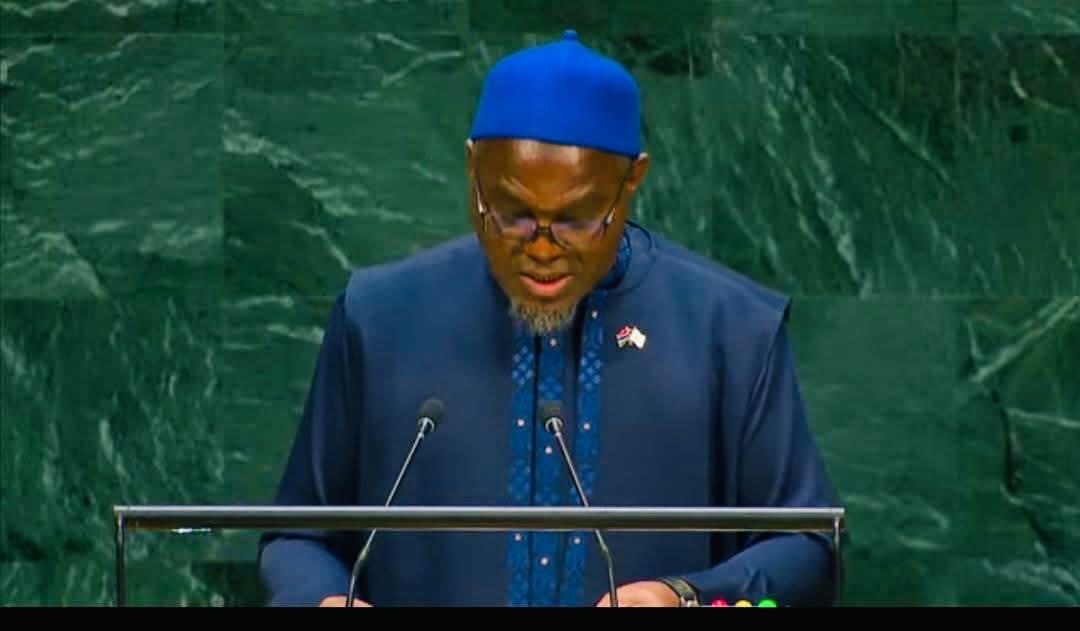
Vice President Mohammed B.S. Jallow on Thursday addressed the 81st United Nations General Assembly on behalf of President Adama Barrow, warning that trust among nations is under strain and urging a stronger, more representative UN that can still prevent war, fund development and protect civilians.
Speaking in the General Assembly Hall, Jallow conveyed greetings from the Government and people of The Gambia and congratulated Dr. Khalilur Rahman on his election as President of the session. The theme — restoring trust and managing transformation so the United Nations can deliver for all — he said, “speaks directly to the moment in which we meet.” He thanked outgoing Assembly President Annalena Baerbock and paid tribute to Secretary-General António Guterres and Deputy Secretary-General Amina Mohammed as they complete their tenure at the end of the year.
Jallow said the Assembly remains the clearest expression of sovereign equality: power and wealth may shape what countries face, but they do not confer a greater claim to membership. Differences are real, he added, “but so is our interdependence.” The UN was built on dialogue, human dignity and common institutions. Eight decades on, he asked whether member states still trust one another enough to act on that insight.
Geopolitical splits are widening, wars are lasting longer, and respect for the Charter is under strain, he said. Developing countries face heavier debt, climate shocks, a gap between pledges and delivery, and a sense of being shut out of the global system. The task, he argued, is to build a more representative and effective multilateral system and a global financial architecture that works for every region.
Multilateralism without unanimity
The Gambia’s chairmanship of the Second Committee during the 80th session, he said, showed that multilateralism can still deliver. Even with deep disagreement on economic and development files, progress was possible when states stayed at the table. “Multilateralism does not require unanimity on every issue. It requires the willingness to remain at the table, to listen, to negotiate, and to have the courage to compromise.”
If diplomacy can find common ground on development, he said, it should use the same courage to prevent conflict and build peace.
2017 and the case for prevention
Jallow anchored that argument in The Gambia’s 2017 crisis. When the country’s democratic choice faced a grave challenge, UN preventive diplomacy — with the African Union and ECOWAS — helped uphold the will of the people and a peaceful transition. “We have not forgotten that solidarity,” he said. Preventive diplomacy is not abstract; it can change a nation’s course. Countries in similar moments should be able to count on the same support.
Civilians still bear the cost of wars; humanitarian workers operate under growing danger; funding falls short of need. Protection of civilians, international humanitarian law and access, he said, are legal obligations, not political conveniences. Early warning, timely mediation and peacebuilding that tackles the roots of conflict must come before a crisis is large enough to dominate headlines.
Prevention is cheaper in human, political and financial terms than managing war after it starts. He called for predictable resources for the Secretary-General’s good offices.
The Gambia, he noted, has seen the Peacebuilding Commission and the Peacebuilding Fund support institution-building and transitional justice since 2017. He backed a stronger Commission, implementation of the Peacebuilding Architecture Review, UN peacekeeping — including Gambian troops and police — and deeper, predictably funded partnerships with the African Union.
Sudan and instability in the Sahel, he said, show that peace cannot be separated from development and governance. Security measures must sit alongside support for democracy, jobs, education and climate resilience. Poverty, weak rights and the loss of homes to climate change leave people as vulnerable as open war.
Democracy at home, development abroad
Since 2017, The Gambia has rebuilt institutions, expanded justice and confronted past abuses through the Truth, Reconciliation and Reparations Commission and a Special Prosecutor’s Office. Democracy, he said, is never finished. On 5 December 2026, Gambians will elect a president. The government, he pledged, is committed to a peaceful, transparent, credible and inclusive vote and seeks international support.
The Recovery-Focused National Development Plan, YIRIWA 2023–2027, guides investment in roads, energy, schools, health, agriculture and digital infrastructure. He thanked bilateral and multilateral partners. With official aid falling and borrowing costs high, he said the Sevilla commitments from the Fourth International Conference on Financing for Development must become real: affordable long-term finance, debt solutions, tax cooperation and action against illicit flows.
Climate change is already hitting The Gambia through coastal erosion, shifting rains and pressure on food and water. National electricity access has reached 90 percent, with universal access targeted by the end of 2026; a 150-megawatt solar park is advancing; and more than 100,000 hectares of mangroves are being restored. Ambition at home, he said, needs accessible climate finance, the New Collective Quantified Goal and arrangements for loss and damage.
On technology, he warned that the digital divide must not become the next development divide. As The Gambia prepares for greater leadership in the LDC Group’s Global Coordination Bureau, he called for full implementation of the Doha Program of Action and graduation that is not “a cliff edge.”
Reform, justice and unresolved crises
UN reform, Jallow said, must strengthen delivery and correct historical injustice. The Assembly should stay at the center of policymaking. Security Council reform is about legitimacy and trust, not only extra seats. The Gambia restated support for the Ezulwini Consensus and the Sirte Declaration.
He highlighted The Gambia’s work with Mexico toward a convention on crimes against humanity. He commended Ghana’s resolution on the trafficking and enslavement of Africans and Togo’s resolution on “correcting the map.”
On Palestine, he called for civilian protection, humanitarian law and a two-state solution. The Rohingya crisis must not fade from the agenda; The Gambia remains committed to accountability. He repeated calls to end sanctions on Cuba, reaffirmed the One China policy and a strategic partnership with Beijing, and backed a UN-led political process on the Moroccan Sahara, citing Morocco’s autonomy initiative and cooperation with MINURSO under Resolution 2797 (2025).
The UN remains the most reliable guarantor of collective peace, he said, if it becomes more responsive and representative. The Gambia’s journey, he added, shows that countries and institutions can recover from uncertainty — and that is the message Banjul brought to the Assembly.