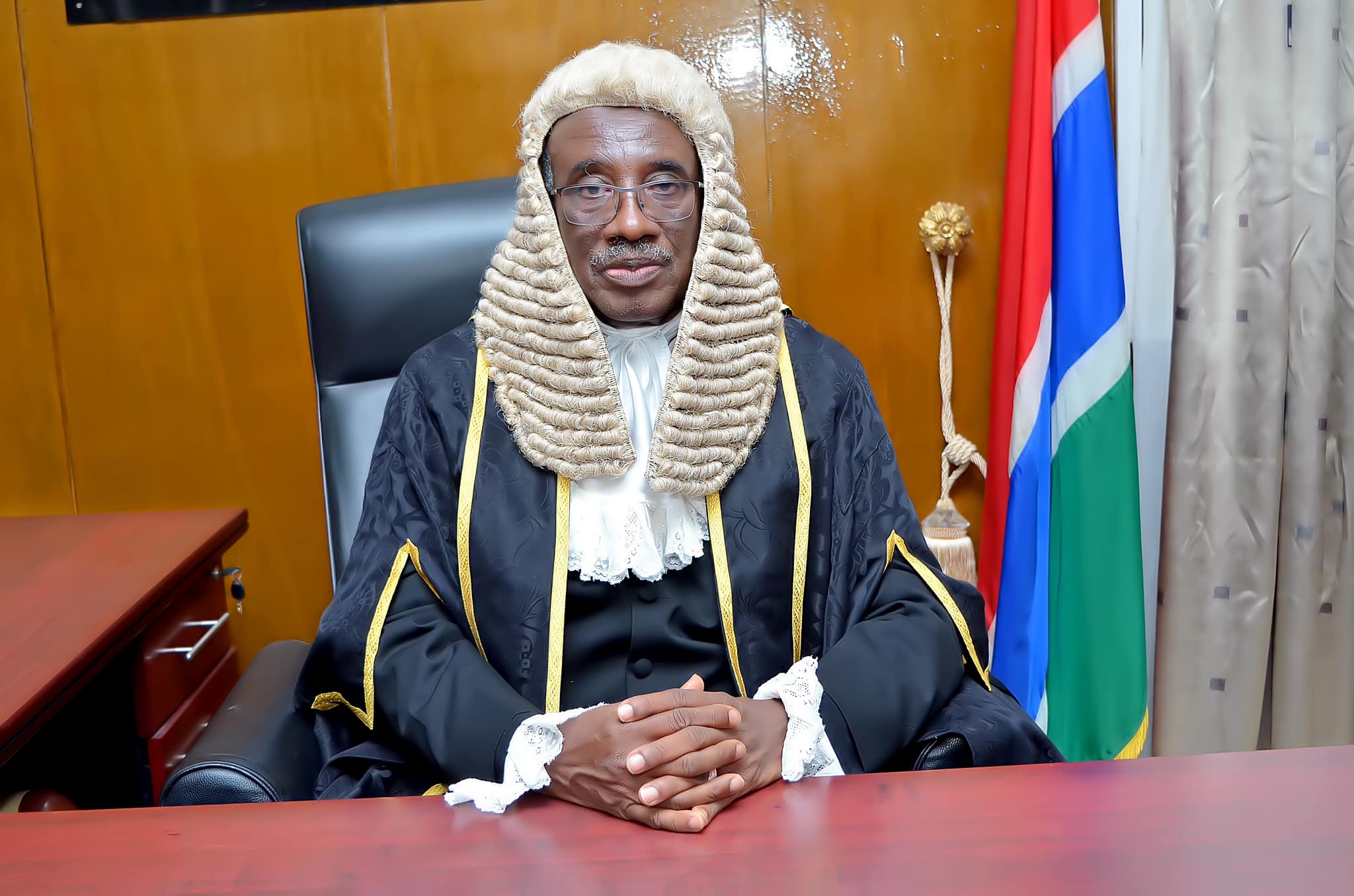
Chief Justice Hassan Bubacar Jallow has announced his voluntary retirement from the apex judicial position, bringing to a close a remarkable career spanning nearly five decades in law, both nationally and internationally.
Jallow informed his colleagues that, with the approval of President Adama Barrow, he will step down as Chief Justice of The Gambia effective 1 August 2026.
“I thank you all very much for your support of my office and the Judiciary as a whole during my tenure,” he wrote.
He praised staff dedication “within and outside the Courtrooms” for keeping “the wheels of justice” turning. He urged them to “increase your determination to keep the machinery of justice functioning ever independently and efficiently.” He concluded with personal reassurance: “My heart, my thoughts, and my prayers shall always be with you and the judiciary.”
Born on 14 August 1951 in Bansang, Jallow, who turns 75 in August 2026—the mandatory retirement age for Gambian judges—has long been a towering figure in the country’s legal landscape. He earned his legal education at the University of Dar es Salaam in Tanzania, the Nigerian Law School, and University College London.
His domestic career began in 1976 as a State Attorney. By 1982, he was appointed Solicitor-General, and from 1984 to 1994 served as Attorney-General and Minister of Justice. He later served as a Justice of the Supreme Court from 1998 to 2002.
Jallow gained global prominence when the United Nations Security Council appointed him Prosecutor of the International Criminal Tribunal for Rwanda (ICTR) in 2003, a role he held until 2014. In 2012, he simultaneously became the first Prosecutor of the International Residual Mechanism for Criminal Tribunals, serving until 2016. His work at the ICTR involved prosecuting high-level figures responsible for the 1994 Rwandan genocide, establishing precedents in international criminal justice.
In February 2017, shortly after the democratic transition that ousted longtime ruler Yahya Jammeh, newly elected President Adama Barrow appointed Jallow as Chief Justice. He was sworn in on 15 February 2017, tasked with restoring public confidence in the judiciary following years of authoritarian interference.
During his tenure, Jallow presided over the Supreme Court, managed the broader judiciary, chaired the Judicial Service Commission, which appoints judicial officers, and oversaw the General Legal Council, which regulates the legal profession. His leadership coincided with efforts to strengthen judicial independence, rebuild institutional trust, and support The Gambia’s democratic consolidation.
Observers view Jallow’s retirement as marking the end of an era. At nearly 75, he leaves a legacy defined by integrity, international stature, and commitment to the rule of law. Speculation has already begun about potential successors, with senior justices such as Cherno Sulayman Jallow and Awa Bah mentioned as frontrunners.
In his farewell note, the outgoing Chief Justice emphasized continuity and resilience. As The Gambia prepares for this leadership transition, Jallow’s call to sustain an independent and efficient judiciary will likely serve as a guiding principle for his successor and the institution he has stewarded for nearly a decade.