By Sainabou Sambou
The National Centre for Civic Education (NCCE) on Wednesday trained senior secondary and Arabic madrasa students in the West Coast Region on peaceful elections, civic responsibility, and the perils of misinformation, in a bid to ensure a calm and credible December 2026 presidential election.
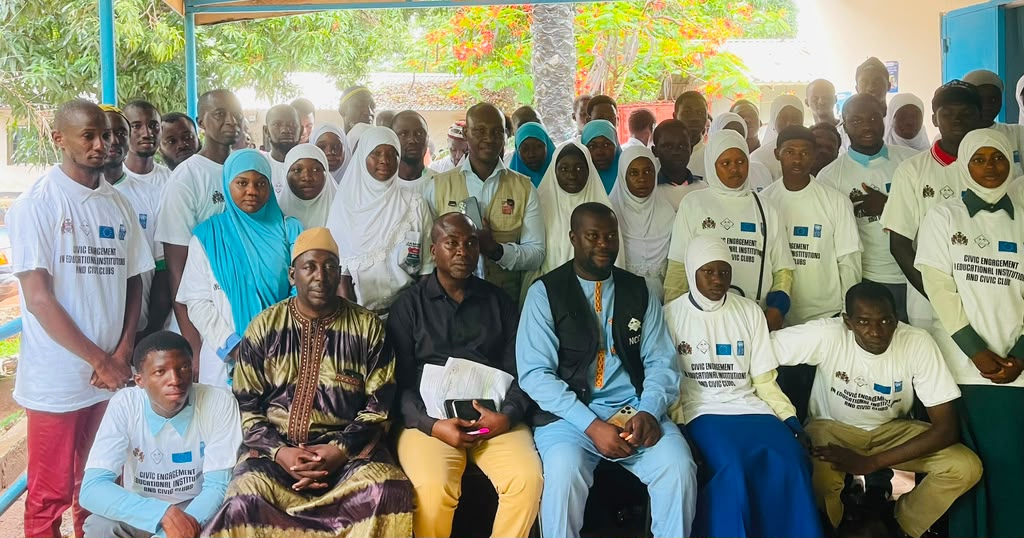
The one-day session, held at the Regional Education Directorate in Brikama, was organized in partnership with the Independent Electoral Commission (IEC), the Ministry of Basic and Secondary Education, and other stakeholders. It brought together students from schools including Jamisa, Gunjur, Banjulinding, Mdosed, Mindaw, Al-Furqan, Al-Huda, Mahad, and Taufiq, urging them to become peace advocates in their communities.
NCCE Program Officer Ansumana Ceesay said the training would not have materialized without the strong support of the Regional Directorate, which mobilized participants from both conventional senior secondary schools and Arabic madrasas.
“We may have the plan and initiative, but without the Regional Directorate’s support, none of you would be here today,” Ceesay told the students. He praised the close collaboration with the IEC, describing the two institutions as pivotal to the electoral process, and thanked the Ministry’s Curriculum Research, Evaluation and Development Directorate (CREDD) for its backing.
Ceesay noted that the program forms part of NCCE’s ongoing civic engagement with schools and civic clubs. While the first day focused on secondary students, madrasas, and teachers, the second day will target tertiary institutions including the University of The Gambia (UTG), University of Education (UEG), USET, Al-Insan, and Amana Islamic University.
“The youth are the heartbeat of every nation,” Ceesay declared. “For any country to move forward, its young people must be ready to contribute to its development.”
He highlighted growing political, ethnic, and religious tensions despite the absence of armed conflict, and urged participants to balance rights with responsibilities. Ceesay warned against misinformation, malinformation, and disinformation on social media, and cautioned against the misuse of Artificial Intelligence to create fake images, videos, or audio that could incite violence.
Principal Education Officer Buba M. Manneh, speaking for the Regional Director of Education, described the initiative as timely. He reminded students they represent the nation’s future leaders and encouraged them to take education seriously and shun crime.
“Ask not only what your country can do for you, but what you can do for your country,” Manneh said, quoting John F. Kennedy. He stressed the need to preserve Gambia’s peaceful coexistence across ethnic and religious lines and warned that a single misleading social media message could spark conflict.
Regional Electoral Officer Arfang Kujabi of the IEC assured participants that the Commission is fully prepared for a free, fair, and transparent election. “The doors of the IEC have always been open to all stakeholders,” he said, adding that regular meetings with political parties and civil society continue to strengthen voter education.
Student participants welcomed the training.
Mariama Jabbi of Dasilami Upper and Senior Secondary School said it deepened her understanding of elections and pledged to share the knowledge with classmates. Sarata Ceesay of Al-Huda Arabic School echoed the sentiment, urging young people to reject violence and vote peacefully.
The NCCE plans to sustain such engagements as the country gears up for the 2026 polls, aiming to harness the energy of youth for national unity and democratic maturity.