By Alieu Ceesay
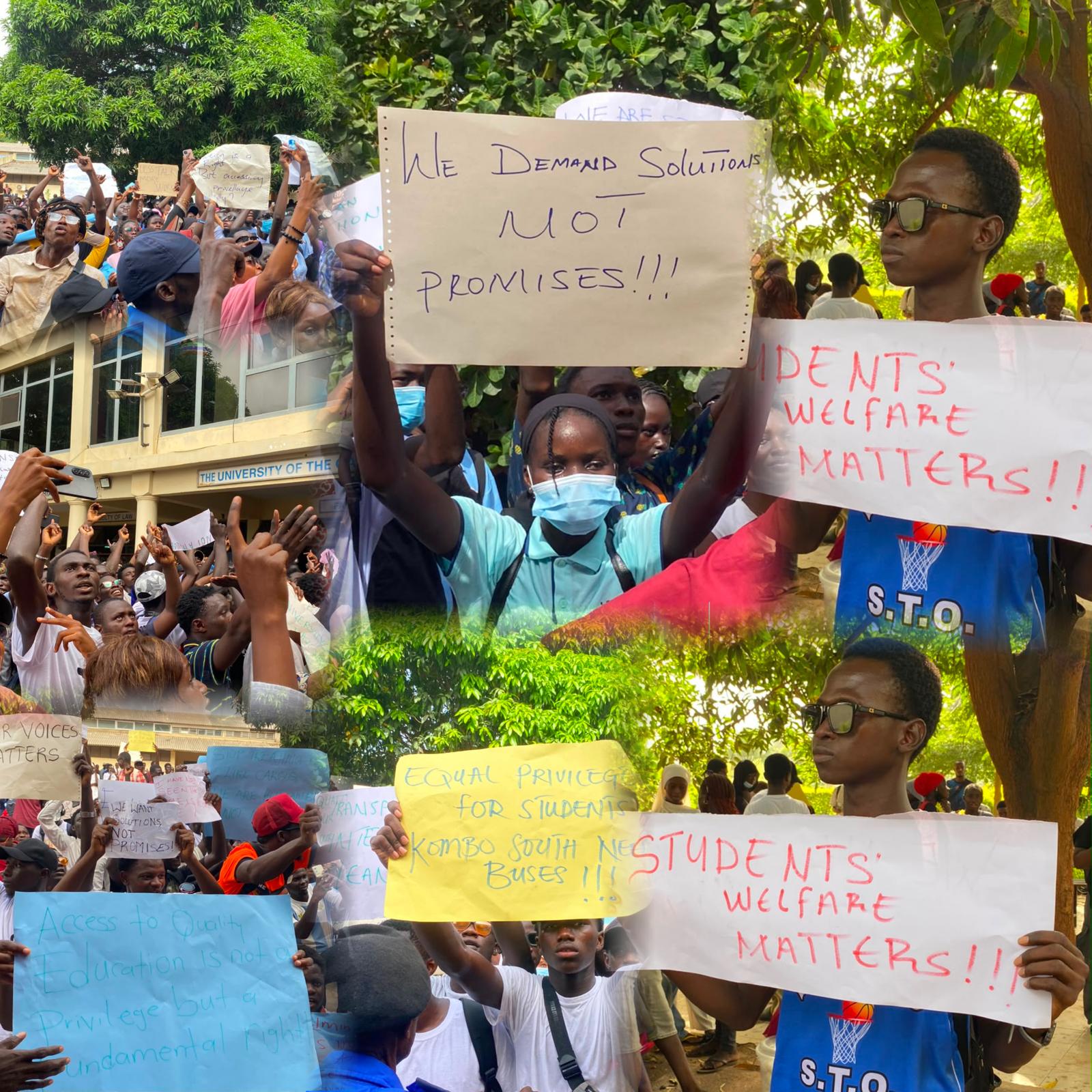
Students of the University of The Gambia (UTG) staged a protest on Monday, 26 October 2026, at the institution’s former Kanifing campus, calling for urgent action on student welfare and demanding the Vice-Chancellor’s resignation.
The demonstration, which began in the early hours, drew participants carrying placards that read “Access to education is not a privilege but a fundamental right,” “We want solutions, not promises,” “Our voices matter,” “Student welfare matters,” and “People with disabilities deserve comfortable and accessible transportation.”
Several student associations, including the School of Journalism and Digital Media, voiced specific grievances. Journalism students demanded a dedicated studio for practical training, arguing that hands-on experience remains essential to their program.
Momdou Lamin, a senior student at the school, highlighted staffing shortages: “At the School of Journalism we only have four or five lecturers currently administering out of thirty-six courses.”
Transport emerged as a central complaint. Students living in the Greater Banjul Area—including Westfield, Kairaba Avenue, Senegambia and Churchill Town—described daily overcrowding on buses ferrying them to the Faraba campus in Kombo East.
Adama Sanyang, Vice-President of the Students’ Union, said: “Honestly, we have been through a lot. For the past six weeks, I was among the students who started going to Faraba since the inception, and I believe we are tired. We cannot have our sisters fainting inside the bus because we have been packed like sardines.”
She added that all cafeterias had remained closed since the semester began, leaving students without reliable food and water. “We can’t drink the water at the campus because it is white; it isn’t potable. Management has to consider all these because we have been through a lot.”
At Faraba, students noted that while buildings appear modern, classes often proceed without markers, reducing lessons to verbal explanations alone.
As the Vice-Chancellor arrived with Professor Perreh Gomez, Minister for Higher Education, Research, Science and Technology, students chanted: “He needs to leave. Enough is enough. We don’t need you, VC.” Moments later, Information Minister Dr Ismael Ceesay appeared; protesters demanded his immediate withdrawal, and the Police Intervention Unit escorted him from the scene.
Ismale Federa, President of the Students’ Association, read a sixteen-page petition addressing food, potable water, internet and transport conditions at Faraba Campus, along with other welfare and learning concerns. The document set deadlines for management to act.
Neither the Vice-Chancellor nor the Higher Education Minister addressed the students on site. After leaving the campus, Professor Gomez spoke to the media on MDI Road in Kanifing. He said his ministry had contributed significantly to student welfare over the years and announced that a student loan scheme—the first of its kind in The Gambia—would launch the following day. “In the university, people can have a divergent view… what’s important is that when they have that, you give them a platform to express themselves. From that, based on things they highlighted which are genuine, we see how to fix that. That’s what we are going to do together with them.”
In a subsequent press release, the ministry pledged to continue working with UTG management, the Students’ Union and relevant stakeholders “to review outstanding issues, assess the implementation.